


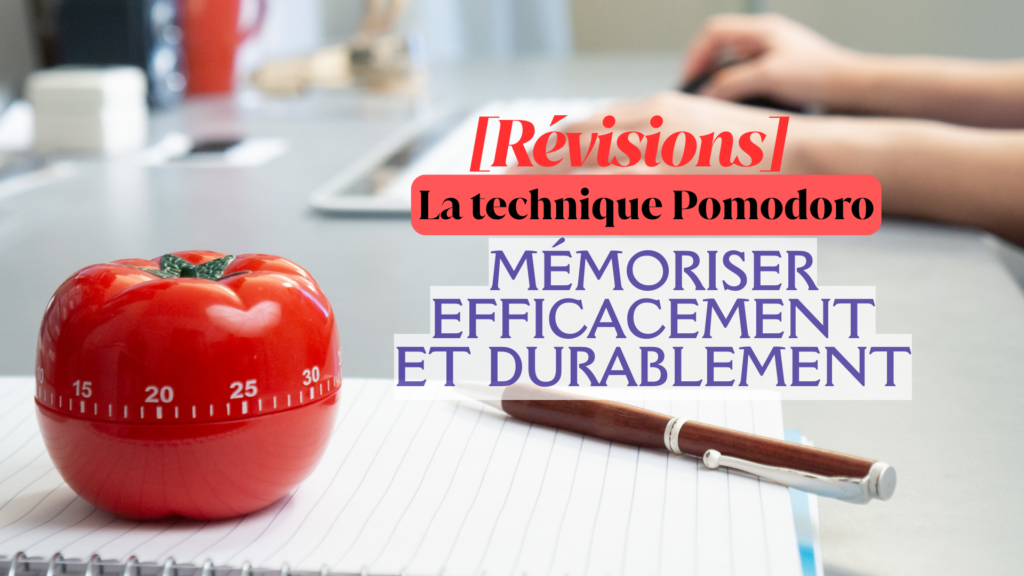
The Pomodoro Technique for revision is a simple way to plan study sessions in short, focused blocks so that the breaks do as much work as the studying. It was invented by Francesco Cirillo, and "pomodoro" is simply Italian for tomato — a nod to the tomato-shaped kitchen timer he used when he first developed the method.
The idea rests on something the brain does on its own: it keeps linking ideas and information after a period of learning, even when we are not consciously thinking about the subject. In her book on memory and study, Hélène Weber explains that the technique exploits this tendency and also makes planning easier, which helps in the fight against procrastination.

Quick takeaways
- Plan revision by objectives and skills before touching a timer
- Break each objective into tasks that fit inside 25 minutes
- Stop at 25 minutes whether the task is finished or not
- Take a real five-minute break and let the brain keep linking ideas
- Review after three or four Pomodori to plan the next session
- Add flash cards later to reactivate what was learned
Planning the revision sequence
Everything starts with a clear picture of what has to be learned. Which subjects need work? Which chapters, which exercises, which definitions must be known by heart? This planning phase can cover any span of time — a school year, a term, a weekend or a single afternoon — and its purpose is to organise revision by skills to master and by concrete objectives rather than by vague intentions.
Parents can help here by asking questions rather than giving answers, letting the child name the goals out loud. A written list works better than a mental one, and it becomes the reference point for every session that follows. If your child is still young, the same principle applies to play and reading time, much as with quiet toys that invite a child to practise a skill step by step. Even a small treat can mark a milestone, just like the industrial ice creams you enjoyed as a child.
Turning objectives into 25-minute tasks
The second phase is to break each objective down into tasks that can realistically be finished in 25 minutes. These can be very varied: redoing a set of exercises, learning the key dates of a chapter, writing the introduction to an essay, memorising the formulas of a maths lesson, or simply being able to state a definition without looking.
An effective phase two means choosing and listing the tasks according to the time actually available, so that nothing is left to improvisation when the timer starts. Younger children can be given the same structure through short, clearly bounded activities — the logic behind open ended toys is similar, since a task with a visible end is far less daunting than an open horizon. The same principle of breaking things into manageable steps runs through helpful parenting apps and everyday family decisions alike.
Why the 25-minute limit matters
A task that fits the block gives a sense of completion, and completion is what keeps motivation alive from one session to the next.

| Phase | What you do | Why it helps |
|---|---|---|
| Planning | List subjects, chapters and objectives | Gives revision a direction |
| Task list | Cut objectives into 25-minute tasks | Removes improvisation |
| Work block | 25 minutes on one task, timer visible | Sustains focus |
| Break | 5 minutes, quick stock of progress | Lets the brain link ideas |
| Review | After 3-4 Pomodori, note gaps | Shapes the next session |
Alternating Pomodori and five-minute breaks
Set a timer for 25 minutes — a Time Timer is well suited because the remaining time shrinks visibly, and an ordinary kitchen timer does the job too. Once it starts, the first session begins. When the 25 minutes are up, a break is required whether or not the planned task is finished.
Before the break, it is more effective to take a quick stock: what did I learn, where am I, what did I do, what is left? Then glance at the next task. During the five minutes you might make a tea, eat fresh fruit or nuts, check messages or social media — these activities are part of the learning strategy, not a distraction from it. Weber puts it plainly: it does not matter whether the previous task was completed, because the brain keeps working in the background and ideas will be much clearer when you return. Parents can apply the same rhythm at home with educational toys, and the spirit of a good father shows how steady support keeps those short sessions calm.

Taking time for a real review
After three or four Pomodori in a row, it is worth stopping for a proper review. Which tasks were completed? Which objectives were reached? What work remains? Which misunderstandings or blockages are still there? This step makes the next session easier to plan and lets you count on a brain that keeps working in the interval.
Weber describes the effect well: once you have identified your gaps, what is left to do and the questions still open, your mind stays alert and ready to make unexpected connections with anything that might bring answers or new ideas. A short written note of those open questions is enough — there is no need for an elaborate system.

Pairing Pomodoro with flash cards
The technique becomes more powerful still when it is combined with later reactivation of knowledge using flash cards, which make it easier to bring previously learned and understood material back to mind. The Pomodoro sessions build the understanding; the cards keep it available.
This combination suits children who like handling things, and the same hands-on principle shows up in Montessori toys that encourage repetition at a child's own pace. For families who prefer paper over screens, a simple stack of cards beside the timer is all the equipment required.
My hands-on take
I tried this at home with a plain kitchen timer rather than anything fancy, and the visible countdown turned out to matter more than I expected. What changed for us was not the studying itself but the stopping: my child used to push on until frustration set in, and the rule that we stop at 25 minutes no matter what removed that pressure entirely.
The quick stock-taking before each break took a few days to become a habit, and I had to prompt it at first. Once it stuck, the review after three or four rounds became genuinely useful, because we could see on paper which questions were still open. I keep those notes and we start the next session from them.
Frequently asked questions
Does the task have to be finished when the timer rings?
No. The method asks you to stop at 25 minutes regardless, because the break and the brain's background work matter more than forcing completion. Unfinished work simply goes back on the list.
What should a child do during the five-minute break?
Anything light and pleasant: a drink, fruit, nuts, a quick look at messages. The point is to step away from the task so the mind can keep making connections without conscious effort.
When should the longer review happen?
After three or four consecutive Pomodori. It is the moment to note what was achieved, what remains and which questions are still open, so the next session starts from a clear picture.
Can the method be combined with other revision tools?
Yes. Flash cards used later to reactivate knowledge work particularly well alongside it, since they bring back material that was already learned and understood.
Product Reviews
 Best Toys for Dogs With High Prey Drive |
Best Outdoor Toys for 3-4 Year Olds |
Best Outdoor Toys for 6 Year Olds |
Best Harness for Poodle |
Best LEGO Sets for Adults |
Best Travel Toys for 4 Year Olds on Airplane |
Best Toy Stores in Washington DC |
Best Potty Training Toys |
Best Toys for Tripod Dogs |
Maillot equipe de france







