


The 2018 vaccination schedule differs from the previous one in some points, although not as many as happened the previous year compared to 2016. We must first make clear the difference in the vaccination schedule of the Ministry of Health, Social Services and Equality (MSSSI), which is the one that marks the health decisions of the autonomous communities, and the one proposed by the Vaccine Advisory Committee of the Spanish Association of Pediatrics (CAV-AEP), which is only indicative of what this committee of experts believes. which should apply to the entire child population, regardless of their geographical residence.
A vaccination schedule is a document that sequences, chronologically, the vaccines that will be systematically administered to the entire population of a geographic area or country, in this case, Spain.

This calendar is a public health tool designed by the Interterritorial Council of the National Health System (CISNS) which includes the vaccines that are recommended to be administered, depending on age, to the entire child population.
The criteria for including vaccines in a calendar depends on different aspects, but the aim is always to achieve harmony between the important aspects of the different health programs of the autonomous communities.
The evaluation criteria that are taken into account to justify and allow changes in vaccination schedules are the following:
- Disease burden
- Vaccine effectiveness and safety
- Repercussions of the modification in the vaccination program
- Ethical aspects
- Economic evaluation
The establishment, execution and evaluation of the vaccination schedule in the respective territory is the responsibility of each autonomous community.
MSSSI 2018 vaccination schedule

2018 vaccination schedule proposed by the CAV-AEP
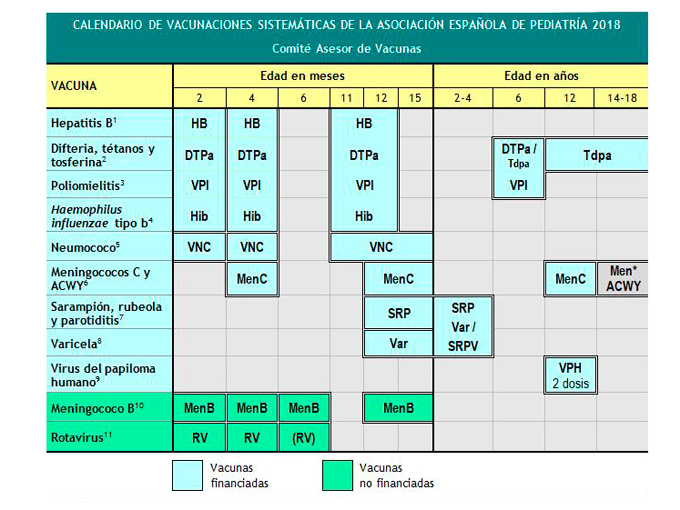
Main changes to the 2018 vaccination schedule compared to 2017
While the Ministry of Health, Social Services and Equality states on its website:
“The common childhood vaccination schedule recommended for 2018 has been agreed by the Public Health Commission on November 16, 2017. The vaccination programs and guidelines agreed for 2017, when important qualitative changes were made, are maintained.”
For example, the three doses of the hexavalent vaccine, the three of the pneumococcal vaccine and the two doses of the meningitis C vaccine are maintained. The doses of the tripe virus that immunizes against measles, rubella and mumps, as well as the chickenpox vaccine, are also maintained.
If we compare the schedules proposed by the Vaccine Advisory Committee (CAV-AEP) we find some changes, although not as significant as last year.
During the first 15 months of children's lives, no relevant changes are seen. The difference between the official calendar and that of the Vaccine Advisory Committee is the same as last year, they continue to recommend the meningitis B vaccine (Bexsero) establishing the guideline at 2,4 and 6 months with subsequent reminders at 12 and 15 months. Since this vaccine is not included in the MSSSI schedule, it is not subsidized. It also recommends rotavirus vaccination, opting for three doses (Rotateq) or two (Rotarix) and requests its inclusion in the funded systematic schedule.
From the baby's 15 months onwards we do find differences compared to last year if we look at the calendar proposed by the CAV-AEP.
They suggest reaffirming vaccination against meningococcus C with a 1+1+1 schedule: one dose at 4 months (depending on the vaccine preparation, two may be required, at 2 and 4 months), another at 12 months and a third, in adolescence, at 12 years of age.
The human papillomavirus vaccine is recommended in both sexes and not only in girls, since the burden of the disease in boys is also important. They also recommend vaccination in the most recent version (Gardasil 9) which contains 5 more serotypes than the previous version. Currently this vaccine is only subsidized for girls.
They suggest maintaining the MMR and chickenpox vaccination schedule with 2 doses, recommending the tetraviral vaccine for the second dose. That is, use the quadrivalent vaccine at 2-4 years, made up of measles, rubella, mumps and chickenpox, as a possible alternative to administration with two separate vaccines (the MMR on the one hand and the chickenpox on the other).
With the recent appearance in pharmacies of quadrivalent meningococcal vaccine or ACWY meningitis vaccine (contains meningitis vaccines A, C, W and Y, rare in Spain), it is recommended to carry out a vaccination studied for certain circumstances such as for adolescents who travel or have contact with travelers where these viruses are frequent. The AEP itself suggests that this vaccine be administered to adolescents aged 14 and older (14-18) who are going to reside in countries where the vaccine is indicated, such as the US or the United Kingdom.
Furthermore, outside the children's calendar, they continue to recommend Tdpa vaccination for pregnant women starting at the 27th week of gestation.
Main changes to the 2017 vaccination schedule compared to 2016
The changes in the vaccination calendar of the Ministry of Health, Social Security and Equality this year compared to last year are not relevant, in fact this 2017 calendar was already included in the health plans of some autonomous communities in Spain.
The changes in the calendar proposed by the Vaccine Advisory Committee of the Spanish Pediatric Association are significant.
To begin with, they distinguish the vaccines from the systematic schedule into two categories, according to their financing, and they have eliminated vaccines aimed at risk groups such as hepatitis A and influenza from the table.
The following classification then remains:
-Systematically Funded Vaccines: Hepatitis B, diphtheria, tetanus, whooping cough, polio, H. influenzae type b, meningococcus C, pneumococcus, measles, rubella, mumps, chickenpox and HPV (the latter only in girls).-NOT Funded Systematic Vaccines: Meningococcus B and rotavirus in infants, and meningococcus ACWY and ADHD in adolescents.
Regarding vaccines and their guidelines, the modifications proposed by the CAV-AEP are the following:
- The 2+1 schedule is maintained with the hexavalent vaccines, with the 2,4 and 11-12 months of age schedule, thus disappearing the 6-month dose and the pentavalent dose at 18 months.- The vaccination schedule against adiphtheria, tetanus, pertussis, poliomyelitis and Haemophilus influenza type b is maintained with hexavalent vaccines that include hepatitis B (the administration schedule will be 2+1 at 2,4 and 11-12 months) while it is requested to add a fourth vaccination at 6 years of age for this vaccine due to the limited duration of immunity against pertussis, so it would be administered together with the corresponding polio dose, DTPa-VPI (although Tdpa+VPI is also valid, which is the same vaccine as DTPa-VPI but with a lower viral load). We must add that outside the children's calendar, vaccination with Tdpa is still recommended for pregnant women from the 27th week of gestation, due to the immunological need against whooping cough, therefore, since there is a shortage in the supply of this vaccine, pregnant women are being prioritized over this vaccination of children at 6 years of age. - Reaffirmation of the vaccination schedule against meningococcus C: one dose at 4 months, another at 12 months and a third in adolescence where, at twelve years of age, it is proposed to change this last dose for one of the ACWY tretravalent conjugate meningococcal vaccine, which is why the category change of this vaccine from hospital use to a prescription drug is requested. - The 2+1 antipneumococcal vaccination schedule is maintained (2, 4 and 11-12 months), finally introduced in the systematic calendars Spaniards in 2016 and reaffirmation that PCV13 is the vaccine that best adapts to the epidemiological characteristics of the current moment in our country. - Inform those families with male children of the quadrivalent human papillomavirus vaccine, since the burden of the disease due to this virus is also important in men. - They request the introduction of the vaccine against meningococcus B for infants with a 3+1 regimen and with a minimum separation of 15 days from to the rest of the vaccines to minimize the reaction that may occur in the child and also avoid simultaneous application with the meningococcal C vaccine (2.5-3, 4.5-5 and 6 months and booster at 12-15 months), although with Meningitec and Menjugate it can already be applied in the same visit.- Maintain the MMR and chickenpox vaccination schedule with 2 doses.
In addition, it is requested that vaccines not included become part of the free calendar, with a review of the form of financing, to facilitate their acquisition by Spanish families.
Source: Ministry of Health, Social Security and Equality and the Vaccine Advisory Committee of the Spanish Association of Pediatrics.
The Best Building Block Sets for Creative Kids and Adult Collectors
Building block toys continue to dominate the world of creative play, STEM learning, and collectible model building. Whether you enjoy detailed racing replicas, advanced engineering kits, or imaginative fantasy worlds, modern brick sets offer something for every age group. Enthusiasts looking for premium collections often start with the best-selling building block sets, where the most popular models showcase impressive craftsmanship and display value.
Explore Racing Cars, Supercars, and Vehicle Models
Car enthusiasts can discover stunning replicas inside the Miniso F1 collection, the high-speed supercars and racing cars collection, and detailed classic car building sets. Fans of realistic mechanics will also appreciate advanced technic models, premium technic building sets, and educational mechanical engineering sets.
Collectors who enjoy motorcycles and industrial vehicles can explore the motorcycle and bike sets alongside massive truck and construction vehicle sets. For interactive play, remote-controlled fans can browse both the remote control collection and the exciting remote control building sets.
Architecture, Ships, and Space Collections
Architectural enthusiasts often enjoy the elegant skyline designs from the modern skyscraper series and culturally inspired Chinese architecture sets. Builders who prefer compact creations can discover detailed micro block models perfect for desks and display shelves.
Nautical collectors can build historic vessels from the boats and ships collection, legendary pirate ship sets, and highly detailed Titanic model kits. Aviation fans can assemble realistic aircraft from the aircraft and jet collection, while science fiction lovers may prefer futuristic space station building sets.
Fantasy Worlds, Pop Culture, and Adult Building Sets
Creative builders searching for immersive display models should explore premium building sets for adults. Fantasy fans can recreate medieval adventures using the castle collection, while anime and entertainment lovers can enjoy themed cartoon and pop culture sets.
Urban enthusiasts can also discover stylish city-inspired models inside the Japanese street collection and premium licensed car building sets. Students and curious minds can further develop STEM skills with interactive science educational building sets.
Helpful Guides and Building Block Resources
Collectors frequently search for expert guides before purchasing new sets. Popular resources include advice on when Rivendell may retire, tutorials explaining how to change characters in Marvel Superheroes, and insights into how much the first LEGO set is worth.
Gamers and collectors can also learn whether LEGO Star Wars Skywalker Saga supports crossplay, discover how many villagers you can have in Fortnite, and understand how much insider points are worth.
Parents can also find family-friendly recommendations such as the best outdoor toys for 3 to 4 year olds, the best outdoor toys for 6 year olds, and pet-related guides covering the best toys for dogs with high prey drive and the best harnesses for poodles.
From advanced engineering models to collectible ships and fantasy castles, modern building block sets combine entertainment, creativity, and education into one rewarding hobby enjoyed by both children and adults worldwide.
Product Reviews
 Best Toys for Dogs With High Prey Drive |
Best Outdoor Toys for 3-4 Year Olds |
Best Outdoor Toys for 6 Year Olds |
Best Harness for Poodle |
Best LEGO Sets for Adults |
Best Travel Toys for 4 Year Olds on Airplane |
Best Toy Stores in Washington DC |
Best Potty Training Toys |
Best Toys for Tripod Dogs |
Maillot equipe de france
Best Toys for Dogs With High Prey Drive |
Best Outdoor Toys for 3-4 Year Olds |
Best Outdoor Toys for 6 Year Olds |
Best Harness for Poodle |
Best LEGO Sets for Adults |
Best Travel Toys for 4 Year Olds on Airplane |
Best Toy Stores in Washington DC |
Best Potty Training Toys |
Best Toys for Tripod Dogs |
Maillot equipe de france







