


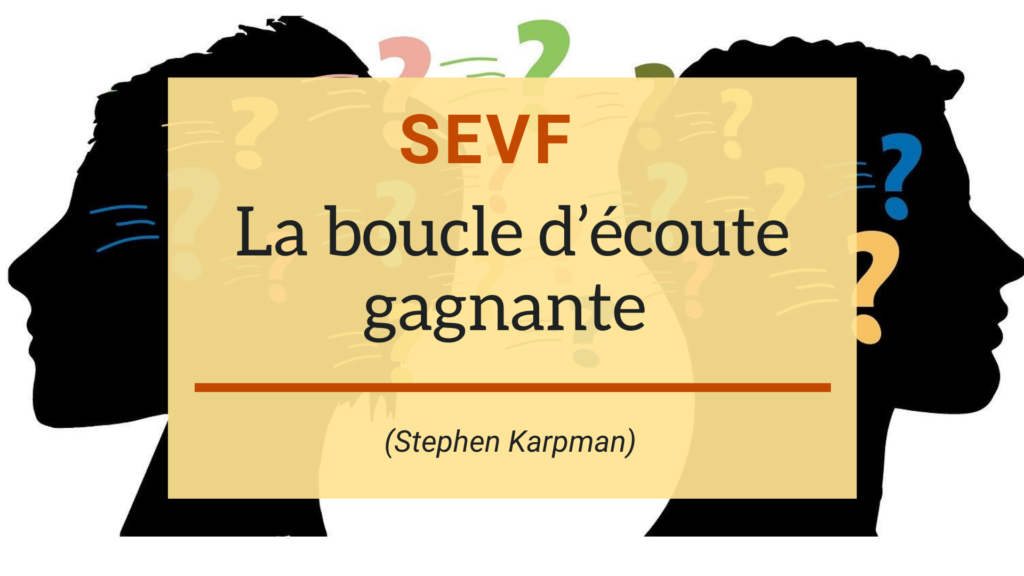
Listening skills are often reduced to staying quiet while someone else talks, but real listening is an active craft. Stephen Karpman, a therapist in the Transactional Analysis tradition and the creator of the Drama Triangle, places great importance on the quality of listening. In his book on the Drama Triangle, he offers four skills that improve how we listen and help others feel heard and validated.
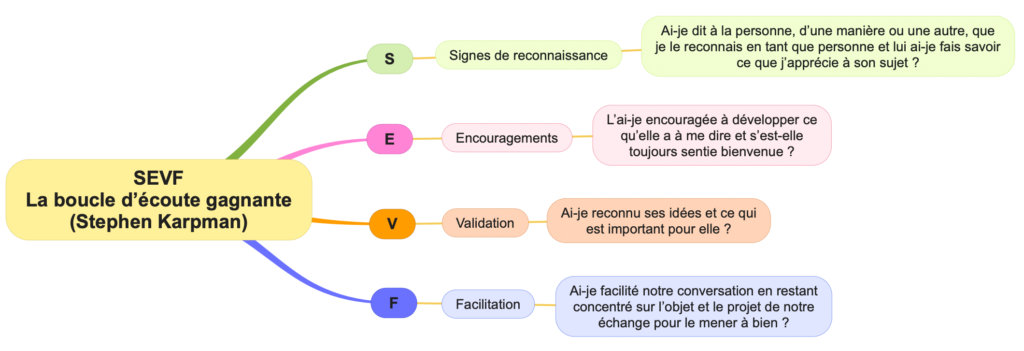
These qualities form the acronym SEVF: Signs of recognition, Encouragements, Validations and Facilitations. Karpman sees these four letters as matching a basic human relational need: to be heard and understood. Knowing them can help with listening in the middle of relationship problems, in a couple for example.

Quick takeaways
- Signs of recognition tell the other person they matter, whatever the message.
- Encouragements make people feel welcome to speak, anytime and anywhere.
- Validations focus on the ten percent of truth in what someone says.
- The iceberg of information reminds us to look beyond the visible subject.
- Facilitations keep the conversation moving toward the other's goal.
- Four simple questions let you check your listening after a hard talk.
Signs of recognition
In Transactional Analysis, great importance is given to strokes, or signs of recognition. Finding the words to tell the other person that they matter, whatever message we are sending, is a fine proof of altruism. These signs preserve the channel of the relationship, keeping the connection open even when the conversation is difficult.
This first skill is about the person rather than the content. Before solving anything, you let the other know you see them as someone who counts. It is a small gesture with a large effect on how safe the conversation feels, much like the reassurance a parent offers a child who wants to be small.
Why it comes first
Recognition sets the tone for everything that follows. Without it, even good advice can land as criticism. With it, the other person is more willing to stay in the exchange.
Encouragements
Encouragements are the signs and words given to the other person so that they express and say what they want to say. Karpman describes active encouragement, spoken out loud, as what ensures the other person feels welcome to talk, anytime, anywhere.
In practice this can be as simple as inviting someone to continue, asking a gentle open question, or saying plainly that you have time. The point is to remove the small barriers that make people hold back, whether shyness, fear of boring you or the sense that their topic is trivial.
Encouragement also matters when children are learning to put feelings into words. A patient invitation to speak works alongside everyday routines that build confidence, such as motivating children through study or introduction of solids at the family table, where talk flows naturally. The same applies to the father's role, which shapes how freely a child speaks, and to the changes parents face, as seen in celebrities after giving birth.
| Skill | What you do | What the other person feels |
|---|---|---|
| Signs of recognition | Say what you appreciate about them | Seen as a person |
| Encouragements | Invite them to keep talking | Welcome to speak |
| Validations | Acknowledge the ten percent of truth | Heard and understood |
| Facilitations | Explore means and possibilities | Taken seriously |
| Self-check | Ask the four questions afterwards | Respected over time |
Validations
Validations are thanks given to the other person for what they have confided, even when it is not "positive" in the usual sense. It may be criticism, reproach or complaint. Karpman relies here on his ten percent rule: there is always at least ten percent of accuracy in what someone says, even if we do not always perceive it. This principle echoes the broader idea that homeopathy for children and similar approaches deserve careful, open-minded attention.
Drawing on the Drama Triangle, he suggests that in every psychological game the players play at least ten percent of each role, at the same time or in sequence. Keeping in mind that there is at least ten percent of positive intention in each game helps us see what motivates a person's words. A victim who complains may be sending signals, seeking to be understood and trying to change the situation, even if the way of communicating the need is inappropriate or aimed at the wrong person. The rule applies to ourselves as well as to others.
The iceberg of information
Karpman also invites us to be aware of the iceberg of information. What is shown or heard is only the visible tip: the subject. The submerged part contains the information, the importance and the intention. We do not all give the same importance to a subject, and something that looks superficial to one person may be of high importance to them. Discovering the hidden intention, the inner motivation, allows us to really listen because we align with the other. Being on the same wavelength means seeing the submerged layers of the iceberg. Active listening means validating the subject, the information, the importance and the intention.
Facilitations
According to Karpman, facilitating means giving life to the subject by projecting into possibilities, plans and means. It shows the other person that we are sticking with the topic they wanted to raise with us. He also speaks of engaged listening: listening with commitment shows that we will not drop the matter and that we are ready to cover every subject connected to the problem.
Keeping the goal of the conversation in view is also an excellent way to refocus the discussion if it strays. The gift here is showing our interest in the other's subject by discussing the means that lead to the desired result. This is where practical planning, the kind of forward thinking behind escape rooms Madrid or a rural houses weekend, becomes a form of care rather than mere logistics.
Assessing your listening quality
Karpman offers four questions to assess the quality of our listening. First, did I tell the person, in one way or another, that I recognise them as a person and let them know what I appreciate about them? Second, did I encourage them to develop what they had to say, and did they always feel welcome?
Third, did I acknowledge their ideas and what is important to them? Fourth, did I facilitate our conversation by staying focused on the object and the project of our exchange so as to carry it through? These questions work as a quick self-check after a difficult talk, and they pair well with the patience adults need in ordinary family life, from baby bathing routines to choosing teething toys for a fussy infant.
None of this requires special equipment or a perfect setting. It requires attention, a few deliberate words, and the willingness to stay with the other person's subject rather than steering it back to your own. Practised regularly, the four skills become habits, and the people around you notice the difference before you do.

My hands-on take
I started using these four skills during bedtime conversations with my children, when the talk tends to drift and stall. Instead of jumping to solutions, I now try to name something I appreciate about them first, then invite them to keep going. It feels slower, but the talks last longer and end more calmly.
The ten percent rule has been the most useful part for me. When one of my kids complains that something is unfair, I look for the small piece that is genuinely true and reflect it back. They usually relax a little, and we can then talk about what to do next rather than circling the complaint. I still forget the four questions often, but running through them after a tense evening has shown me where I rushed past the other person's subject.
Frequently asked questions
What does SEVF stand for?
It stands for Signs of recognition, Encouragements, Validations and Facilitations. Karpman presents these four skills as matching the human need to be heard and understood.
What is the ten percent rule?
It is Karpman's idea that there is always at least ten percent of accuracy in what someone says. Focusing on that small share of truth helps you validate the person instead of arguing with the rest.
What is the iceberg of information?
It describes how the visible subject of a conversation is only the tip. Below it lie the information, the importance and the intention, which you need to perceive in order to truly listen.
Can these skills help in couple conflicts?
Yes, Karpman considers them useful in the middle of relationship problems. They keep the channel of communication open while the actual issue is being worked through.
Product Reviews
 Best Toys for Dogs With High Prey Drive |
Best Outdoor Toys for 3-4 Year Olds |
Best Outdoor Toys for 6 Year Olds |
Best Harness for Poodle |
Best LEGO Sets for Adults |
Best Travel Toys for 4 Year Olds on Airplane |
Best Toy Stores in Washington DC |
Best Potty Training Toys |
Best Toys for Tripod Dogs |
Maillot equipe de france







