


A first period book for girls can do something a parent's short talk often cannot: it can slow the subject down, page by page, and make it feel ordinary. "Le Fil Rouge" (The Red Thread), subtitled a manual for your first moons, is a small illustrated guide written for girls of roughly eight or nine up to thirteen or fourteen.
The author's aim is to shift how menstruation is seen, to loosen a topic that is still treated as a taboo, and to help girls meet their first periods with confidence rather than worry. This enriched edition was created by four women, working from a text originally published in the United States.

Quick takeaways
- Written for girls from about eight or nine up to thirteen or fourteen
- Eleven chapters, from identity and cycle basics to plants and protection
- Clear explanations of where the blood comes from and the cycle's phases
- Strong message on bodily autonomy: your body belongs to you
- Practical ideas: washable pads, soothing plants, a homemade lunar dial
- Designed as a conversation starter between girls and the women around them
What the book sets out to do
The guiding idea is simple and generous: a girl should understand what is happening in her body before it happens, and should hear that the change is welcome. The book speaks directly to her, in the second person, and treats her as someone capable of understanding real information.
Rather than a single lecture on hygiene, it builds a picture of the female cycle as a rhythm that runs alongside the rest of life. Parents looking for happy family keys often find that this kind of honest, early conversation removes tension later on.
The tone stays warm throughout, which matters for a reader who may be nervous. It also gives adults a shared text to point at when words feel awkward.

The eleven chapters, one by one
The contents move from identity to practical care: what it means to be a woman; what menstruation is; how periods actually unfold; the female cycle; why menstruation is powerful; your body is sacred; the cycle of the moon; how to make your own lunar dial; taking care of yourself during your moons; intimate protection; and plants as allies of the cycle.
That order is deliberate. Meaning comes first, mechanics second, practical comfort last, so a girl is not handed a pad and a diagram with no context. It is a useful reminder that books about routines work best when they explain the why, not only the what, much like the familiar motherly phrases that carry meaning across generations.
How the cycle is explained
The section on the cycle is unusually complete for the age group: it describes where the blood comes from and walks through the different phases, clearly and concisely. Questions girls actually ask get direct answers instead of metaphors, echoing the honest conversations raised in this chirigota about mothers and fathers.

| Chapter theme | What it covers | Useful for |
|---|---|---|
| Being a woman | Identity, generations, talking with relatives | Opening family conversations |
| Menstruation basics | What it is, where blood comes from | First clear answers |
| The cycle | Phases explained simply | Understanding rhythms |
| The moon and the dial | Observation, craft, self-knowledge | Tracking patterns playfully |
| Self-care | Rest, cloth pads, plants | Everyday comfort |
| Body and boundaries | Consent, privacy, respect | Pre-teen confidence |
Bodies, boundaries and consent
One of the strongest passages concerns the body itself: your body belongs to you, and you decide when you are ready to share your intimacy, and with whom. For a reader on the edge of adolescence, that sentence does more work than a chapter of warnings.
It connects naturally to the physical changes of growing up. Families who talk early about the first shave and similar milestones usually find the ground already prepared for conversations about privacy and consent.
The book also frames menstruation as a positive moment, linked to creativity and to the cycles of nature, and as an invitation to rest and to turn inward. That reframing is rare and, for many girls, relieving.
Practical care: protection, plants and rest
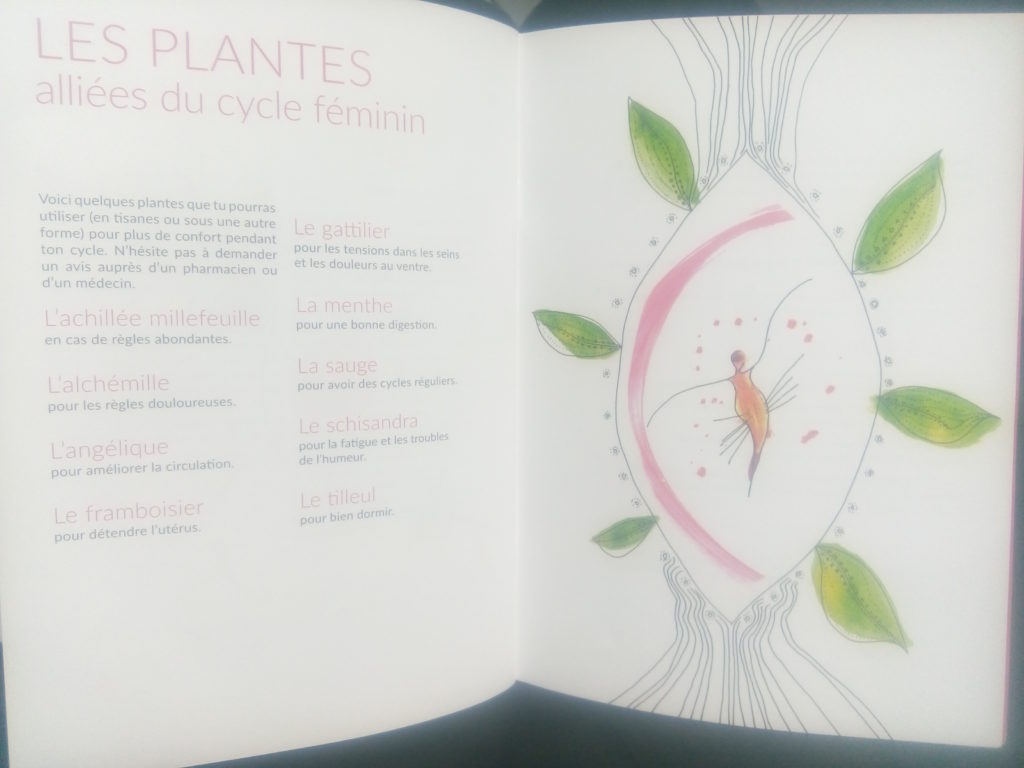
Advice stays concrete. The book discusses ecological protection such as washable cloth pads, and lists plants traditionally used to ease discomfort. It also encourages girls to notice how they feel and to allow themselves quieter days when their body asks for them.
These small habits of self-care echo what we teach children elsewhere in daily life, from getting them to shower without a battle to listening to their own tiredness. The message is consistent: your body is not a problem to manage.
Readers who like learning through making will enjoy the lunar dial, a simple craft that helps a girl track her own rhythms by observation rather than by worry.

The lunar dial and the moon connection
A whole chapter is devoted to the cycle of the moon and to building your own lunar dial. The idea is to observe behaviours and bodily reactions over time, so a girl begins to know her own patterns instead of being surprised by them.
Tracking something on paper is a skill children already practise elsewhere, whether through mathematics made fun or a simple diary. Here it becomes a tool for self-knowledge, and the craft element keeps it playful.
Some families will connect easily with the Native American legends and the notion of "moon time"; others will not. The text is written so it can be read as an opening for discussion, taking what speaks to each reader and leaving the rest.

Women across generations, and what readers say
The book invites girls to talk with the women around them, mothers, grandmothers, aunts, about what being a woman means. That thread between generations, and the call to solidarity between women, is one of its most touching aspects, opening with a warm welcome to the young reader.
The illustrations are lively, creative and colourful, with suggestive shapes that support the positive message rather than decorate it. One mother describes reading it with her nine-year-old and finding clarity, harmony and poetry in its pages; another says she wishes someone had given her this book as a teenager and now wants to share it with her daughters and even her son.
It is a self-published French manual, available directly from its own site, priced modestly. For parents building a small shelf on growing up, it sits comfortably beside stories about the sea and other gentle reads that open big subjects, much like short women easier birth or interacting with children on the spectrum.


My hands-on take
I read this one slowly, a few pages at a time, with a child who asks a lot of questions and dislikes long explanations. What worked for us was the order of the chapters: we started with the pages on what being a woman means, skipped the moon section entirely the first time, and came back to it weeks later when she was curious about the dial.
The craft idea was the surprise hit. Drawing a simple dial gave us something to do with our hands while talking, which is often easier than sitting face to face. I would suggest keeping the book visible on a shelf rather than handing it over as a solemn gift, and letting your child choose the pace.
Frequently asked questions
At what age should I give this book to my daughter?
The book is written for girls of roughly eight or nine to thirteen or fourteen. You can offer it before the first period arrives, so the information is familiar when it happens.
Can a parent read it with a younger child?
Yes. Reading it together lets you pause on the pages your child is curious about and skip what feels early. It works well as a shared text rather than a solo read.
Does it only talk about periods?
No. It also covers the wider cycle, body autonomy and consent, self-care, ecological protection and the link between generations of women.
Is it suitable for boys too?
Some families share it with sons as well, since understanding cycles helps everyone at home. You can decide based on your child's questions.
Product Reviews
 Best Toys for Dogs With High Prey Drive |
Best Outdoor Toys for 3-4 Year Olds |
Best Outdoor Toys for 6 Year Olds |
Best Harness for Poodle |
Best LEGO Sets for Adults |
Best Travel Toys for 4 Year Olds on Airplane |
Best Toy Stores in Washington DC |
Best Potty Training Toys |
Best Toys for Tripod Dogs |
Maillot equipe de france







