


Ending adult domination begins with a small, uncomfortable observation: most of us discipline children the way we were disciplined, without ever choosing it. The beliefs arrive early, long before we have children of our own.
A friend once told me about a girl of under four who watched her calmly invite an attention-seeking child to join a game instead of sending her to her room. The little girl was stunned. She had already learned that excited children are “naughty” children, and that naughty children are isolated and punished.

That moment captures the whole problem. Educational violence is so ordinary that a preschooler can recite its rules. This article looks at where those rules come from, what they cost, and how parents can quietly refuse them.
Quick takeaways
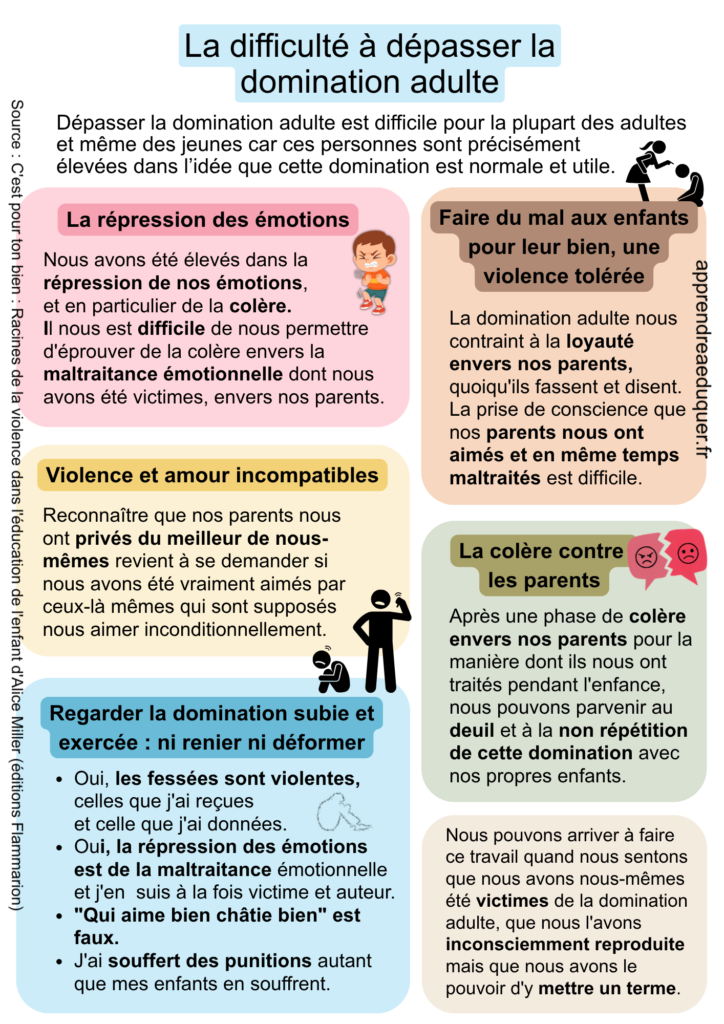
- Black pedagogy describes an education built on breaking a child's will through obedience and shame.
- Its principles are often unconscious: adults as masters, feelings as dangerous, will as a threat.
- Punishment, humiliation and withdrawal of love still feel natural because they echo our own childhoods.
- Questioning them can stir anger toward our parents, and that anger is legitimate.
- Gentle authority replaces power over the child with explanation, limits and repair.
- Children learn respect from every adult they meet, not only from their parents.
The logic of black pedagogy
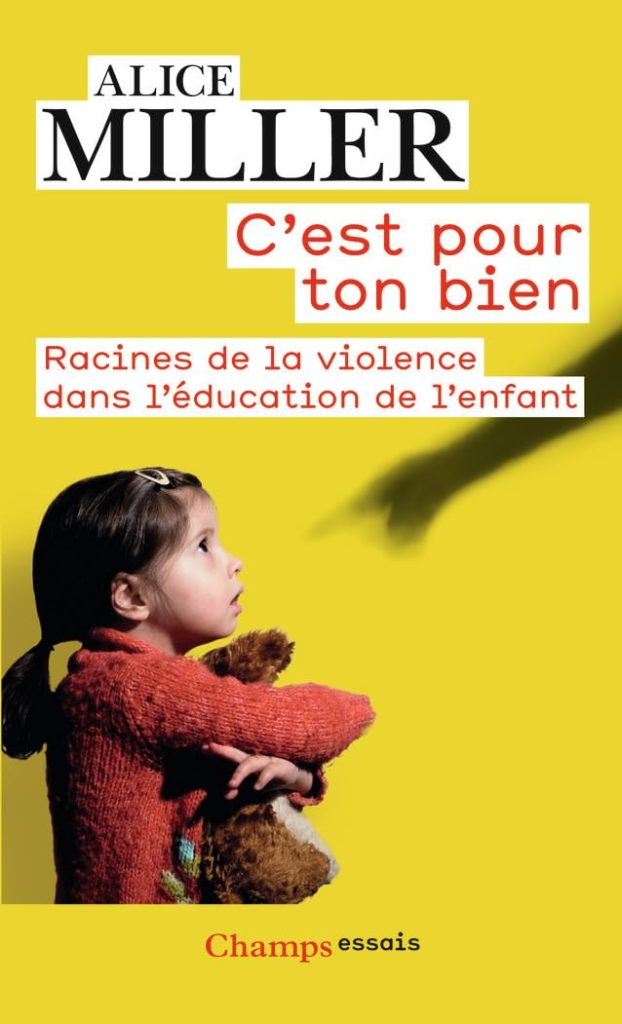
The term “black pedagogy” was coined by Katharina Rutschky and later taken up by Alice Miller to describe an education built on breaking a child's will. It rests on the belief that children are naturally bad and must be made to obey adults, whether parents or teachers. The aim is a docile, malleable child — “black” referring to the dark side of this approach and to the shadowy part of the unconscious.
Corporal punishment paired with humiliation has certainly not disappeared in the twenty-first century. Children are still called stupid, useless or nasty, and still emotionally mistreated by the adults who love them. Miller listed the often unconscious principles behind it: adults are the masters, adults decide good and evil like gods of Olympus, and their anger — really the product of their own conflicts — is blamed on the child.
Parenthood itself becomes sacred, and parents feel they must be protected from children's “bad nature” for fear of being devoured. Strong feelings of any kind are treated as dangerous: too much love looks sentimental, anger is forbidden. And as early as possible, without the child noticing, their own will must be removed so they cannot betray the adult.

The tools of control
The means of this oppression are familiar: traps, lies, manipulation, intimidation, withdrawal of love, shame, isolation, humiliation, contempt and mockery, escalating to outright violence. Ridicule and shame can wound a child every bit as much as a slap. Underneath it all, this traditional education runs on power rather than respect and love.
None of this is exotic or rare. It hides in plain sight, which is exactly why it is so hard to name and root out. Until a collective awakening happens, inherited beliefs about raising children will keep passing from one generation to the next, starting in the earliest years. If you are curious how play and reading can carry a gentler message, an author like Julia Donaldson shows how stories can respect a child's mind rather than lecture it. Even everyday skin concerns such as molluscum contagiosum can become a chance to listen to a child rather than dictate.
The same power dynamic shows up far beyond the home. Adults decide when a baby sits at the table, when a child is ready, when feelings are allowed. Sitting the baby at the family table, for instance, is often framed as a rule to enforce rather than a moment to share. Control can even reach into pregnancy, as with high blood pressure.
| Feature | Black pedagogy | Respectful parenting |
|---|---|---|
| Goal | Obedience and docility | Cooperation and understanding |
| Adult role | Master who decides good and evil | Guide who holds kind limits |
| Emotions | Repressed or mocked | Named and accepted |
| Discipline | Punishment, shame, isolation | Explanation, choices, repair |
| Child's will | Broken early and quietly | Protected and heard |
| Long-term effect | Fear and hidden feelings | Trust and emotional literacy |
Why good parents defend punishment
Denying a child's physical and moral integrity — through punishments, verbal humiliation, taps on the hand or bottom, withdrawal of love, threats and blackmail — still feels natural to many parents, childcare professionals and teachers. They cannot imagine anything else, because their own childhood gave them no other model.
There is a deeper reason too. Any new information about early childhood necessarily calls into question the way our own parents loved us. If it is possible to become a balanced, responsible and respectful adult without punishment, then why was I treated that way by parents who were supposed to love me and want the best for me?
That question can legitimately lead to anger: how could my parents, however well-meaning (“it's for your own good”), have misled me and deprived me of the freedom of my emotions? The calm self-mastery we worked so hard to achieve, and are so proud of, may turn out to be a bleak impoverishment rather than the cultural value we assumed.
What the child actually learns
What children learn from this model is not respect but fear, and often the belief that love and control are the same thing. A child who is mocked learns to hide; a child who is shamed learns to perform. These lessons travel with them into adulthood, shaping how they treat their own children and how they handle their own emotions.
Choosing a different authority
Refusing domination does not mean refusing authority. It means replacing power over the child with influence alongside them: explaining, listening, holding limits kindly and letting feelings exist. When a child is loud and restless, the first question is not “how do I stop this?” but “what is this child trying to tell me?”
Practical shifts help. Name the feeling before correcting the behaviour. Offer a real choice instead of a threat. Repair after you lose your temper, out loud, so the child sees that mistakes are survivable. And notice the small daily moments where control creeps in — mealtimes, bedtime, getting dressed — because those are where habits are formed.
This gentler approach shows up in everyday care too. A baby who doesn't eat or sleeps badly is often met with pressure, when what is needed is patience and observation. Even the arrival of a sibling, or a parent returning to work, can be handled with going to work framed honestly rather than as abandonment. And when a child is absorbed in play, toys for six-year-olds can be chosen to invite cooperation rather than competition. The same patience applies to an imaginary friend, and a look at the best toys under $50 can help you choose playthings that invite cooperation.

Modelling respect outside the home
Children learn domination or respect from every adult they meet. A teacher who humiliates, a relative who mocks, a coach who shouts — each one teaches a lesson about who holds power. Parents can gently name these moments at home, without drama, so children learn to recognise disrespect when they see it.
Respect also grows through shared experience. Time outdoors, caring for animals, cooking together: these build the kind of relationship where a child's feelings matter. Families who keep birds and children together, for instance, often find that daily care teaches patience and empathy far better than any lecture.
And it helps to remember that children are not products. They are not standardised goods to be cut, planed and shaped on an industrial line. They are people whose will deserves the same protection we claim for our own.
My hands-on take
I remember the first time I caught myself saying “stop crying or we go home” to a child I adore. Nothing terrible happened, but the sentence came out fully formed, as if borrowed. It was borrowed — from my own childhood, from the adults around me, from a culture that treats a quiet child as a good child.
What helped was not guilt but curiosity. I started watching for the moments when I reached for control instead of connection: the rushed morning, the spilled drink, the loud game. I began naming feelings out loud, offering two real choices, and apologising when I got it wrong. It felt clumsy for weeks. It still does sometimes. But the child in front of me is learning that feelings are allowed and that adults can be trusted — and honestly, so am I.
Frequently asked questions
What exactly is black pedagogy?
It is a term coined by Katharina Rutschky and developed by Alice Miller to describe an education that aims to break a child's will through obedience, repression of feelings and punishment. It is not a historical curiosity; its habits still shape everyday discipline.
Does respectful parenting mean no limits?
No. It means holding limits without humiliation, threats or withdrawal of love. You can say no firmly, explain why, and stay connected while the child is upset.
Why do I feel angry when I read about this?
Because recognising that punishment was unnecessary often means re-examining how your own parents loved you. That anger is a normal part of the process, not a sign you are being disloyal.
Where do I start?
Start with one daily moment, such as mealtimes or bedtime, and notice where control creeps in. Naming feelings, offering real choices and repairing after mistakes are small changes that add up.
Product Reviews
 Best Toys for Dogs With High Prey Drive |
Best Outdoor Toys for 3-4 Year Olds |
Best Outdoor Toys for 6 Year Olds |
Best Harness for Poodle |
Best LEGO Sets for Adults |
Best Travel Toys for 4 Year Olds on Airplane |
Best Toy Stores in Washington DC |
Best Potty Training Toys |
Best Toys for Tripod Dogs |
Maillot equipe de france







