


Emotimètres are simple printable scales that help children build a richer vocabulary around emotions, so they can name what they feel with more precision. The aim is to sharpen children's perception of their own emotions and those of others, one feeling at a time.
Enriching emotion vocabulary carries several benefits: children get to know themselves better by using the information emotions send, they understand other people more easily, and they can adapt their reactions to the intensity of what they feel. That means choosing regulation strategies for themselves and, toward others, avoiding violence or voicing requests that start from the emotion rather than the impulse.

Quick takeaways
- Emotimètres are printable scales that build precise emotion vocabulary.
- Seven emotions are covered, including shame because of its role in difficult behaviour.
- Each emotion is worked on separately, reading the words aloud together.
- Mime and human sculpture games make intensity differences physical and visible.
- Children may disagree with the ranking; that argument is part of the learning.
- New words proposed by children are added where the group agrees.
Why emotion words matter for children
A child who can only say "angry" has one tool for a whole range of inner states. A child who can also say irritated, frustrated or furious can describe what is happening with far more accuracy, and the adults around can respond to the actual situation rather than to a vague outburst.
This vocabulary also supports self-knowledge. Emotions carry information, and naming them helps children read that information instead of being swept along by it. It supports empathy too, because recognising shades of feeling in yourself makes it easier to recognise them in someone else.
Finally, precision helps children adapt their reactions to intensity. A small irritation calls for a different response than a full-blown rage, both in how they calm themselves and in how they speak to others. Learning to formulate a request from the emotion felt, rather than lashing out, is a skill that grows with the words available. Hands-on play can reinforce this learning, and foam block toys offer a simple way to practise naming feelings during play. Parents who want to broaden their own toolbox can look at parenting TED Talks or read about forms of aggression that adults sometimes normalise without noticing.
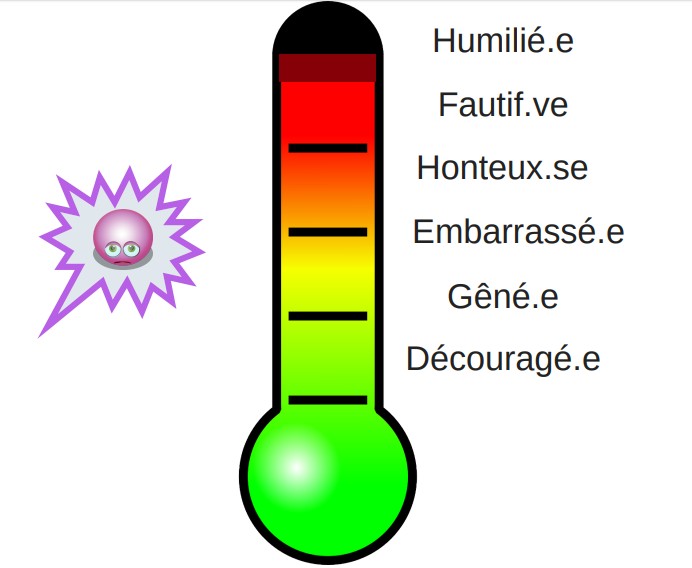
What the emotimètres contain
Each emotimètre invites children to find synonyms for one primary emotion: anger, sadness, fear, joy, disgust, surprise, and also shame. Shame is included even though it is socially constructed and generally not classed as a primary emotion, because it sits behind many behaviours that cause difficulty in childhood and adolescence: withdrawal, touchiness, defensiveness, aggression.
The scales show words already written in, arranged by intensity. Children are shown the tool while the adult explains that emotions come in different degrees, and each emotion is worked on separately, reading the words aloud together. For younger children, the same gradual approach used with tummy time toys applies: short, repeated sessions work best.
Questions that open the conversation
Children can then be asked what each word means to them: which situations it brings up, what they feel in their body, what thoughts appear, what they want to do. Asking what makes one word different from another is often where the richest discussion happens.
Disagreement is welcome. If a child thinks a word sits in the wrong place on the scale, that is a chance to argue a case and give examples. The tool is a starting point, not a verdict, much like choosing among the best 1 year old toys.

| Step | What the adult does | What the child does |
|---|---|---|
| 1. Warm up | Suggests a mime or a shared memory | Acts out or recalls the feeling |
| 2. Present | Shows the scale and reads the words | Listens and asks about unknown words |
| 3. Explore | Asks about situations, body, thoughts | Explains what each word means to them |
| 4. Compare | Points to two neighbouring words | Argues the difference with examples |
| 5. Extend | Invites new adjectives | Proposes and justifies a new word |
| 6. Display | Puts the scale somewhere visible | Uses it later to name a feeling |
Mime games to anchor the words
Body-based play makes the scales concrete. Ask children to mime someone who is frightened, then someone terrified, and to explain what changed in posture, thoughts, bodily sensations and actions. The contrast does more work than any explanation.
You can also give each child an adjective matching a degree of the emotion being studied, have them line up in order of increasing intensity, and mime their assigned version. Spectators then discuss what differed between degrees of the same feeling: the body, the posture, the face.
These games pair naturally with sensory play, such as games to stimulate senses, and with everyday movement. If you are choosing props or active toys for younger children, reviews of outdoor toys or toys for three-year-olds can help you pick something that supports physical expression rather than replacing it.

Human sculpture: a group game
In pairs, one child sculpts the other, adjusting mouth, hands, arms, legs and eyes to express an adjective the adult has given in secret. When the sculptures are finished, the other sculptors walk around the still figures like a museum and try to guess which emotion word each one represents.
The sculptor confirms or corrects, and when a guess is right the child who found it explains which clues they used. This turns observation into explicit reasoning about faces and bodies.
Afterwards the sculpted children, now released, can talk about what they felt. Did holding that posture actually produce a hint of the emotion? What did they want to do while standing there? Their answers often surprise adults.
Following these exchanges, children may propose new adjectives for other intensities or shades of the same emotion. They explain them, and the words are added to the emotimètre in a spot everyone agrees on. Small group rituals like this sit comfortably alongside the calm routines described in guides on child sleep, since emotional vocabulary tends to surface at bedtime too.

Using the scales at home, step by step
Start with one emotion only, ideally one that has come up recently. Print the corresponding scale, read the words together, and let your child place a recent memory on it. Keep sessions short and stop while it is still enjoyable.
Prepare the ground with mime, remembered emotional moments or everyday scenarios before showing the printed tool. The scale then lands as a summary of something already experienced rather than an abstract worksheet.
Keep the finished scales visible, perhaps on a wall or inside a calm corner, so children can point to a word when talking is hard. Over time the family vocabulary grows, and so does the shared understanding of what each word means in your household. For families navigating big transitions, such as a new baby, the same naming approach helps, and guides on newborn adaptation offer useful context.
My hands-on take
I started using these scales with one emotion at a time, and the first attempt was a flop: I showed the whole anger scale and my child shut down. The second time I mimed "a bit annoyed" and "absolutely furious" first, and suddenly the words had something to attach to. Since then I keep sessions to a few minutes and let the child lead.
The human sculpture game was the surprise. Standing frozen in a posture I had built produced giggles and then a genuinely thoughtful comment about how the body seemed to drag the feeling along with it. I now keep one printed scale on the kitchen wall, and it gets pointed at far more often than I expected, usually at moments when nobody feels like talking.
Frequently asked questions
At what age can I start using emotimètres?
There is no fixed age, but the tool works best once a child can talk about feelings in short sentences. Younger children benefit most from the mime games first, with the printed scale introduced gradually as their vocabulary grows.
What if my child disagrees with where a word sits on the scale?
That is a good sign, not a problem. Ask them to explain their reasoning and give an example, then agree together on a placement. The discussion itself is where most of the learning happens.
Why include shame if it is not a primary emotion?
Shame is socially constructed rather than primary, but it underlies many behaviours that worry adults, such as withdrawal, defensiveness and aggression. Naming it gives children a way to talk about it instead of acting it out.
Do I need to print the scales?
Printing makes them easy to display and annotate, but you can also draw a simple ladder of words on paper. What matters is the ordered words and the conversation around them, not the format.
Product Reviews
 Best Toys for Dogs With High Prey Drive |
Best Outdoor Toys for 3-4 Year Olds |
Best Outdoor Toys for 6 Year Olds |
Best Harness for Poodle |
Best LEGO Sets for Adults |
Best Travel Toys for 4 Year Olds on Airplane |
Best Toy Stores in Washington DC |
Best Potty Training Toys |
Best Toys for Tripod Dogs |
Maillot equipe de france







