


Dessinetto is a drawing game designed to help children learn to draw from geometric shapes and simple patterns, starting in nursery or preschool. Free drawing remains essential for young children, yet many of them ask to be guided so they can draw realistic objects or characters.
The game answers that request without taking away the pleasure of making art. Children who cannot yet draw, or who are afraid to attempt complex pictures, build up a stock of models they can copy, then vary, personalise and adapt over time. In the process they regain confidence and draw with genuine enjoyment.

Quick takeaways
- Dessinetto teaches drawing through four-step cards, starting from simple geometric shapes.
- The box holds 60 cards across four difficulty levels, covering everyday objects and animals.
- Play follows a Pictionary-style loop: draw, guess, and climb the ladder to win.
- Copying shapes strengthens fine motor control, which supports later handwriting.
- Rules can be adapted so that guessing, not drawing, decides the winner.
- Free drawing stays essential; the game simply adds a reserve of models to build on.
Why guided drawing helps young children
Copying shapes and patterns is not a distraction from free drawing; it is a complement to it. When a child reproduces a form step by step, they work on fine motor control, which matters enormously for the later acquisition of handwriting.
There is also an emotional benefit. A child who has a reserve of models to fall back on no longer freezes in front of a blank page. They can start from a known shape and then personalise it, which is exactly how confidence grows. Parents looking for more ways to support this stage may enjoy these independent play toys, which leave room for self-directed practice.
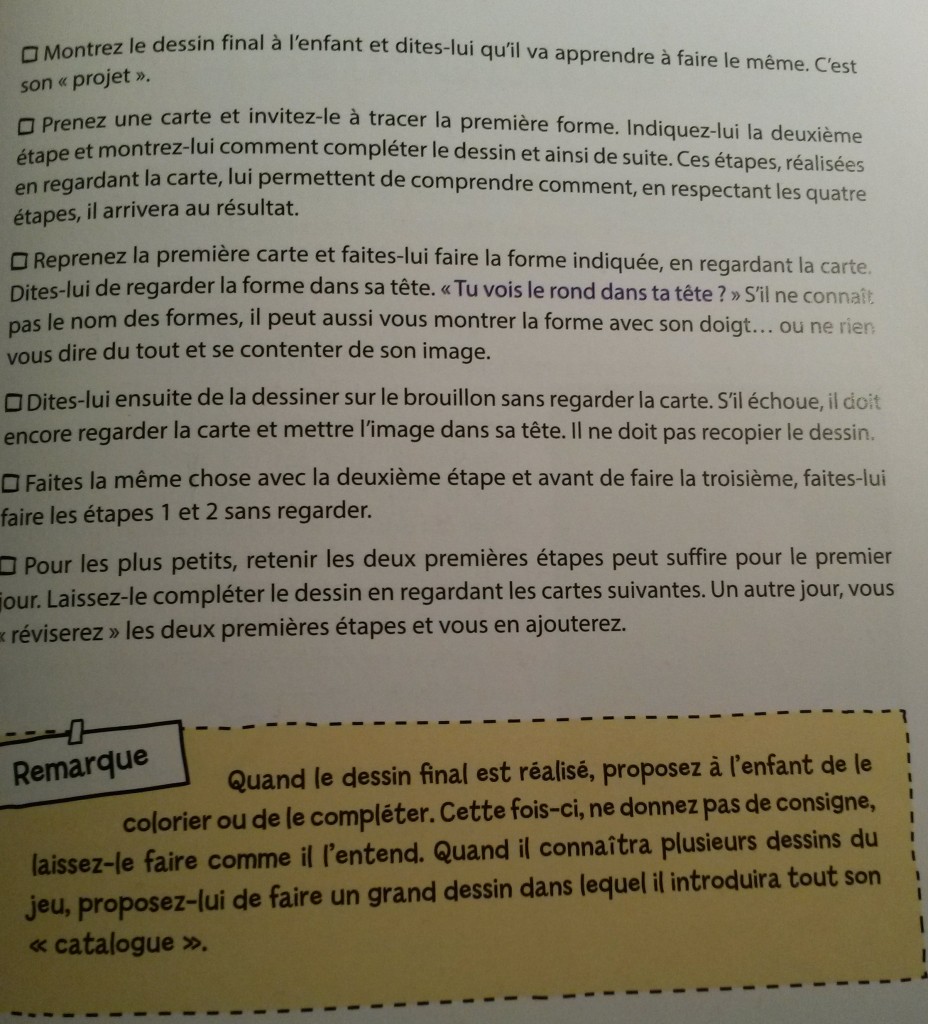
The approach echoes the guided drawing activity described in books on learning through the pedagogy of Antoine de la Garanderie, where children memorise the stages of a picture rather than copying a finished result.
What is inside the box
The game contains 60 cards, each showing a drawing to be completed in four steps. Every card is divided into four boxes, and each box represents one stage on the way to the final picture.
The subjects are everyday objects and animals: a candle, a fish, a fir tree, a truck, a key, and many more. The cards are sorted into four levels of difficulty, so a younger child and an older sibling can play from the same box. If you are stocking a playroom, this sits well alongside the outdoor toys kids love, since drawing and active play balance each other nicely. It also pairs well with the gentle, child-led spirit of Julia Donaldson's approach to children's creativity.
A familiar format, made accessible
Dessinetto borrows the concept of Pictionary but makes it reachable for the youngest players by giving them a method rather than a blank page. Much like the structured Baby Einstein method, it offers a scaffolded path into a new skill.

| Element | What it offers | Who it suits |
|---|---|---|
| 60 step cards | Four-stage drawings of objects and animals | Children from nursery age |
| Four difficulty levels | Progression within one box | Mixed-age siblings |
| Ladder and tokens | Clear goal and gentle competition | Group play at home |
| Guessing mechanic | Keeps non-drawers involved | Less confident artists |
| Adaptable rules | Guess-to-win variant | Children who struggle with shapes |
How a game actually works
Each player draws a card and must reproduce the drawing by following its four stages. The other players watch and try to guess what the picture represents.
If a player succeeds in making the others guess their model, they move up one notch on their own ladder card. The first player whose token reaches the top of the ladder must draw the object shown there, and wins the game. It is a simple loop that keeps everyone drawing, guessing and laughing rather than waiting their turn. Families who like structured games with a clear goal often pair this with the LEGO building software they use for digital building at home.
Because the guessing matters as much as the drawing, even a child with shaky hands stays involved for the whole round.
When the rules need adjusting
Not every child can reproduce the shapes well enough to reach the final picture, and that is fine. One parent simply changed the rules: since her daughter struggled to complete the drawings, the winner became the player who managed to guess instead.
That small tweak keeps the game enjoyable and removes the pressure to perform. You can adapt it further by letting a child choose their own card, take extra time, or describe the stages out loud before starting. The point is to keep the pleasure of drawing alive, not to enforce a rulebook. For children who need a calmer outlet after a frustrating round, a few of the dog toys dachshunds enjoy can be a nice way to reset the mood.

Building a habit of drawing at home
A stock of model cards works best when it is left within reach. Keep the box on a low shelf with paper and pencils so a child can return to a favourite card and try it again another day. Repetition is what turns a copied shape into a remembered one.
Over time, encourage your child to change one element of a model: a different colour, an extra detail, a new background. This is how a copied drawing becomes their own. Parents who want to extend the habit into other quiet activities may find ideas in these toys for baby showers, many of which suit older siblings too.
For a broader cultural angle, books introducing art can sit alongside the drawing table and feed the same curiosity.
Where to find it and who it suits
Dessinetto is sold in toy shops, in toy libraries and online. It suits children from nursery age upward, particularly those who ask to be shown how to draw something realistic.
It is also a good fit for a child who is reluctant to attempt complex pictures, since the four-step format removes the fear of the blank page. If you are shopping around, toy stores Houston and similar local shops often stock this kind of educational game, and a toy library lets you try before buying. For quiet screen time, these digital books for children pair well with drawing practice. Siblings of different ages can share one box thanks to the four difficulty levels.

My hands-on take
I have used step-by-step drawing cards at home, and the difference from a blank sheet is striking. My youngest would hover over the paper, unsure where to start, until I broke a picture into stages; suddenly a fish or a truck was achievable rather than intimidating.
What I learned is to leave the cards out rather than packed away. Children come back to a favourite model on their own, and that repetition is where the real progress happens. I also stopped correcting the drawings. If a child wants a green fish with three fins, that is the point.
Frequently asked questions
What age is Dessinetto for?
It is designed for children from nursery or preschool age upward, and the four difficulty levels let older siblings play from the same box.
Does guided drawing replace free drawing?
No. Free drawing remains essential; the game simply gives children who ask for guidance a reserve of models they can copy and then personalise.
What skills does it develop?
Copying shapes and patterns works on fine motor control, which supports the acquisition of handwriting, and it builds confidence in children who fear complex pictures.
Can the rules be changed?
Yes. One parent made the guesser the winner, and you can also allow extra time, free choice of card, or describing the stages aloud before drawing.
Product Reviews
 Best Toys for Dogs With High Prey Drive |
Best Outdoor Toys for 3-4 Year Olds |
Best Outdoor Toys for 6 Year Olds |
Best Harness for Poodle |
Best LEGO Sets for Adults |
Best Travel Toys for 4 Year Olds on Airplane |
Best Toy Stores in Washington DC |
Best Potty Training Toys |
Best Toys for Tripod Dogs |
Maillot equipe de france







