


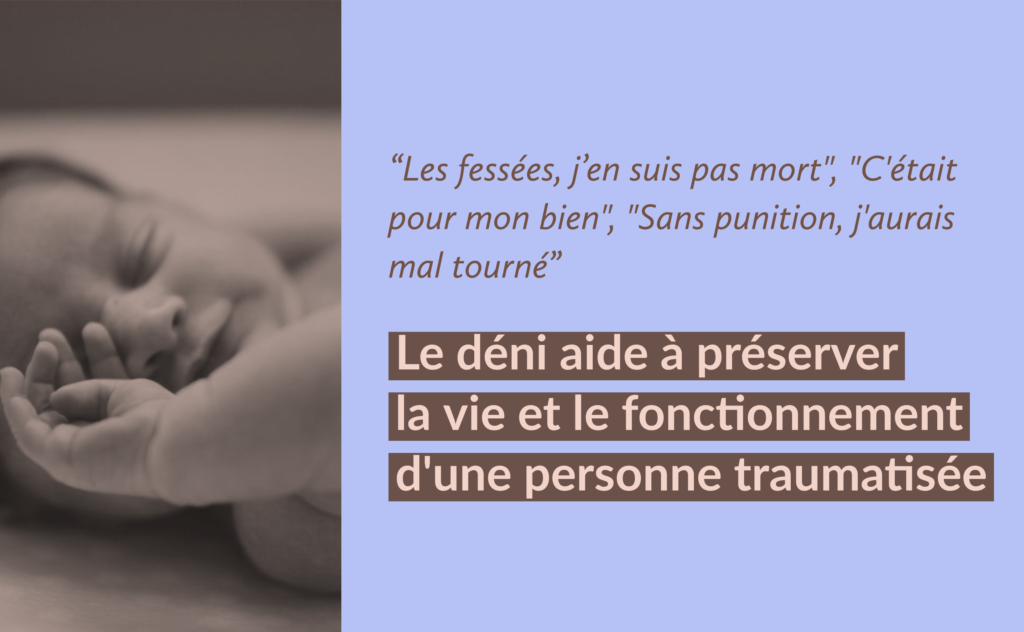
Denial of childhood trauma often sounds like a familiar sentence: "I got spanked and I turned out fine." That phrase, repeated by so many adults, is not really proof that hitting children is harmless. It is more often a quiet symptom of something the person has never been allowed to feel.
Understanding why this denial exists can help parents break the cycle. It is not about blaming anyone, but about noticing what gets buried and how that buried pain can shape the way we raise our own children.

Quick takeaways
- "I survived spanking" is often a symptom of trauma, not proof of harmlessness.
- Denial and amnesia are involuntary protections, not character flaws.
- Leaving denial takes courage and usually happens when a person feels safe.
- Unprocessed childhood pain can lead to re-enactment with one's own children.
- Gentle routines and honest feelings build the safety healing requires.
- Breaking the cycle benefits individuals, families and society.
The sentence as a symptom
Many trauma survivors resign themselves to their symptoms without ever looking for the cause. They live with stomach aches, back pain, restless sleep, unstable moods, or low energy, and they treat each complaint on its own. Denial and amnesia quietly keep this resignation in place.
So the person insists nothing happened, that they were never afraid, and that they never felt pain. Children already do this in the moment, shouting "it didn't even hurt!" after a smack. That bravado is worth noticing, because it follows us into adulthood.
It helps to treat denial itself as part of the injury, not as a character flaw or a dishonest trick. As one trauma specialist explains, denial and amnesia are not voluntary choices. They are wired into human psychology and biology, protecting life and functioning at the moment of the event.
Why the mind protects itself
When something overwhelming happens, denial helps a person keep going. The problem is what comes later, when that same protection becomes a symptom that keeps the pain locked away. Naming this gently matters, especially for parents who carry their own childhood memories into daily family life, from bedtime routines to the small stresses described in postpartum challenges.
This is where the work of Alice Miller and Muriel Salmona on ordinary educational violence becomes so relevant. It is precisely the denial of suffering that leads people who were spanked and punished to say they survived it and even thank their parents for hurting them "for their own good."
Denial is not weakness
Seeing denial this way removes shame. A parent who understands this can approach their own history with curiosity rather than self-criticism, and can respond more calmly when a child's difficult behaviour stirs old feelings.
| Area | Denial pattern | Healing pattern |
|---|---|---|
| Memory | "Nothing happened to me" | Acknowledging painful moments |
| Feelings | "I was never afraid" | Naming fear and hurt honestly |
| Body | Treating symptoms only | Looking for underlying causes |
| Parenting | Repeating old punishments | Choosing calm responses |
| Support | Going it alone | Accepting help from others |
Leaving amnesia behind
Coming out of denial or amnesia takes real courage, and the energy it releases can be considerable. It should never be underestimated, because it is a major step on the road to healing. According to the specialist, denial holds a traumatised person in its grip until the primary processes blocking the system decide to release it.
People tend to emerge when they feel safe, when another event triggers a "memory," or when the body simply says "enough." Friends, relatives and therapists can offer real help, but sensing the right moment is essential. That is why a calm, steady home environment matters so much, much like the reassuring presence described in parenting as mirror.
Small daily rituals, predictable routines and honest conversations all build the sense of safety that makes this inner work possible.
The risk of re-enactment
Trauma works insidiously, shaping our motivations and impulses in ways we rarely notice. A person who was hit as a child, including through "simple" spankings, may end up hitting as an adult if no awareness work is ever started. This repetition of past traumatic events is called re-enactment.
One trauma specialist calls re-enactment the most binding, most mysterious and most destructive symptom, for individuals, for society and for the wider world. It is why breaking the cycle is not a private matter but something that ripples outward. Even everyday frustrations, such as a child's sore ear on a rough morning covered in child ear pain, can become a flashpoint if old patterns take over.
Noticing the pattern is the first step. The second is choosing, deliberately, to respond differently.
Choosing a kinder path
Moving toward gentle, respectful relationships does not mean pretending the past was fine. It means acknowledging the pain, however small it seemed, and refusing to pass it on. Parents can start by learning to name their own triggers and by giving children words for feelings instead of punishment.
Practical care supports this shift. A predictable, comfortable environment, from warm clothing on cold days as covered in protecting children's feet to calm bedtime routines, tells a child their needs matter. Gentle guidance around health, such as the advice in infant umbilical hernia, reinforces that care is about attention, not fear.
Play is another powerful tool. Shared moments with toys and games, whether a simple airplane travel toy or a thoughtful Christmas gift, build connection and trust. Even choosing the right fidget toy reminds us that comfort and calm matter at every age.
Healing is a family project
Breaking the cycle is rarely a solo journey. Partners, friends and professionals can all play a part, and so can the small choices made at home every day. Reading about child development, including topics like interacting with ASD peers, helps parents respond to difference with patience rather than punishment.
It also helps to remember that healing is not linear. Some days old reflexes return, and that is normal. What matters is the direction of travel: toward safety, honesty and respect, one calm response at a time.

My hands-on take
I remember the first time I caught myself about to repeat a phrase I had heard as a child, one of those "it's for your own good" lines. My hand was already moving, and I stopped. It felt uncomfortable, almost disloyal, to admit that something from my own childhood still had a hold on me.
What helped was slowing down. I started noticing my triggers, talking about them with someone I trust, and giving myself permission to feel what I had long dismissed. My children did not need a perfect parent. They needed one who was willing to look honestly at the past and choose something kinder, one small moment at a time.
Frequently asked questions
Does saying "I survived spanking" mean I was definitely traumatised?
Not necessarily. It simply means the phrase is worth examining gently. Many people use it to avoid painful feelings, and exploring that with curiosity, not judgment, can be the first step.
Can I heal without therapy?
Friends, family and self-reflection can help, but professional support is often valuable. Healing usually happens when a person feels safe enough to face what was buried.
Why do I repeat my parents' methods even when I don't want to?
This is called re-enactment, and it happens when past pain goes unexamined. Noticing the pattern and choosing a different response, again and again, gradually breaks the cycle.
Is it too late to change if my children are already older?
It is never too late. Honest conversations, calmer responses and consistent care can rebuild trust at any age.
Product Reviews
 Best Toys for Dogs With High Prey Drive |
Best Outdoor Toys for 3-4 Year Olds |
Best Outdoor Toys for 6 Year Olds |
Best Harness for Poodle |
Best LEGO Sets for Adults |
Best Travel Toys for 4 Year Olds on Airplane |
Best Toy Stores in Washington DC |
Best Potty Training Toys |
Best Toys for Tripod Dogs |
Maillot equipe de france







