


What is revalidation?
The independent exams that students will undergo at each end of the training cycle are called revalidations to certify their skills and knowledge and to be able to access, from then on, the following school years, vocational training, high school and even the University.
The Ministry of Education, Culture and Sports defines the revalidation as the external end-of-stage evaluations and, according to its criteria, they will help to improve the quality of the Spanish educational system, since they ensure that OECD countries (Organization for Economic Cooperation and Development) with similar evaluation criteria have up to sixteen points of improvement in accordance with the criteria of the International Program for Student Assessment (PISA).

It is also worth noting that only five countries in the European Union use this form of qualification.
These tests must be passed (they will be averaged with the grade obtained in the school subjects) for the students to receive the title of the academic cycles, that is, it will no longer only be necessary to have a positive assessment in all subjects to obtain the title but they will also have to "revalidate" (hence the name by which these evaluations are known) their knowledge.
Revalidation in Primary Education
In the third and sixth grades of Primary, these types of evaluations will be carried out to check the student's level with respect to those required at the state level. However, unlike what happens with subsequent revalidations, these tests have no consequences when it comes to limiting access to the rest of the courses or obtaining the degrees but are merely indicative and informative for parents, schools, teaching teams and students.
The objective of the validation test carried out at the end of 3rd year of Primary School is to check "the degree of mastery of the skills, abilities and abilities in oral and written expression and comprehension and problem solving in relation to the degree of acquisition of competence in linguistic communication and mathematical competence" as stated on the website of the Ministry of Education, Culture and Sports.
In the case of the final evaluation carried out on 6th grade Primary students, its objective is to verify, at the end of Primary Education, the degree of acquisition of competence in linguistic communication, mathematical competence and basic competences in science and technology, as well as the achievement of the objectives of the stage.
The revalidation in ESO
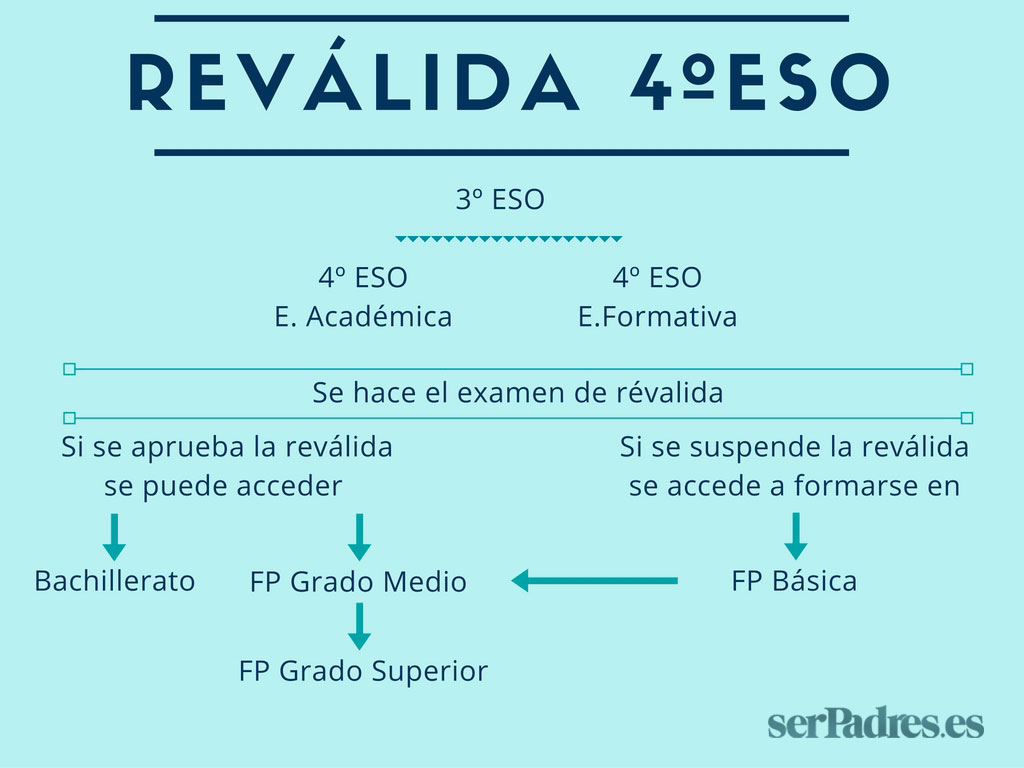
The final evaluations of Secondary Education or revalidation exams are carried out in the 4th year of ESO and can be taken by all those students who have failed a maximum of two subjects, as long as these are not both Language and Mathematics.
If they pass these evaluations, students will have access to the baccalaureate and the teachings applied to the Intermediate Grade Cycles. The evaluation criteria, contents and characteristics of the tests are set by the Ministry of Education, Culture and Sports throughout the Spanish territory. The educational administrations will be responsible for the application of these measures, and teachers external to each center will also be responsible for correcting the evaluations.
The tests are divided into three blocks: in one the four core materials will be evaluated using multiple choice questions and semi-constructed or open response questions, in another block the core subjects chosen by the ESO modality that the student has taken will be evaluated and a third block in which a free subject chosen by the student is evaluated in which Physical Education, Religion or Ethical Values are not included. The student will be considered to have passed the revalidation tests if he or she achieves a grade equal to or greater than 5. points out of the maximum of 10. However, to obtain the title of Graduate in Compulsory Secondary Education it is necessary to pass the final evaluation and average all the grades obtained during ESO, counting these as 70% of the average and 30% of the final grade obtained in the revalidation exams. The Ministry of Education, Culture and Sports will choose when the tests will be held and there will always be two annual calls. In the event that the student fails and wants to, he or she may continue to appear in calls after the year in which the fourth year of ESO ends.
The revalidation in Baccalaureate
High school students will carry out an individualized evaluation at the end of this stage as long as they have passed all the subjects taken, as already happened with the defunct Selectivity. Also as was the case with the extinct test, for the new revalidation the Ministry of Education, Culture and Sports is the one that establishes for the entire Spanish territory the characteristics of the test and will set its content, for its application it will be taken into account with the educational Administrations and the evaluations will be corrected by teachers external to the center where the student will study.
The division of the tests will be into three blocks, similar to what will be done in the ESO revalidation tests. To pass the Baccalaureate revalidation a grade equal to or greater than 5 points out of 10 will be required. To obtain this grade, each subject will be graded between 0 and 10 points and an arithmetic average of all the subjects evaluated will be made.
However, to obtain the Bachelor's degree it is necessary to pass the final evaluation and average all the grades obtained during the Baccalaureate, counting these as 60% of the average and 40% of the final grade obtained in the revalidation exams. The Ministry of Education, Culture and Sports will choose when the tests will be held and there will always be two annual calls. In the event that the student fails and wants to, he or she may continue appearing in calls after the year in which he or she completed the second year of high school.

Objectives of revalidation
- Define the goals and objectives to be overcome at the end of each school stage.
- Obtain information about the student's progress during their time in the educational system.
- Early detection of learning deficiencies that the child may have and doing so early.
- See if the student needs individualized attention.
- Generate and have tools to make a change in the teaching methodology.
- Integration of competencies as the center of the evolution of the educational model.
- Help establish efficient educational policies.
- Motivate students to remain in the educational system, and continue beyond the mandatory stages.
- Recognition of good results.
- Concentrate student competencies on minimum requirements common to all territories.
LOMCE implementation schedule
And, therefore, also of the revalidation:
In Primary Education
1st, 3rd and 5th years: 2014-2015 school year.
Revalidation: First evaluation of 3rd year of Primary at the end of this course, for students who have completed 3rd year.
2nd, 4th and 6th grades: 2015-2016 school year.
Revalidation: First final evaluation at the end of this course, for students who have completed 6th grade.
That is, the LOMCE in Primary Education began its implementation two academic years ago and, therefore, sixth and third grade students have already taken revalidation exams.
In Compulsory Secondary Education
1st and 3rd years: 2015-2016 school year.
2nd and 4th courses: 2016-2017 school year.
Revalidation: The final evaluation of Compulsory Secondary Education corresponding to the call carried out in 2017 will not have academic effects. In that school year there will only be a single call.
That is, the first revalidation exam for fourth-year ESO students will be taken at the end of the academic year that has just begun, however it will not have academic effects, which means that it will not be a closed door (in case of failing) when it comes to accessing the next training.
In Baccalaureate
1st year: 2015-2016 school year.
2nd year: 2016-2017 school year.
Revalidation: The first final Baccalaureate evaluation will be carried out at the end of the 2016-2017 academic year for students who have completed the 2nd year of Baccalaureate, and will not have academic effects (it will not be necessary to pass it to obtain the Bachelor's degree), although it will be taken into account for access to the University.
The final evaluation carried out at the end of the 2017-2018 academic year will have academic effects.
That is, the students who finish this second year of Baccalaureate will take the revalidation test but, if they fail, they will obtain the Bachelor's degree although, as was the case with the previous Selectivity, their grade will affect their entry into the University. However, starting next year (2017-2018 academic year) the LOMCE and the revalidation will be fully implemented and those students who do not successfully pass the test will not receive their degree, although they will receive a certificate.
Source: Ministry of Education, Culture and Sports and www.revalidas.es
New pact for education?
LOMCE October 2016 update:
On September 26, educational strikes were called throughout Spain, strikes that called for a review of the revalidation or, at least, a review of its terms.
The Wert Law does not have the support of any of those involved: educators, students and parents believe that the mistake will be made of giving greater importance to a final grade than to the effort made during all school years. The Congress of Deputies also completely rejects this reform and everything that it entails, the controversial revalidation, among other things.
Due to these pressures and probably also due to the situation of political uncertainty that we currently experience in the country, the acting President Mariano Rajoy has announced on October 27, 2016 that he will paralyze the academic effects of the revalidation, that is, the exam will be carried out but if it is suspended it will not imply not obtaining the ESO or Baccalaureate degree as long as the student has passed the corresponding academic year. This situation will continue until a new pact for education is reached.
The Best Building Block Sets for Creative Kids and Adult Collectors
Building block toys continue to dominate the world of creative play, STEM learning, and collectible model building. Whether you enjoy detailed racing replicas, advanced engineering kits, or imaginative fantasy worlds, modern brick sets offer something for every age group. Enthusiasts looking for premium collections often start with the best-selling building block sets, where the most popular models showcase impressive craftsmanship and display value.
Explore Racing Cars, Supercars, and Vehicle Models
Car enthusiasts can discover stunning replicas inside the Miniso F1 collection, the high-speed supercars and racing cars collection, and detailed classic car building sets. Fans of realistic mechanics will also appreciate advanced technic models, premium technic building sets, and educational mechanical engineering sets.
Collectors who enjoy motorcycles and industrial vehicles can explore the motorcycle and bike sets alongside massive truck and construction vehicle sets. For interactive play, remote-controlled fans can browse both the remote control collection and the exciting remote control building sets.
Architecture, Ships, and Space Collections
Architectural enthusiasts often enjoy the elegant skyline designs from the modern skyscraper series and culturally inspired Chinese architecture sets. Builders who prefer compact creations can discover detailed micro block models perfect for desks and display shelves.
Nautical collectors can build historic vessels from the boats and ships collection, legendary pirate ship sets, and highly detailed Titanic model kits. Aviation fans can assemble realistic aircraft from the aircraft and jet collection, while science fiction lovers may prefer futuristic space station building sets.
Fantasy Worlds, Pop Culture, and Adult Building Sets
Creative builders searching for immersive display models should explore premium building sets for adults. Fantasy fans can recreate medieval adventures using the castle collection, while anime and entertainment lovers can enjoy themed cartoon and pop culture sets.
Urban enthusiasts can also discover stylish city-inspired models inside the Japanese street collection and premium licensed car building sets. Students and curious minds can further develop STEM skills with interactive science educational building sets.
Helpful Guides and Building Block Resources
Collectors frequently search for expert guides before purchasing new sets. Popular resources include advice on when Rivendell may retire, tutorials explaining how to change characters in Marvel Superheroes, and insights into how much the first LEGO set is worth.
Gamers and collectors can also learn whether LEGO Star Wars Skywalker Saga supports crossplay, discover how many villagers you can have in Fortnite, and understand how much insider points are worth.
Parents can also find family-friendly recommendations such as the best outdoor toys for 3 to 4 year olds, the best outdoor toys for 6 year olds, and pet-related guides covering the best toys for dogs with high prey drive and the best harnesses for poodles.
From advanced engineering models to collectible ships and fantasy castles, modern building block sets combine entertainment, creativity, and education into one rewarding hobby enjoyed by both children and adults worldwide.
Product Reviews
 Best Toys for Dogs With High Prey Drive |
Best Outdoor Toys for 3-4 Year Olds |
Best Outdoor Toys for 6 Year Olds |
Best Harness for Poodle |
Best LEGO Sets for Adults |
Best Travel Toys for 4 Year Olds on Airplane |
Best Toy Stores in Washington DC |
Best Potty Training Toys |
Best Toys for Tripod Dogs |
Maillot equipe de france
Best Toys for Dogs With High Prey Drive |
Best Outdoor Toys for 3-4 Year Olds |
Best Outdoor Toys for 6 Year Olds |
Best Harness for Poodle |
Best LEGO Sets for Adults |
Best Travel Toys for 4 Year Olds on Airplane |
Best Toy Stores in Washington DC |
Best Potty Training Toys |
Best Toys for Tripod Dogs |
Maillot equipe de france







