


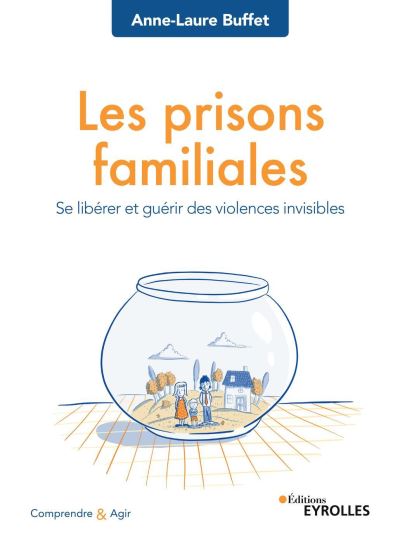
Psychological abuse leaves marks on the body too, and that connection is easy to overlook. Anne-Laure Buffet, who specialises in supporting victims of psychological abuse, stresses in her book on family prisons that psychic and physical pain are usually inseparable in the person who suffers it.
When emotions are forbidden or treated as dangerous, they do not disappear. They settle somewhere in the body, and that stored tension becomes a real physiological risk.

Quick takeaways
- Repressed emotions get stored in the body and become a real physical risk.
- Victims often treat physical pain the way they treat feelings: "I'll deal with it later."
- Ignoring pain weakens the body and dulls the internal compass of what is good for you.
- Healing means working on sensations and emotions at the same time.
- Rephrasing your inner questions shifts the focus from guilt to your own needs.
- Recovery is slow, and professional support matters alongside daily self-care.
Why emotions get locked away
For an adult or a child living under psychological abuse, emotions are often banned by the abuser, or the victim comes to see them as dangerous. Under that influence, the person is not allowed to express feelings, or even to have them. She must ignore or repress them, out of fear of the abuser's reaction.
This is close to what happens when a child is told to swallow tears instead of being comforted, a question explored in hold crying child. Repressed emotions do not vanish; they get stored in one or more parts of the body, which turns them into a physiological danger. Learning to read those signals is part of the broader work of children self improvement and of rebuilding trust in your own reactions.

The body treated like the emotions
Anne-Laure Buffet notes with regret that many adult victims treat their physical sensations exactly as they treat their emotions. Even when they are in physical pain, they say things like "I have to hold on for now, I'll deal with it later."
By ignoring physical pain, victims make it worse. This cut-off from emotions and this neglect of pain also weaken the body's ability to react, because they strip away the internal compass that says what is good or bad for you. It is a bit like ignoring a baby's distress signals, the theme of baby first days, until the whole system is exhausted.
A question that says it all
Buffet asks how anyone can accept themselves and define their needs and limits when they are nothing but suffering, dependent on treatment, feeling diminished, fragile and excluded from the world. That question explains why psychic and physical pain are generally inseparable.

| Old question | New question | What it changes |
|---|---|---|
| What did I get wrong? | Does this suit me? | Shifts blame to your own needs |
| Am I doing this right? | Do I have the ability to succeed? | Builds confidence instead of doubt |
| How can I please them? | What does this bring me? | Puts your wellbeing first |
| What can I do for the other? | Do I want to do this? | Restores free choice |
| Am I guilty? | What is actually my responsibility? | Separates your share from theirs |
Healing by working on both sides
Working on sensations and emotions at the same time is essential on the road back to yourself after psychological abuse. During recovery, emotions are tamed, understood and better adapted to the situations that come next. The victim can then feel her emotions physically again.
This is slow, patient work, closer to the gentle repetition of simple box play than to a single breakthrough. It also means learning to notice what your body is telling you before you push through, the same attentiveness you would give to parent child relationship signals in daily family life.
Changing the questions you ask yourself
For Anne-Laure Buffet, finding yourself again after being under the influence of psychological abuse means changing your questions. She writes that learning to rephrase the questions we ask ourselves endlessly opens the door to another understanding and to a reality that belongs to us.
So "What did I get wrong?", "Am I doing this right?", "How can I please them?", "What can I do for the other person?" and "Am I guilty?" become "Does this suit me?", "Do I have the ability to succeed?", "What does this bring me?", "What is actually my responsibility?", "Do I want to do this?" and "Who or what am I acting for?"
That reframing is a form of freedom, and it echoes the respectful alternatives to forced affection described in greeting without kisses. Healing, then, means opening up to the freedom to think and to change your thoughts.

Rebuilding limits and daily life
Once the internal compass returns, limits become easier to name and defend. Parents recovering from abuse often find this hardest with their own children, where old reflexes resurface; the practical ideas in first night away can help you rehearse small, safe separations. Reclaiming your body also means accepting its visible history, as with accepting stretch marks after pregnancy.
Rebuilding also means allowing yourself ordinary pleasures and gentle outings again, whether that is a calm walk like the family hiking routes you can manage at your own pace, or simply choosing toys and activities that feel safe and predictable, as with toys for one year.
None of this replaces professional support. It is simply the daily scaffolding that makes the deeper work possible.
My hands-on take
I have watched someone close to me hold on through pain for months, always saying she would deal with it later. What struck me most was not the pain itself but how naturally she dismissed it, as if her body were an inconvenience. When she finally started paying attention to small sensations, a tight jaw, a clenched stomach, the change was gradual but real.
What helped in practice was simple: naming one feeling a day, resting without guilt, and rewriting a single harsh question into a kinder one. None of it was dramatic. It was the quiet, repeated act of taking her own signals seriously again, and that turned out to matter far more than any grand gesture.
Frequently asked questions
Can psychological abuse really cause physical pain?
Yes. Repressed emotions get stored in the body, and the resulting tension is described as a genuine physiological danger. That is why psychic and physical pain are usually inseparable in victims.
Why do victims ignore their own physical pain?
They often treat physical sensations the way they were forced to treat emotions, postponing them with "I'll deal with it later." This neglect tends to worsen the pain and weakens the body's ability to react.
What does "changing your questions" mean in practice?
It means replacing guilt-driven questions such as "Am I guilty?" with questions centred on yourself, like "Does this suit me?" or "Do I want to do this?" This rephrasing opens the way to a reality that belongs to you.
Is self-work enough to recover?
Self-work on sensations and emotions is essential, but it is not a substitute for professional support. It is the daily scaffolding that makes deeper therapeutic work possible.
Product Reviews
 Best Toys for Dogs With High Prey Drive |
Best Outdoor Toys for 3-4 Year Olds |
Best Outdoor Toys for 6 Year Olds |
Best Harness for Poodle |
Best LEGO Sets for Adults |
Best Travel Toys for 4 Year Olds on Airplane |
Best Toy Stores in Washington DC |
Best Potty Training Toys |
Best Toys for Tripod Dogs |
Maillot equipe de france







