


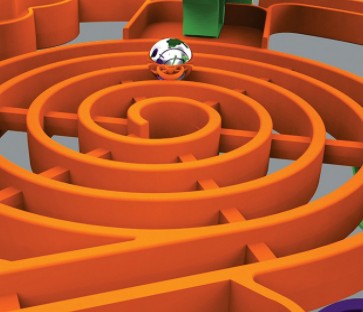
The Perplexus 3D maze ball is a sphere that holds a small marble you guide through a twisting labyrinth built inside it. The goal is simple to understand: move the marble from the start to the finish without letting it fall off the track.
What makes this maze unusual is that you cannot touch the marble directly. You rotate the whole sphere in your hands to tilt the path and roll the ball forward, which turns every move into a small exercise in control.

Getting started takes only a moment because the aim is obvious, yet finishing a route demands real patience, close observation and steady dexterity. It suits curious kids and adults alike.
Quick takeaways
- The Perplexus is a transparent sphere with a marble you steer through a 3D labyrinth by rotating the ball.
- It trains patience, observation, concentration, spatial awareness and logical thinking.
- Three routes of increasing difficulty keep the challenge fresh over time.
- Falling is part of the game; restarting builds persistence and calm problem-solving.
- Recommended from about eight years old, but adults enjoy it just as much.
- It is sold in toy shops, cultural centres and online stores.
What the Perplexus Maze Ball Actually Is
The Perplexus is a transparent sphere containing a three-dimensional labyrinth and a single marble. Instead of drawing a line on paper, you physically turn the ball so gravity carries the marble along the track, past obstacles and numbered checkpoints.
Because the path wraps around itself, the marble is sometimes underneath, sometimes on the side, sometimes tucked in a corner and sometimes caught in a spiral. Each of these positions asks for a different wrist movement and a different sense of where things are in space.
This is why the toy doubles as quiet training for spatial awareness and logical thinking. Children have to picture the route before they see it, plan a sequence of tilts and correct themselves when the marble slips. For younger players still building hand control, a set of fine motor toys can be a gentle warm-up before they tackle a sphere like this.

Patience, Observation and Concentration in Action
Nothing about the Perplexus rewards rushing. You progress slowly, hunt for the next number on the track, turn the sphere in every direction and learn to dose your speed so the marble does not fly off at a corner.
Sooner or later the marble falls, and that is part of the design rather than a failure. You start again, and each restart quietly trains the kind of focused attention that carries over into homework, reading and any task that asks a child to stay with something difficult.
Why the restarts matter
Falling teaches children to notice what went wrong a second before the drop: too much speed, a tilt that was too abrupt, a corner taken too loosely. That habit of reviewing a mistake and trying a calmer approach is exactly what builds persistence.
Parents often find the same effect at work in other slow, hands-on activities, from a calm sensory blanket corner for winding down to the steady focus children need for classroom breakfast routines before lessons begin.

| Feature | What it involves | Why it helps |
|---|---|---|
| Skill focus | Patience, observation, dexterity | Builds focus and hand control |
| Thinking skills | Spatial awareness, logic | Encourages planning ahead |
| Difficulty | Three routes, growing challenge | Keeps motivation over time |
| Age guide | From around 8 years | Matches hand control and patience |
| Adults | Equally enjoyable | Shared, screen-free challenge |
| Portability | One self-contained sphere | No loose pieces to lose |
Three Routes with Growing Difficulty
The sphere offers three separate routes, each with its own challenges to outsmart. One section hides the marble underneath, another sends it along a side channel, another traps it in a corner and another winds it through a spiral.
This staged structure is what keeps the toy interesting over months rather than an afternoon. A child can master the easier route first, then move to the next without the whole challenge feeling impossible.
The designers clearly enjoyed themselves, and the creativity shows in how many small surprises sit along each path. It is the kind of clever, low-noise play that fits naturally alongside other screen-free favourites, much like the classic building sets behind International Lego Day or the imaginative play sparked by children's movies with a real message.

Who It Suits: Age Range and Adults
The Perplexus is recommended from around eight years old, which matches the level of hand control and patience the routes demand. Younger children can still enjoy holding and turning it, but they may need help and a lot of encouragement.
Adults get just as much out of it. Many parents pick it up "just to try" and find themselves quietly determined to reach the finish, fingers and neurons both working hard.
It also travels well, since it is a single self-contained object with no loose pieces to lose. That makes it a practical choice for car trips, waiting rooms and quiet afternoons, in the same spirit as the compact fun found in airplane toys for long journeys. If you are choosing gifts for a slightly older child, the same "one clever object" logic applies to kindergarten graduation gifts.
Where to Buy and How to Get Started
Perplexus is sold in toy shops, cultural centres and online stores, so it is easy to find in most places. Before buying, check which version you are looking at, since different spheres offer different levels of difficulty.
When you first open it, resist the urge to chase speed. Start on the easiest route, learn where the first few checkpoints sit, and let your child set the pace. A short session of ten or fifteen minutes is plenty at first.
Keep the sphere somewhere visible rather than packed away, because it works best as a "pick it up for a minute" toy. Families who like active, physical play may also enjoy the outdoor energy of backyard toys or the teamwork lessons in team sports as a balance to this quieter challenge.



My hands-on take
I first handed the sphere to a child "just to see", and within minutes I was the one hogging it. What surprised me most was how quickly the obvious goal turned into a genuine puzzle: you understand what to do immediately, but your hands need time to catch up with your intentions.
In practice, I found short sessions worked best. We would take turns, laugh at the inevitable drops and stop before anyone got frustrated. The numbered checkpoints turned out to be the real hook, because hunting for the next number gave each attempt a small, reachable target instead of one distant finish line. I would recommend starting on the easiest route and leaving the harder ones for later, and keeping the sphere within reach rather than in a cupboard, since it works best as something you pick up for a few minutes at a time.
Frequently asked questions
What age is the Perplexus suitable for?
It is recommended from around eight years old, when most children have the hand control and patience the routes require. Younger children can still explore it with help and encouragement.
How does the Perplexus work?
A marble sits inside a transparent 3D labyrinth, and you rotate the whole sphere to roll it from start to finish. You never touch the marble directly, so every movement is controlled through the ball.
Is it only for children?
No. Adults often find it just as engaging and quietly competitive, since the challenge scales with how precisely you can tilt and control the sphere.
What happens if the marble falls?
You simply start again from the beginning of that route. The restarts are part of the learning, teaching children to slow down, notice their mistakes and try a calmer approach.
Product Reviews
 Best Toys for Dogs With High Prey Drive |
Best Outdoor Toys for 3-4 Year Olds |
Best Outdoor Toys for 6 Year Olds |
Best Harness for Poodle |
Best LEGO Sets for Adults |
Best Travel Toys for 4 Year Olds on Airplane |
Best Toy Stores in Washington DC |
Best Potty Training Toys |
Best Toys for Tripod Dogs |
Maillot equipe de france







