


Child creativity works like oxygen for a young mind, and the adults around a child shape how freely that creativity breathes. Julia Cameron, in her book on liberating children's creativity, uses the phrase "believing mirrors" for the adults who guide children.
Believing mirrors are people who see the best in those around them and reflect back an image that is larger and more remarkable than the one the child holds of themselves. They notice potential, talents, passions and desires, and they welcome ideas with enthusiasm and confidence.

Becoming that kind of mirror for our children may require some work of reconnection with the creative part inside ourselves first.
Quick takeaways
- A believing mirror sees a child's potential and reflects it back generously.
- Creativity works like oxygen for a child's mind and needs room to breathe.
- Forcing children into narrow boxes invites rebellion, not growth.
- Small gestures, like showing up and laughing together, build creative confidence.
- Free, unstructured time lets imagination move into real making.
- Reflecting on your own believing mirrors helps you become one for your child.
What a believing mirror actually does
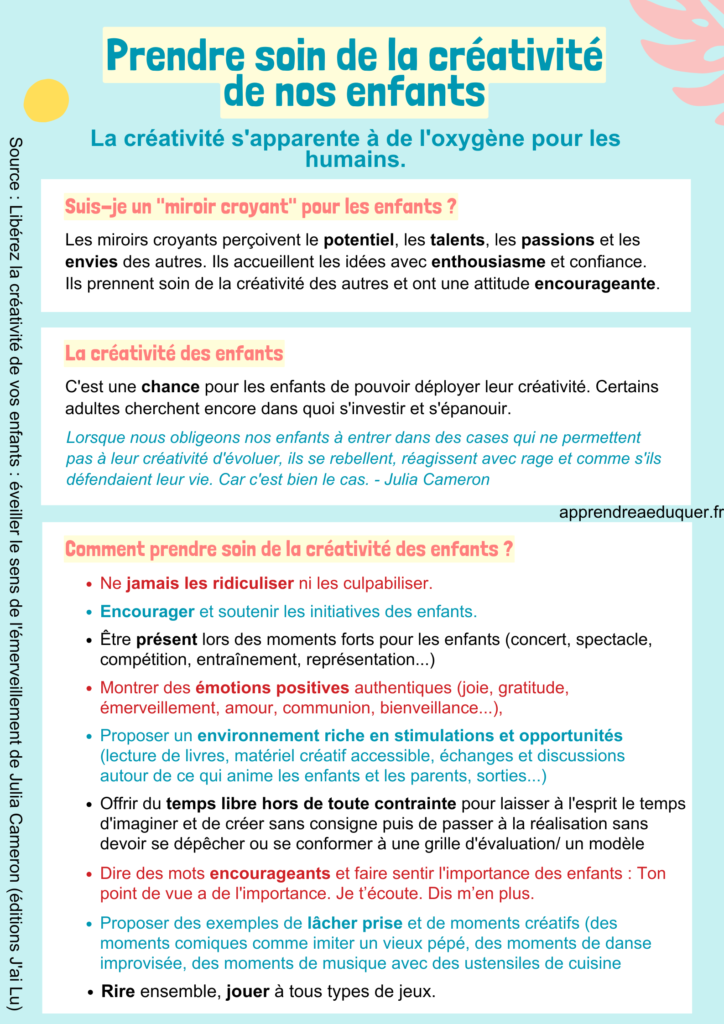
A believing mirror perceives the potential, talents, passions and desires of others. This allows them to welcome ideas with enthusiasm and confidence, to take care of other people's creativity and to hold an encouraging attitude. Cameron believes we should all be believing mirrors for our children.
This posture is not about empty praise. It is about genuinely seeing what is there and naming it back to the child. When we take care of our inner artist by encouraging and respecting it, we understand how to encourage and respect the inner artist of our children. When we reflect back their main and most valuable qualities, they develop accordingly and grow to fulfil their creative potential.
Adults are not so different from children in this respect. We all need someone who sees us clearly and kindly, and children simply need it earlier and more often.
Why creativity is like oxygen
For Cameron, creativity is akin to oxygen for a child's mind. When we force children into boxes that do not let their creativity evolve, they rebel, react with rage and behave as if they were defending their lives. Because, in a real sense, they are.
It is even a stroke of luck for some children to find their passions early and to be able to unfold their creativity. Plenty of adults are still searching for what to invest in and where to thrive, which is why early encouragement matters so much.
We are all meant to create. This can show up in many ways, and those who can practise, embody and pass on the act of creating are the believing mirrors we all need. As our attentive gaze reminds us, children build themselves through being seen. If your child's behaviour feels like constant pushback, it may be worth asking whether the environment is simply too narrow, a question explored in children misbehaving. The same respect for rhythm applies to milestones like removing the diaper.
| Behaviour | What it looks like | What it builds |
|---|---|---|
| Never ridiculing | Accepting an odd idea without mockery | Safety to experiment |
| Showing up | Attending the concert or match | Feeling valued |
| Offering free time | Unstructured hours with materials | Imagination and follow-through |
| Modelling letting go | Dancing or silly voices at home | Permission to play |
| Encouraging words | "Your point of view matters" | Confidence and identity |
Everyday ways to be a believing mirror
This posture can take many forms, some of which may seem tiny or insignificant in our eyes. Never ridicule or shame children, and encourage and support their initiatives. Be present at the moments that matter to them, such as a concert, a show, a competition, a training session or a performance, because your presence teaches children that you are happy to see them happy too.
Show authentic positive emotions such as joy, gratitude, wonder, love and kindness. Offer an environment rich in stimulation of every kind: books and stories, accessible creative materials, conversations about what animates children and parents, outings, and adapted approaches such as the Reggio Emilia pedagogy.
Give free time away from any constraint, so the mind has room to imagine and create without instructions, then move to making without rushing or conforming to a model. Creativity rests on specificity and precision, meaning on what is well imagined. Say encouraging words and make children feel their importance and uniqueness: "Your individual point of view matters. I want to listen to what you see and what you think."
Modelling creative freedom and letting go
Offer examples of letting go and of creative moments, without needing to be an artist. This can be comic moments such as imitating an old grandpa, spontaneous dancing, making music with kitchen utensils while preparing dinner, or trying out new recipes. Laughing together counts too.
These small scenes teach children that creating is ordinary, available and allowed. A home stocked with open-ended materials makes this easier, and the ideas in screen free toys can help you build a play space that invites invention rather than passive consumption. When a child has something to build, draw or assemble, the imagination has somewhere to land.
If you are unsure where to start, look at how other families arrange their play areas. Guides such as outdoor toys and science toys show how a single good object can open a whole direction of exploration for a curious child.
Reflecting on your own believing mirrors
Cameron invites us to spend a moment thinking about our own believing mirrors. Who in my life was one of my believing mirrors? What did that person show me about myself? These questions often surface a teacher, a grandparent or a friend whose faith in us quietly changed our trajectory.
We can do the same exercise for our children. Am I myself a believing mirror for them? Are they surrounded by believing mirrors? Are there others we could invite into the children's lives? A neighbour who loves gardening, an uncle who plays guitar or a friend who draws can all become part of that circle.
This reflection is also a reminder of how much children absorb from the adults around them. The idea that parents are a mirror children look into every morning, explored in pediatrician reflection, captures the same principle from a health perspective. Everyday habits like teaching your child their teeth show how much children learn by copying what they see. Building that circle takes patience, and it helps to remember that rest and support matter too, as relieve fatigue explains for new parents. Sharing books that teach routines can gently reinforce these everyday lessons.

My hands-on take
I tried the believing mirror idea on a rainy afternoon when my child presented me with a drawing I genuinely did not understand. Instead of asking what it was supposed to be, I asked what was happening in the picture, and the answer turned into a twenty-minute story about a city under the sea. That small shift, from judging the result to welcoming the idea, changed the mood of the whole afternoon.
What has stuck with me most is the free-time part. I used to fill every gap with an activity, and I noticed the resistance that followed. Now I leave a stretch of the day deliberately empty and keep paper, tape and old boxes within reach. Some days nothing happens. Other days something gets built. Either way, my child learns that their own ideas are worth following, and I learn to be a little less of a director and a little more of a mirror.
Frequently asked questions
What is a believing mirror?
It is a term from Julia Cameron for an adult who sees the best in a child and reflects back a larger, more remarkable image of them. Believing mirrors notice potential, talents and passions and welcome ideas with enthusiasm.
Why is creativity compared to oxygen?
Cameron suggests creativity is as essential to a child's mind as oxygen is to the body. When children are forced into boxes that block creative growth, they react as if defending their lives.
Does being a believing mirror mean never correcting a child?
No. It means avoiding ridicule and shame while still guiding behaviour. Encouragement and honest, respectful feedback can coexist.
How can I start if I don't feel creative myself?
Start small with spontaneous dancing, silly voices or kitchen-utensil music. These moments show children that creating is ordinary and allowed, and they help you reconnect with your own inner artist.
Product Reviews
 Best Toys for Dogs With High Prey Drive |
Best Outdoor Toys for 3-4 Year Olds |
Best Outdoor Toys for 6 Year Olds |
Best Harness for Poodle |
Best LEGO Sets for Adults |
Best Travel Toys for 4 Year Olds on Airplane |
Best Toy Stores in Washington DC |
Best Potty Training Toys |
Best Toys for Tripod Dogs |
Maillot equipe de france







