


Helping children respect rules starts with how we phrase them. Instead of describing what we do not want, we can state clearly what we expect the child to do, giving a clean picture of the behaviour ahead.
The PARCA acronym keeps five communication principles in mind: Precision, Abbreviation, Repetition, Contact and Affirmation. Each one turns a vague demand into something a child can actually understand and carry out, whether at home, in the car or at bedtime.

Quick takeaways
- State what you want, not what you don't want
- Give one or two instructions at a time
- Show the action with gestures and move with the child
- Ask the child to repeat the rule back to check understanding
- Make eye contact and get down to the child's level
- Name the feeling before redirecting behaviour
1. Precision: say exactly what you expect
A precise, explicit instruction lets a child understand exactly what is expected. “Tidy your room” is far too vague, especially for young children and for children with attention difficulties. An effective instruction details the actions and their order, and it is delivered face to face rather than shouted from the bottom of the stairs.
We often assume children are not listening when in fact we have not spelled out the behaviour. “Clear the table” may mean plates and cutlery into the dishwasher, wrappers in the bin and a wipe over the surface — or, to the child, simply plates in the sink. Breaking tasks into small steps works the same way as teaching tooth brushing: one action, then the next. The same goes for the everyday phrases you repeat, as these common parenting phrases show.
What it sounds like
“Time to put the bike in the shed and close the door, then into the car.” “Let’s start with the cubes — they go in the toy chest, like this. Now the cuddly toys in their box. Now clothes in the laundry basket.” “One arm through this sleeve, now the other, and let’s pull up the zip.” Clear steps also help at mealtimes, as with fun character meals.

2. Abbreviation: fewer words, more movement
Rules that are too long or too numerous are less likely to be understood or followed. Give one or two instructions at a time, then ask the child to come back once they are done before adding the next. Showing the action with gestures, not just words, makes it clearer — invite the child to repeat the gesture or do it alongside you, such as stroking the cat rather than pulling its ears or tail.
Speaking less and offering fewer choices brings more fluidity and less stress to daily interactions. Parents can simply get moving while announcing that it is time to go out, sit at the table or wash, and children follow because the adult acts with decision. No threats, no rushing — the child steps into the sequence because it is simply what happens next. This mirrors the simple, step-by-step approach used in easy tie dye activities.
Catching a child’s attention may mean “parallel parking”: standing beside the child rather than opposite, without imposing, showing you understand the moment is hard. Say little (“That seems difficult for you”), wait for the child to relax, and perhaps sit doing something quiet nearby, like sewing or leafing through a book. It also echoes the curious scientific facts about how parental presence shapes cooperation.

| Principle | Weak version | Stronger version |
|---|---|---|
| Precision | "Tidy your room" | "Cubes in the chest, then clothes in the basket" |
| Abbreviation | A long list of rules | One or two instructions, then check back |
| Repetition | Assuming it was heard | "Tell me what you remember" |
| Contact | Shouting from the stairs | Eye level, hand on shoulder |
| Affirmation | "Stop running" | "Walk please, next to me" |
3. Repetition: check that the rule landed
Asking children to repeat a rule back confirms that they have not only heard it but understood it. Before expecting a rule to be respected, check comprehension with simple questions: “How do you understand my request?”, “Could you tell me what you remember?”, “Why do you think I am asking this?”
You can also check by naming what is already done: “The books are on the shelf and your dirty trousers are in the basket. Only a T-shirt is left on the floor — do you remember where T-shirts go?” This turns a correction into a small, confidence-building quiz rather than a telling-off.
Repetition also pays off with routines that children must eventually own themselves, much like the habits behind protecting children's backs or the daily grooming steps we teach early on. The goal is understanding, not obedience for its own sake.
4. Contact: connect before you correct
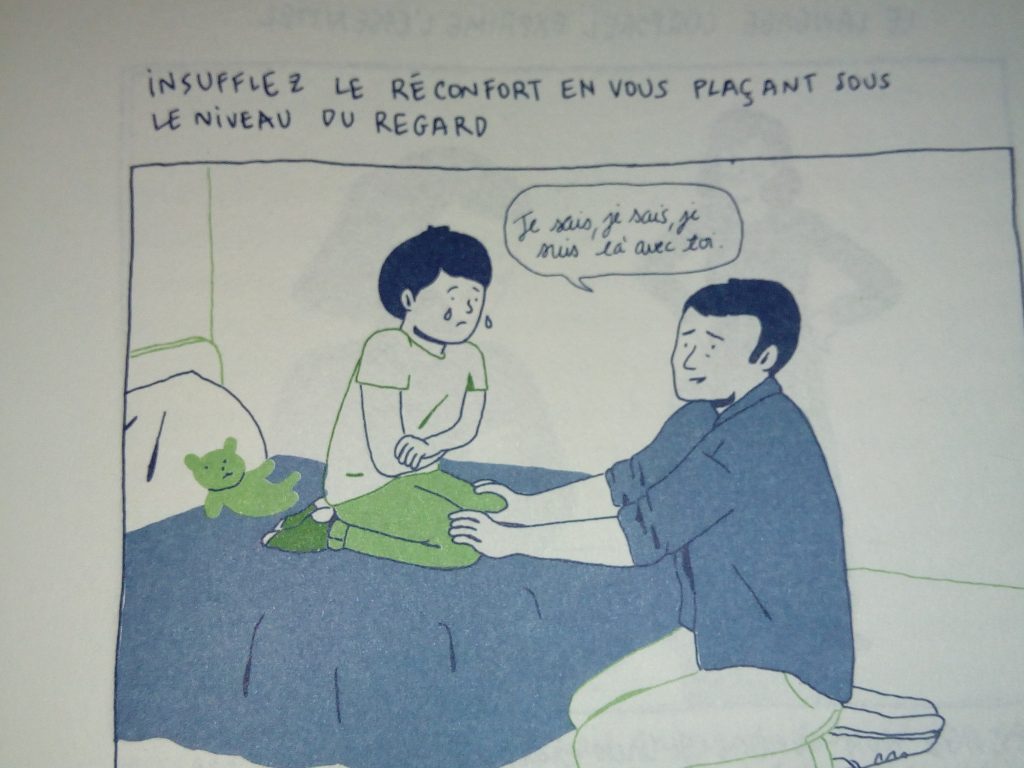
Establishing eye contact, and even physical contact — a hand on the shoulder, hands held in hands, a child on an adult’s lap — matters. A child who is playing or watching a screen is unlikely to hear, let alone understand, a reminder of the rule. Nobody needs to shout at a child who behaves inappropriately: an adult can gently take a hand and redirect the behaviour, without threat or criticism.
According to child neuroscientist Daniel Siegel, one of the fastest ways to inspire trust and cooperation is to position yourself below the child’s eye level with a relaxed, calming posture. Without opening your mouth, you are already saying a great deal.
Small moments, big effect
These calm redirections build the same quiet trust we rely on during everyday care, from the first shave to settling a toddler who throws himself out of the. Children receive what they need: help, gentle redirection and confidence.

5. Affirmation: say what to do, not what to avoid
A request phrased affirmatively tells children what we want them to do rather than what we want them to stop. Saying what we do not want does not automatically make the desired behaviour obvious. When a rule is stated positively, the brain can more easily process the request and build a different action.
For effective redirection of inappropriate behaviour, first connect emotionally: “You are angry”, “You feel like…”, “You think…”. Naming the feeling helps the child settle before any instruction lands, and it keeps the adult’s tone steady rather than escalating.
This positive framing is the same principle behind the values of Thanksgiving shared around a table, or the encouragement we offer when a child tries something new such as baby water stimulation classes. Say the wanted action, and repeat it calmly until it becomes the habit.

My hands-on take
I started using these ideas on school mornings, when the old routine was a stream of reminders shouted from the kitchen. Now I go to my child, crouch down and give one instruction — shoes on, then bag by the door — and I wait. If I need a second step, I ask them to come back first. It feels slower for about a minute, then it is faster for the rest of the morning.
The parallel parking idea was the biggest surprise. Sitting beside my child on the floor, saying almost nothing, and letting them calm down before I ask for anything has defused more standoffs than any lecture. I still forget and shout sometimes, but naming the feeling out loud usually gets us back on track.
Frequently asked questions
Why is "tidy your room" not an effective instruction?
It is too vague for a child to picture the expected actions. A precise version names the steps and their order, so the child knows exactly where to start and what comes next.
What should I do if my child is absorbed in a screen?
Get close, make eye contact and perhaps touch a shoulder before speaking. A child who is playing or watching is unlikely to hear a rule called across the room.
Does repeating a rule mean nagging?
No. It means asking the child to say the rule back so you can check understanding. Questions like "How do you understand my request?" turn it into a short, calm exchange.
How do I phrase a rule positively?
Say the behaviour you want: "Walk next to me" instead of "Stop running". Naming the feeling first ("You are angry") helps the child settle before the instruction lands.
Product Reviews
 Best Toys for Dogs With High Prey Drive |
Best Outdoor Toys for 3-4 Year Olds |
Best Outdoor Toys for 6 Year Olds |
Best Harness for Poodle |
Best LEGO Sets for Adults |
Best Travel Toys for 4 Year Olds on Airplane |
Best Toy Stores in Washington DC |
Best Potty Training Toys |
Best Toys for Tripod Dogs |
Maillot equipe de france







