


Educational toys turn a child's natural curiosity into real learning, because children discover the world by handling, testing and playing. Memory, logic and imagination all get a workout when a toy invites a child to try something and see what happens.
Not every activity works the same way, though. Some toys suit a toddler who is still learning to grip, while others fit a preschooler ready to follow rules. Matching the toy to the child's stage, interests and level of independence matters more than buying the biggest box.

Quick takeaways
- Educational toys build memory, logic, imagination and problem-solving through hands-on play.
- Board games teach rules, turn-taking and how to accept losing.
- Role play develops imagination and empathy by letting children try other points of view.
- Puzzles and construction train fine motor skills, spatial logic, creativity and persistence.
- Check safety, materials and age suitability before choosing a toy.
- Match the toy to the child's stage and interests rather than to trends.
What counts as an educational toy?
Educational toys come in many shapes: puzzles, board games, early-learning toys and structured learning sets. Each one targets particular abilities, and the right pick depends on the child's age, mood and how much they can do alone.
A good toy leaves room for repetition. Children often return to the same puzzle or game for weeks, and that repetition is where the learning settles in. Rotating a small selection rather than piling up new things keeps interest alive without overwhelming anyone.
It also helps to watch how your child plays before buying. A child who loves sorting will take to matching games, while a builder may prefer construction sets. Following that lead makes the toy more likely to be used again and again.
Board games and role play: learning to be with others
Board games and role-play activities let children learn while having fun. Board games teach them to follow rules, accept losing and play alongside others, which is a big step for a young child.
Role play works differently. Dressing up and acting out a character feeds imagination and empathy, because the child tries on another point of view and slowly learns to name their own emotions. That emotional vocabulary grows through practice, much like the everyday bond described in parental education teamwork.
These games also build patience. Waiting for a turn, sitting through someone else's move and coping with a lost round are small frustrations that add up to real self-control. Parents can help by naming feelings out loud and keeping games short enough to end on a good note. The same care applies to everyday products, as explained in our guide to choosing nipple creams, and remember to use gel carefully around little ones.
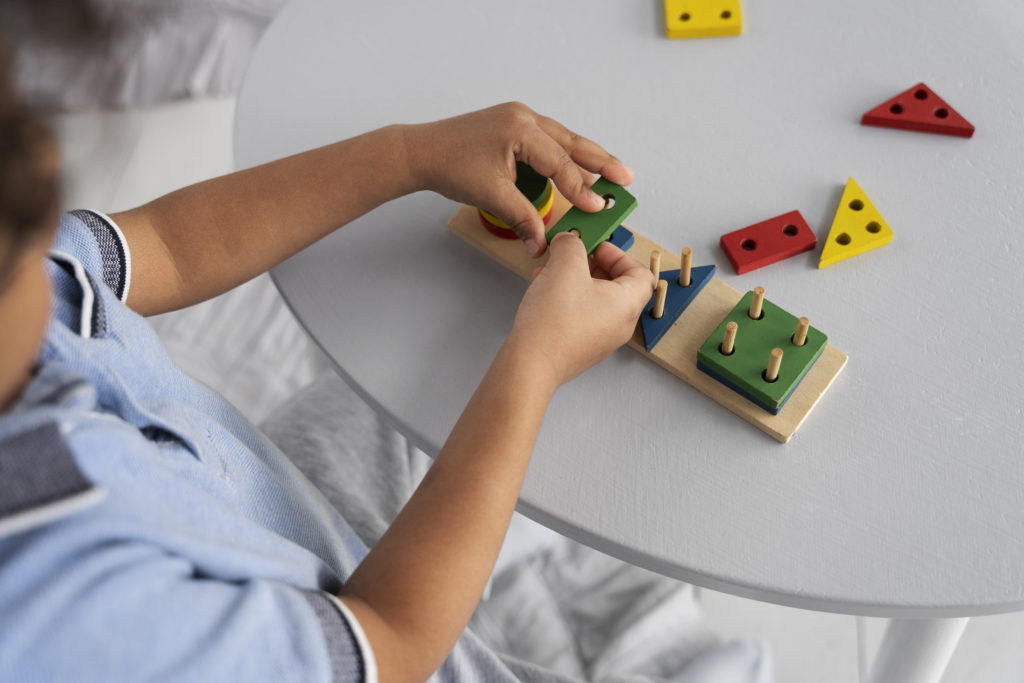
| Age or stage | Good toy types | Main skills developed |
|---|---|---|
| Under 3 | Stacking, nesting, handling toys | Fine motor skills, sensory discovery |
| Around 4 | Puzzles, sorting games, first board games | Logic, concentration, rule-following |
| Early school years | Letter and number sets, construction kits | Early literacy, numeracy, spatial logic |
| Any age | Role-play props, open-ended building | Imagination, empathy, creativity |
| Buying check | Solid materials, child-safe finishes, clear age label | Safety and durability |
Puzzles and construction: hands, logic and persistence
Puzzles and construction toys ask children to handle pieces, fit shapes together and hunt for solutions. These activities build concentration, logic and creativity, and they quietly train several skills at once.
Fine motor skills
Gripping and placing small pieces helps a child control their movements, which later supports holding a pencil. The same steady hand practice matters when children move on to learning to write.
Spatial logic and creativity
Assembling shapes teaches how pieces fit together, while building without a model gives children room to invent their own creations. Displaying finished builds, even on a simple shelf, shows that the effort counted.
Concentration and persistence
Finishing a puzzle encourages a child to stay attentive to the end. When a piece doesn't fit or a tower collapses, they learn to try again, a habit that carries into toys for toddlers and beyond. Simple travel games can reinforce this same patience on the go.
The everyday benefits of educational play
Educational toys help children build logic, memory and problem-solving skills. With regular play, they learn to think before acting and to look for a solution instead of giving up.
These activities also support emotional regulation. Waiting a turn, accepting a loss or facing frustration gets easier with practice, and the calm reassurance of a parent makes a real difference here.
Role play adds empathy to the mix. Playing a character lets a child explore other ways of thinking and better understand what others feel. That same social confidence shows up in group settings, from speech therapy play to the first days at nursery. Choosing learning toys that match each stage keeps that progress steady.
None of this requires expensive equipment. A few well-chosen puzzles, a simple board game and a box of building pieces cover most of these benefits, as long as they match the child's stage. Just as adults rebuild their lives after a separation, as explored in rebuilding after divorce, children rebuild confidence through play.

How to choose the right educational toy
Safety comes first. Solid wooden toys tend to withstand heavy use, and paints and finishes should be suitable for children. Check the manufacturer's notes on materials and conformity with safety standards before buying.
Age matters too. Before three, stacking, fitting and handling toys stimulate motor skills. From about four, puzzles, sorting games and first board games develop logic. The child's abilities and interests remain the best guide.
Think about the play space as well. A toy that needs a flat surface and quiet time suits a corner of the living room, while a compact game travels well. Practical details like storage and piece count often decide whether a toy gets used.
Finally, consider how the toy fits family life. A game everyone can join gets played more often, and shared play builds the kind of closeness described in family time memories.
Matching toys to your child's stage
Every stage brings new needs, and the toy shelf should shift with them. A baby exploring textures and sounds needs different stimulation than a four-year-old learning letters and numbers.
For the youngest children, early-learning toys that stack, nest or manipulate are the foundation. As coordination improves, puzzles and sorting sets take over, followed by games with simple rules and letter or number supports.
Older children can handle new learning challenges while still having fun, which keeps motivation high. A toy that is slightly too easy bores them, while one that is far too hard frustrates them, so aim for the sweet spot just beyond what they can already do.
It also helps to revisit old favourites. A puzzle a child abandoned months ago may suddenly click, and that success builds confidence for the next challenge.
My hands-on take
I learned the hard way that more toys do not mean more play. For a while our shelf was crowded, and my child flitted from one thing to the next without finishing anything. When we packed most of it away and kept out one puzzle, one building set and a simple board game, something shifted. The puzzle got finished, then done again the next day.
What surprised me most was the persistence. A tower fell over three times in a row, and instead of walking away my child rebuilt it, talking through each step out loud. I stopped jumping in to help and just sat nearby. That small change, plus choosing toys by what my child actually reached for rather than what looked impressive in the shop, made playtime calmer and far more productive.
Frequently asked questions
Are educational toys really better than ordinary toys?
They are not automatically better, but they are designed around a specific skill such as logic, memory or motor control. Ordinary toys can be just as valuable when they invite open-ended play and imagination.
How many educational toys does a child need?
A small, rotating selection works better than a large pile. A few puzzles, one or two board games and a box of building pieces cover most developmental needs without overwhelming a child.
At what age should I introduce board games?
Simple games with few rules usually suit children from around four, when they can follow instructions and wait a turn. Start with short rounds and expect to model the rules several times.
How do I know if a toy is safe?
Check the manufacturer's age recommendation, material information and conformity with safety standards. Look for solid construction and finishes suitable for children, and inspect pieces regularly for wear.
Product Reviews
 Best Toys for Dogs With High Prey Drive |
Best Outdoor Toys for 3-4 Year Olds |
Best Outdoor Toys for 6 Year Olds |
Best Harness for Poodle |
Best LEGO Sets for Adults |
Best Travel Toys for 4 Year Olds on Airplane |
Best Toy Stores in Washington DC |
Best Potty Training Toys |
Best Toys for Tripod Dogs |
Maillot equipe de france







