


The anger thermometer is a small, practical tool you can introduce to children to help them tame anger and discharge its energy before it turns into violence. Like every emotional education tool, it works best when you present it while everyone is calm, never in the middle of a meltdown.
It suits children from around six years old and up, and it costs nothing more than a printed sheet and a few crayons. The idea is simple: give a child a way to see anger, name it, and choose a physical outlet before the feeling overflows.

Quick takeaways
- Present the anger thermometer while everyone is calm, never mid-crisis
- Let the child colour the level of a real, recent anger
- Write triggers on the left, helpful outlets on the right
- Name and accept the anger before trying to calm it
- Offer physical discharge instead of saying “calm down”
- Practise slow breathing together, at least three times
What the anger thermometer actually is
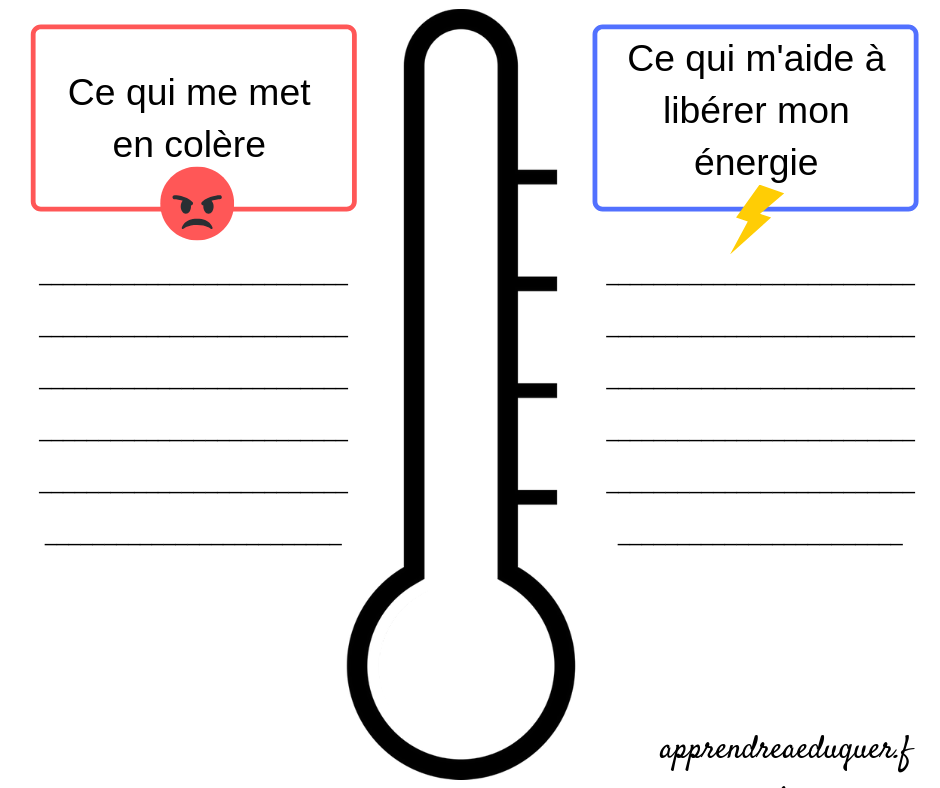
The anger thermometer is a drawing of a blank thermometer that a child fills in with colour. Ask them to think of a recent situation and colour the thermometer in red up to the level of anger they felt. A very strong anger reaches the top, a strong anger stops at the last line, and a small anger only colours the first line.
This visual scale does something words alone struggle to do: it turns an abstract, overwhelming sensation into something a child can point at. It also shows that anger comes in degrees, so a child learns to notice the difference between mild irritation and a feeling that is about to boil over.
Why the visual scale helps
Seeing the level marked on paper makes the emotion feel more manageable and less frightening. It gives both of you a shared reference point you can return to later.
Filling in the two sides of the sheet
Once the colouring is done, children write on the left side of the thermometer the causes of the anger they thought about, and on the right side what could have helped them release the anger energy while they were in that state. These strategies become a personal menu they can draw on in the future to avoid violence when anger rises.
A typical answer might read, on the left: “I am angry when my friend doesn't want to play with me,” with the colouring reaching the last line. On the right: “what helps me is shouting into an anger box to discharge my anger,” or “what helps me is stomping my feet,” or “what helps me is taking three big breaths.”
Other outlets you can suggest include drawing the anger, throwing a rolled-up sheet of paper as hard as possible, going outside for fresh air, running, drinking a large glass of water, isolating for a moment, shaking the hands and arms for as long as needed, or pushing hard against a wall. Some families find that sibling friction is the most common trigger, and the sibling fight solutions follow a similar logic of naming and discharging. Just as with choosing nipple creams and planning milk for daycare, a little preparation makes the hard moments easier.
| Level on thermometer | What it may look like | Strategy to offer |
|---|---|---|
| First line (small anger) | Slight irritation, sulking | Name the feeling, take a big glass of water |
| Middle lines (strong anger) | Raised voice, tense body | Shake hands and arms, push against a wall |
| Last line (very strong anger) | Shouting, urge to hit | Shout into an anger box, run, go outside |
| Any level | Child cannot settle | Breathe together with long exhales, three times |
| After the episode | Calm has returned | Review the sheet and update strategies |
Naming anger before trying to calm it
Adults can tell children that the first thing to do when they are angry is to become aware that they are angry and to accept it without trying to minimise it. Naming the anger already reduces its intensity. This is the foundation of all the happy family keys that make a home feel safe.
When a child feels their anger is so strong it will overflow and turn into violence, they can then look for a way to discharge it or calm down. That is exactly where the thermometer becomes useful, because it points to the level and to the matching strategy.
Children who struggle to identify what they feel often benefit from hearing adults talk about emotions out loud. Everyday moments, even the funny kid quotes that make everyone laugh, can become openings for that conversation.
Breathing together when the storm is high
Facing an angry child who cannot calm down, an adult can offer to breathe deeply with long exhales. Try a tandem exercise: breathe in through the nose, feel the air entering, feel the belly inflating like a soap bubble, then the belly deflating as you exhale slowly and for a long time through the mouth. Repeat at least three times.
Doing it alongside the child matters more than instructing them. Your own slow rhythm gives them something to borrow when their own regulation is offline, much like the steady presence described in the Kristeller maneuver article. If you are looking for calm, screen-free activities to fill the rest of the day, the outdoor toys list offers plenty of physical outlets.
What not to say
Telling a child “Calm down!” is not effective. We often try to calm angry children when what they actually need is to discharge their energy so it doesn't stay locked in tension. It is better to put words on the anger (“Wow, I can see you are really angry, you are more than furious!”) and to accompany them with the calm you expect from them, offering to discharge the anger energy until calm returns.
Some children respond better to movement than to talk, so keep a few bath toys or squeeze toys within reach for the evenings when tension builds, just as you might follow the guidance on children's knives to build confidence step by step.

Building the habit over weeks
The thermometer is not a one-off worksheet. Revisit it regularly, at calm moments, and let the child update their strategies as they discover what truly works for them. A short review after a difficult episode, once everyone is settled, teaches reflection without shame.
Keep the language neutral and curious rather than corrective. The goal is not a child who never gets angry, but a child who recognises the signal early and knows several safe ways to let the energy out. Pair the tool with predictable routines, since predictability lowers the number of surprises that spark anger in the first place.
If your child is heading into a new environment such as a school trip, rehearse the strategies beforehand so they feel equipped away from home, much like preparing for the questions in this school trip.

My hands-on take
I first tried the anger thermometer on a rainy afternoon, long after the last argument, with a fresh sheet and a red crayon on the kitchen table. My child coloured almost to the top for a fight over a game, then sat quietly and wrote “shout into a cushion” on the right side. The surprise was not the strategy but the calm that came with choosing it themselves.
What I learned is that the sheet has to stay visible. Ours lives on the fridge, and we update it every few weeks. When a storm starts, I no longer say “calm down”; I point at the thermometer and ask which level we are at, then offer the matching outlet. It does not fix everything, but it gives us a shared language and a way out of the tension.
Frequently asked questions
At what age can I introduce the anger thermometer?
It is designed for children from around six years old and up, once they can think about a past situation and colour a scale. Younger children can still use the breathing and movement ideas with adult support.
Should I use it during a tantrum?
No. Present it at a calm, dedicated moment so the child learns the tool without pressure. During a crisis, offer breathing or a physical outlet instead.
What if my child cannot think of any strategy?
Offer a short menu drawn from the article, such as stomping feet, throwing a rolled-up sheet, running, drinking water or isolating for a moment. Let them pick what appeals to them.
Does naming the anger really help?
Yes, naming an emotion and accepting it without minimising it already reduces its intensity. It also gives the child language to use next time.
Product Reviews
 Best Toys for Dogs With High Prey Drive |
Best Outdoor Toys for 3-4 Year Olds |
Best Outdoor Toys for 6 Year Olds |
Best Harness for Poodle |
Best LEGO Sets for Adults |
Best Travel Toys for 4 Year Olds on Airplane |
Best Toy Stores in Washington DC |
Best Potty Training Toys |
Best Toys for Tripod Dogs |
Maillot equipe de france







