


Vocabulary games for kids turn everyday talk into a language workout, and most of them need nothing more than a few cards, a pencil or a lively imagination. They work at school and at home, and you can start with children as young as two.
The principle is always the same: play first, learn along the way. Each game below builds a different skill, from spotting word roots to sorting the world into categories, and all of them grow with your child.

Quick takeaways
- Start early: most of these games work from age two with simple associations.
- Word families teach children to decode new words from familiar roots.
- Sorting cards builds categories, reasoning and clearer expression.
- Oxymorons and word mix-ups make meaning playful and flexible.
- Homemade picture dictionaries and alphabet books add writing and memory.
- Same-letter sentences turn sound awareness into a silly family game.
1. Words from the same family
With the youngest children, work by association. If your child asks what a fin is, ask whether they hear a familiar word hiding inside it. When they answer “swim”, you can explain that a fin is the part of a fish’s body used for swimming: fin and swim share a root and a meaning.
Done often, this habit gives children a strategy for decoding new words from known ones, which builds both autonomy and knowledge of the world. For older children, take turns finding family words from simple to complex: dent, dentist, dental, denture. Whoever runs dry loses and launches the next idea.
Why it works
Morphology, the study of word parts, is one of the most transferable language skills a child can practise. It also pairs naturally with the gradual, child-led pace described in evolutionary process, where the adult follows the child’s curiosity rather than forcing a lesson.
2. Sorting games with categories
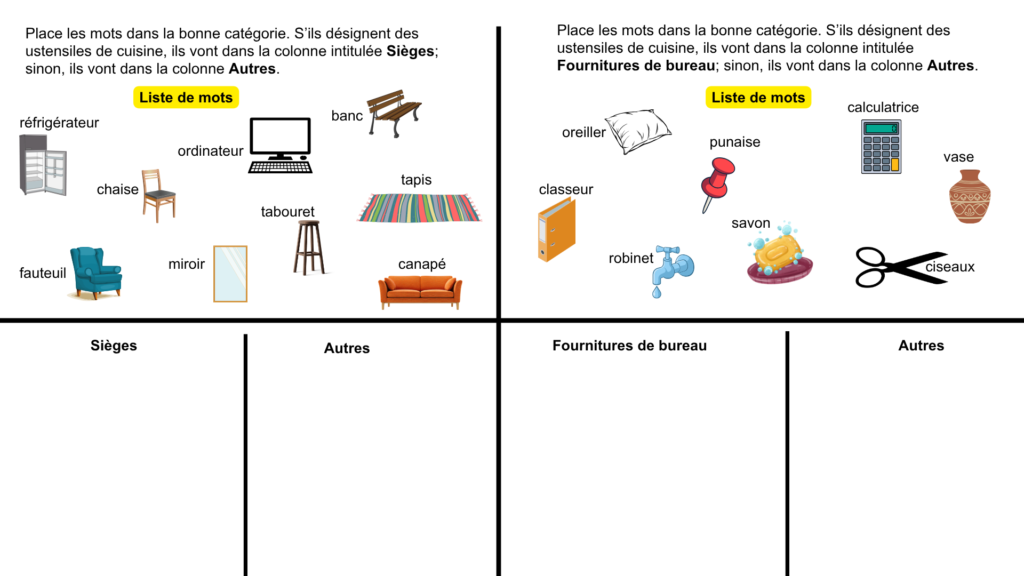
Use cards showing objects, animals, jobs or people; old memory cards work well, or cut pictures from flyers. Start two categories yourself, fruit on one side and vegetables on the other, then ask your child to place the remaining cards. Add categories, cards and intruders as they grow.
You can also lay out several groups and ask the child to name them from the similarities they notice, hide an intruder in a category, or let them invent their own coherent groups. A final variation: show a series representing one category and ask them to swap one card for another from the table without breaking the logic.
This kind of sorting is the backbone of early vocabulary work in the first school years, where the goal is to structure the lexicon, reason about relationships between words and improve both comprehension and expression. A calm, well-organised play space helps, much like the prepared environment of the Montessori method. Keep the table and cards clean between sessions, and you can make disinfecting wipes at home for quick wipe-downs. These games also travel well, so they are handy for family outings.
| Game | Best age range | Main skill built |
|---|---|---|
| Word families | 3 and up | Decoding new words from roots |
| Category sorting | 2 and up | Grouping, reasoning, expression |
| Oxymoron battle | 7 and up | Playing with opposites and meaning |
| Personal picture dictionary | 2 to 6 | Naming, world knowledge, drawing |
| Homemade alphabet book | 4 and up | Letters, sounds, spelling, writing |
| Same-letter sentences | 6 and up | Sound awareness, word recall |
3. The oxymoron battle
An oxymoron pairs two words with opposite meanings to create a contradictory expression that captures something impossible or absurd. The game is simple: each player invents one, and the strangest wins.
Famous examples show how powerful the device can be: “this obscure clarity falling from the stars”, “young old man”, or “sweet violence”. Inventing oxymorons pushes children to think backwards and sideways, playing with meaning rather than simply memorising it.
For a quieter version, write the pairs on paper and illustrate them; the drawing often reveals whether the child has truly grasped the contradiction. Creative word play of this kind sits comfortably alongside open-ended toys and the imaginative freedom explored in toys for five year olds.
4. Picture dictionaries and homemade alphabets
Picture dictionaries present an image with the word for the object, animal or person shown, usually grouped by theme. They are excellent supports for building vocabulary and world knowledge, but avoid freezing one representation of a thing: a seed is not always a bean seed, and a grizzly may go unrecognised by a child who has only seen teddy bears. Keep several picture books, or choose ones that show different images for the same word.
Better still, make a personal picture dictionary together, gluing in photos and drawings your child chooses. A homemade alphabet book works the same way: one letter per page, with words and images in alphabetical order. It trains letter order, letter shapes, sounds, spelling and memory, and gives your child a reason to write.
These projects are ideal slow-craft afternoons, and they pair well with the hands-on spirit of toys for four month olds once a baby sibling is around and everyone needs a shared table activity.
5. Word mix-ups and same-letter sentences
Some picture books are built for word play: pages cut into horizontal strips let children mix animal halves and invent names for the results, such as a goat crossed with a platypus. The same principle works with countries, cities, people, jobs or flowers, and you can make your own strips with paper and markers.
Then try building sentences packed with words starting with the same letter: “Fanny films a farandole of foolish, tired strawberries.” It sounds silly, and that is exactly why children keep going, hunting for words and testing sounds.
Keep a small notebook of the best inventions so they can be reread and illustrated later. Travel time is perfect for these verbal games, as suggested in car games for long journeys.
6. Making vocabulary part of family life
Vocabulary grows in ordinary moments: naming ingredients while cooking, describing the sky on the walk home, wondering aloud about a word heard on the radio. Children copy the adults who wonder with them, so treat unknown words as small puzzles rather than interruptions.
Seasonal rituals are rich in language too. Making treats together, like these Christmas sweets, introduces words for textures, temperatures and actions that rarely come up elsewhere. And when a child asks why a word means what it does, resist the urge to give a quick reward for the right answer; the reflection matters more, as discussed in rewarding good actions. If you are planning a second child, these everyday conversations are worth building into family routines.


My hands-on take
In my own experience, the word-family game was the one that stuck fastest. My child started pointing out “little words inside big words” at the supermarket and in picture books, and that habit lasted far longer than any worksheet we tried. The category cards were messier: we ended up with invented groups such as “things that are soft” alongside fruit and vegetables, and I learned to let those stand.
What surprised me most was how much the silly games carried the serious learning. The same-letter sentences produced giggles and then, quietly, better sound awareness. My advice is to pick two games, keep the materials in a box, and bring them out when everyone is calm rather than when you are trying to fill a difficult moment.
Frequently asked questions
Can I start these games before my child can read?
Yes. Most of them are oral and visual, relying on pictures, objects and conversation rather than written words. Reading and writing only become central with the alphabet book and the sentence game.
How long should a vocabulary game last?
Keep it short and stop while it is still fun, especially with younger children. A few minutes of focused play repeated regularly beats a long session that ends in frustration.
What if my child gives a wrong answer?
Treat it as a clue about how they are thinking rather than a mistake to correct sharply. Ask a guiding question, let them revise, and move on; the strategy matters more than the score.
Do these games replace reading aloud?
No, they complement it. Stories provide rich context and rhythm, while games isolate words and invite children to manipulate them consciously.
Product Reviews
 Best Toys for Dogs With High Prey Drive |
Best Outdoor Toys for 3-4 Year Olds |
Best Outdoor Toys for 6 Year Olds |
Best Harness for Poodle |
Best LEGO Sets for Adults |
Best Travel Toys for 4 Year Olds on Airplane |
Best Toy Stores in Washington DC |
Best Potty Training Toys |
Best Toys for Tripod Dogs |
Maillot equipe de france







