


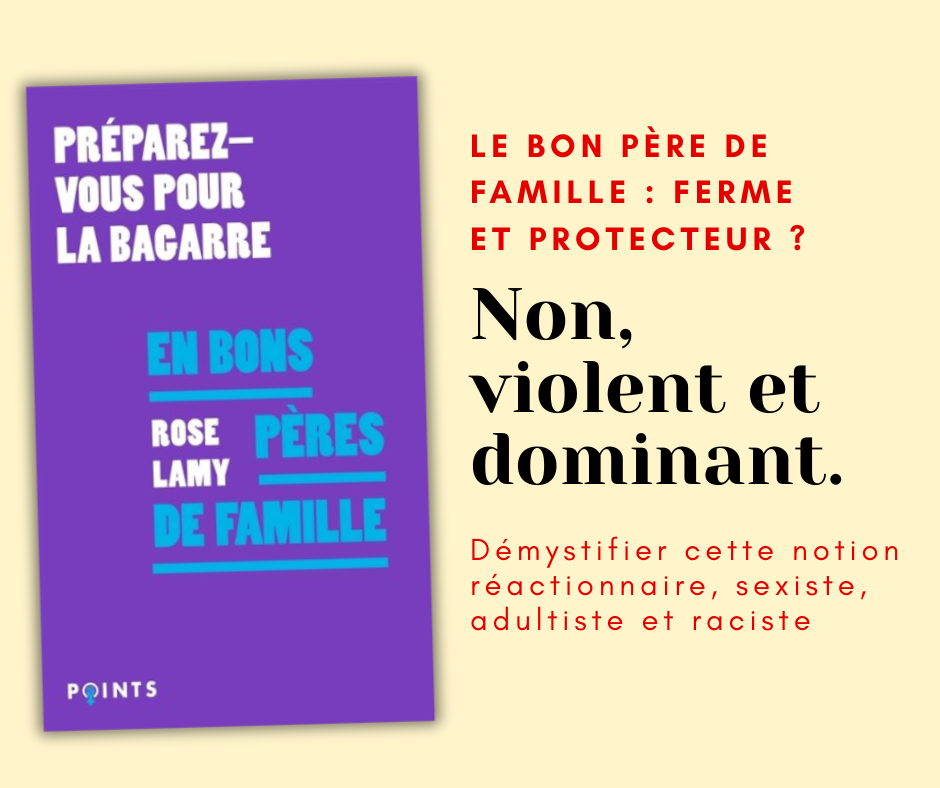
The notion of the "good father of the family" is a reactionary idea, and it is sexist, adultist and racist all at once. It presents a man as both firm and protective, when in truth that firmness hides violence and that protection is really control.
Rose Lamy's work on "good fathers" shows how this figure punishes children who rebel and corrects women who complain, often through attacks on their bodies and reputations. The myth survives because it protects men's reputations far more than it protects women and children.

Quick takeaways
- The "good father" figure hides control behind firmness and protection.
- It punishes rebellious children and corrects women who complain.
- The head-of-household status only left French law in 1970.
- Violence by "good fathers" is excused as love or a slip.
- Boys' clubs protect men's reputations over victims' safety.
- Shared authority and taking children seriously are practical antidotes.
What a "Good Father" Really Protects
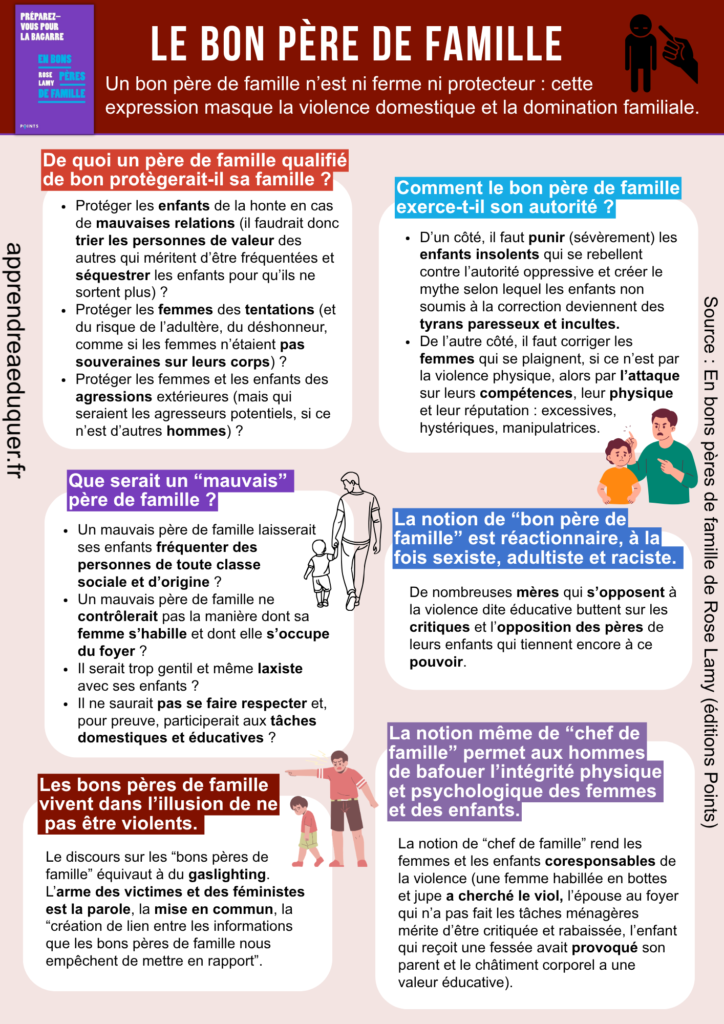
Ask what a good father protects his family from, and the answers get uncomfortable. From shame if children mix with the wrong people? From women's "temptations"? From outside aggression, when the likely aggressors are other men, a reality hidden behind the figure of the foreigner as thief and rapist?
The duty of the good father runs on two tracks. He must punish insolent children who rebel against oppressive authority, and he must correct women who complain, if not with physical violence then by attacking their bodies and reputations: excessive, hysterical, badly behaved, and worse.
Turn the idea around and a "bad" father would let his children mix across social classes, would not control how his wife dresses, and would be gentle, even lax, with his children. He might even share the domestic tasks and the education. The label is clearly reactionary, and it is why many mothers who oppose so-called educational violence hit the opposition of fathers clinging to that power. Some of these mothers find support through prenatal yoga classes that help them stay grounded.
A Short History of Paternal Authority
Family authority was written into the 1804 Civil Code, known as the Napoleonic Code. Napoleon held that the child belongs to the husband as the apple belongs to the owner of the tree, and that a woman is given to a man to make children: she is his property.
The legal status of head of household was only abolished in 1970, when the household became governed by two people. Today's reactionaries still mourn it, and some public figures blame the disappearance of the head of family for the "death of the Western family."
That same logic makes women and children co-responsible for violence: a woman dressed a certain way "asked for it," a wife who skipped chores deserves to be belittled, a child who got smacked provoked it. When a good father turns violent, people say he did it out of love, even too much love. Such violence, sometimes up to murder, is the ultimate reminder of who still holds power, exercised through psychological tools like threats and humiliation and through physical ones, including sexual aggression. This is why what mothers hear so often deserves scrutiny, and why even small rules, like a school's late policy, reveal how authority is still imagined.
| Claim | Reality | Everyday sign |
|---|---|---|
| He protects the family | He controls who is seen and how | Screening children's friends |
| He is firm but fair | Harshness is excused as love | "I did it for your own good" |
| He respects his wife | Her complaints are dismissed | "You're overreacting" |
| Violence is elsewhere | Most aggressors are known men | Blaming strangers instead |
| He keeps order | He keeps power | Chores and decisions stay his |
When Women's Words Weigh the Same as Men's Blows
Rose Lamy regrets that in many marital conflicts, sometimes fatal, women's words are placed on the same level as men's blows. Violence, from a slap to murder, gets framed as a proportionate response to the danger of women's complaints or verbal self-defense, as if male violence were legitimate defense against a bruised ego.
She argues that the "good fathers" discourse amounts to gaslighting. The weapon of victims and feminists is speech itself: sharing, putting things in common, and creating links between the pieces of information that good fathers keep us from connecting.
This matters for everyday parenting too. A home where one adult's word automatically outweighs everyone else's teaches children that power, not fairness, settles disputes, and it makes honest conversation about children's personality and feelings much harder.

The Boys' Club Behind the Reputation
The phrase "as a good father of the family" is inseparable from the boys' club: a tight group of male friends who protect each other, as Martine Delvaux defines it. Boys' clubs turn up in the state, the church, the army, universities and companies.
Good fathers live with the illusion of not being violent. Their violence is a slip, an exception, while violent men are always the others: the lower classes, the foreigners, the monstrous predators. Yet the figures are known. Women are more likely to be killed by a partner than by a stranger during a jog.
In an Ipsos poll from November 2020, one in ten French people said they had been victims of sexual violence within the family during childhood. Juliet Drouar, author of a book on the culture of incest, estimates that 80 to 85% of sexual assaults are incest. Protecting men's reputation, it turns out, counts for more than the bodies of women and children, and that silence shapes how we handle everything from peer interaction to disclosure at home. It also explains why spoiled children and children's apps are so often discussed without questioning the adults behind them.

Resisting the Myth in Everyday Family Life
Naming the myth is the first step. The second is noticing how it shows up in small moments: who gets to be angry, whose version of an argument is believed, who is called too sensitive. These are the daily rehearsals of the same power structure.
Parents who want something different can practice shared authority, take children's words seriously, and refuse the idea that harshness equals love. A household run by two adults, where chores and decisions are genuinely shared, quietly dismantles the model from the inside.
It also helps to watch the messages children absorb elsewhere, from rewards and punishment to the way adults talk about women and strangers. Change starts with refusing the phrase itself and asking, every time, what it is really protecting.
My hands-on take
I first noticed this pattern during family arguments, when one adult's version of events was simply treated as true and everyone else was told they were too sensitive. Once I started paying attention, the same script showed up at dinners, in comments about how women dressed, and in the way a child's complaint was waved away as rudeness.
What helped in my own home was slowing down and asking who gets to be angry and whose account gets believed. We started sharing decisions more openly and taking children's feelings seriously, even when it was inconvenient. It is not a dramatic fix, but it changes the tone of a household, and it makes the old phrase sound exactly as strange as it should.
Frequently asked questions
What does "good father of the family" actually mean?
It describes a man seen as both firm and protective, but the label often masks control and violence. It rewards punishment of children and correction of women who speak up.
Why is the phrase called sexist, adultist and racist?
It treats women as property-like and children as subjects to discipline, while shifting blame onto foreigners and outsiders. The myth locates violence in "other" men rather than in ordinary fathers.
When did the head-of-household status end in France?
It was written into the 1804 Civil Code and only abolished in 1970, when households became governed by two people. Reactionary voices still mourn its loss.
What can parents do instead?
Share authority between both adults, take children's words seriously, and refuse the idea that harshness equals love. Naming the myth out loud is a good first step.
Product Reviews
 Best Toys for Dogs With High Prey Drive |
Best Outdoor Toys for 3-4 Year Olds |
Best Outdoor Toys for 6 Year Olds |
Best Harness for Poodle |
Best LEGO Sets for Adults |
Best Travel Toys for 4 Year Olds on Airplane |
Best Toy Stores in Washington DC |
Best Potty Training Toys |
Best Toys for Tripod Dogs |
Maillot equipe de france







