


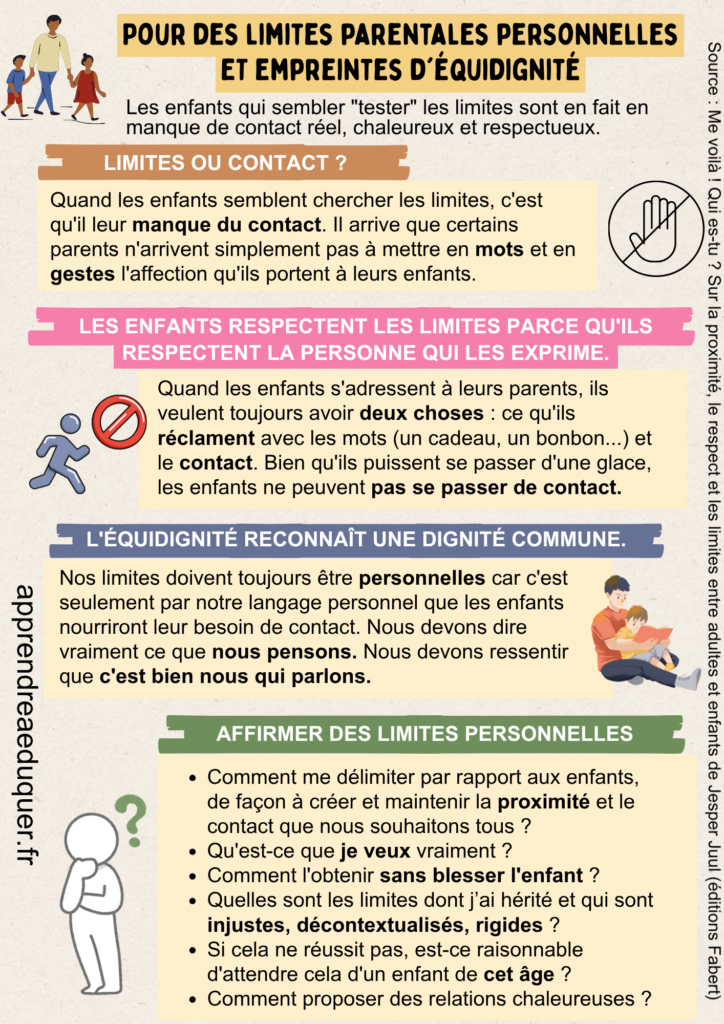
Respect-based boundaries work differently from rules imposed by authority: children follow them because they respect the person expressing them, not because the rule is repeated louder. That single idea reshapes how we think about discipline, obedience and everyday family friction.
Drawing on the work of Danish family therapist Jesper Juul, this article looks at what children are really asking for when they seem to test limits, why some parental boundaries carry weight and others collapse, and how our own childhood and outside influences shape the rules we set.

The aim is not permissiveness. It is a firmer, calmer kind of authority: one built on contact, honesty and equal dignity between adults and children.
Quick takeaways
- Children who seem to test limits are often short of real contact, not discipline.
- Say limits in the first person, only when you truly mean them.
- Keep the child's dignity intact: no criticism, no humiliation, no pleading.
- Watch your irritation; it often signals an old childhood wound.
- Prefer your authentic self over borrowed theories and ideals.
- A short, honest explanation strengthens a limit; a poor excuse weakens it.
What Children Are Really Asking For
When children seem to be pushing against limits, the therapist argues that what they are missing is often contact rather than discipline. A child's loneliness does not come from parents who fail to love them; it can come from parents who struggle to put that affection into words and gestures. Juul compares it to a partner who never says what they want, think or feel: you feel alone even inside the relationship.
Young children's language is always personal, unlike adult language, which is easily polluted by inherited habits or outside injunctions such as "that's how it's always been done". When a child asks for an ice cream, a gift or a story, they want two things at once: the object of the request and the contact. They can easily do without the ice cream. They cannot do without the contact.
This is why a boundary delivered as pure refusal, with no warmth behind it, so often escalates. The child keeps pushing because the real need was never met. Simple rituals of connection, such as a shared game or a quiet moment together, do more for cooperation than another lecture.

Personal Limits, Equal Dignity
Our limits should always be personal, because it is through our personal language that children feed their need for contact. Swapping "you" for "I" is not enough: "you never listen" becoming "I..." only counts if we truly say what we think and feel it is genuinely us speaking. Children detect the difference between a formula and a person.
Limits must also express dignity and equal dignity, which recognises a shared human worth in adults and children alike. The adult's point of view is stated without pleading, without wrapping it in reservations or self-criticism, and without criticising or humiliating the child. Explaining briefly why a limit stands today is part of this: the explanation is short, clear and truthful, never manipulative. Poor excuses weaken limits, and it is better to say honestly that you don't know why you feel this way but that it is what you think and want.
Above all, imposing, arguing and explaining do not automatically earn respect. Children respect limits because they respect the person expressing them.
| Style | What it sounds like | Effect on contact |
|---|---|---|
| Inherited rule | "We've always done it this way" | Distant, automatic |
| Borrowed theory | "The book says children need..." | Performative, less personal |
| Personal limit | "I don't want noise at dinner" | Direct, respectful |
| Equal dignity | "I can't explain, but this is my view" | Honest, trustworthy |
| Rigid reaction | Sudden anger over small things | Signals an old wound |
The Inherited Limits We Repeat
A great deal of what we call discipline is inheritance. Listen for the "parental answering machine": the voice that starts automatically the moment a child comes near, reciting rules, urging correct behaviour and offering recommendations. Many of us grew up with emotional repression, forced to submit to unfair orders without being allowed to express frustration.
Because repression buries the pain, most of us have forgotten what hurt us. In contact with our own children that suffering can resurface, sometimes as rigid limits. Without attention, we risk importing that suffering into our family instead of taking responsibility for our emotions, needs and personal boundaries.
Juul suggests watching the situations in which we feel irritated by our children. The irritation often looks irrational and illogical, and when our reactions contradict our values, a childhood wound has probably been reactivated. He describes the surest sign of having lost our way: the small knot in the stomach and the doubt that made us question ourselves. When you feel it, it is time to think before acting, next time.
Filtering Outside Noise
Juul calls "picking up" all the stuff we collect from everywhere: television, educators, siblings, friends, neighbours, books and conferences. Acting from theories and ideals rather than from ourselves is rarely a good idea, because personal contact between parents and children degrades. And children who appear to test limits are precisely those short of real, warm, respectful contact.
Authentic parents do far better than theoretical ones. Parents who make mistakes and take responsibility for them stay in contact with their child, while parents performing a method drift away from the person in front of them. If you are preparing a long journey and need distraction ideas, a list of toys for flights can help without turning into a rulebook. The same goes for the home: a few quiet toys year olds support calm play far better than a strict schedule.
Outside noise also creeps in through everyday purchases and habits. Before following a trend, it helps to check the mermaid tail dangers or to read up on antibiotic prescribing so that decisions rest on knowledge rather than pressure.

Putting Respectful Limits Into Practice
Start with the body. Notice the knot in your stomach before you speak, and let it slow you down. Then say the limit in the first person, briefly, without a speech. If a child asks why, give the short true reason; if you don't have one, say so. This is how limits stay personal and dignified.
Keep an eye on the pressure coming from outside the home too. Screen time, fashion and friendship worries all generate advice, and it helps to stay informed: understanding topics such as childhood hypersexualization or the dyslexia reading app debate lets you respond as a person rather than react to a headline. Family life also needs room for joy, whether that means planning a Disney birthday party or choosing toys under 50 dollars for a birthday.
Finally, protect your own energy. Tired parents have less contact to give, and relieving baby fatigue is not a luxury but part of keeping boundaries steady. A parent who is present, honest and rested expresses limits children can actually respect.
My hands-on take
I first tried this on a morning when my child kept asking for the same thing over and over. Instead of repeating the rule, I sat down and said plainly that I was tired and didn't want to argue, and that I still meant no. The pushing stopped far faster than it ever had with a longer explanation, and I realised the argument had been about contact, not the request.
What helped most was noticing the knot in my stomach before speaking. When I feel it now, I try to slow down and ask whether the limit is really mine or something I picked up from elsewhere. I am not always successful, and I still hear the automatic voice starting up. But naming it out loud, even to my child, keeps us connected and makes the next limit easier to hold.
Frequently asked questions
Does this approach mean saying yes to everything?
No. It means expressing limits honestly and personally rather than through commands or borrowed rules. The limit stays firm; only the way it is delivered changes.
What if I don't know why I'm setting a limit?
Say so. A short, truthful statement such as "I don't know why I feel this way, but this is what I want" carries more weight than an invented justification.
How do I spot inherited limits?
Listen for the automatic voice that starts reciting rules when your child approaches. Notice irritation that feels out of proportion, and treat it as a signal to pause before acting.
Can I repair things after reacting badly?
Yes. Taking responsibility for your mistake keeps the contact alive, and authentic parents who own their errors do better than parents performing a method.
Product Reviews
 Best Toys for Dogs With High Prey Drive |
Best Outdoor Toys for 3-4 Year Olds |
Best Outdoor Toys for 6 Year Olds |
Best Harness for Poodle |
Best LEGO Sets for Adults |
Best Travel Toys for 4 Year Olds on Airplane |
Best Toy Stores in Washington DC |
Best Potty Training Toys |
Best Toys for Tripod Dogs |
Maillot equipe de france







