


Helping children return to calm can start with something surprisingly simple: changing the position of the body. When a child is overwhelmed by emotions, offering a physical activity that discharges energy without competition or obligation often works better than words.
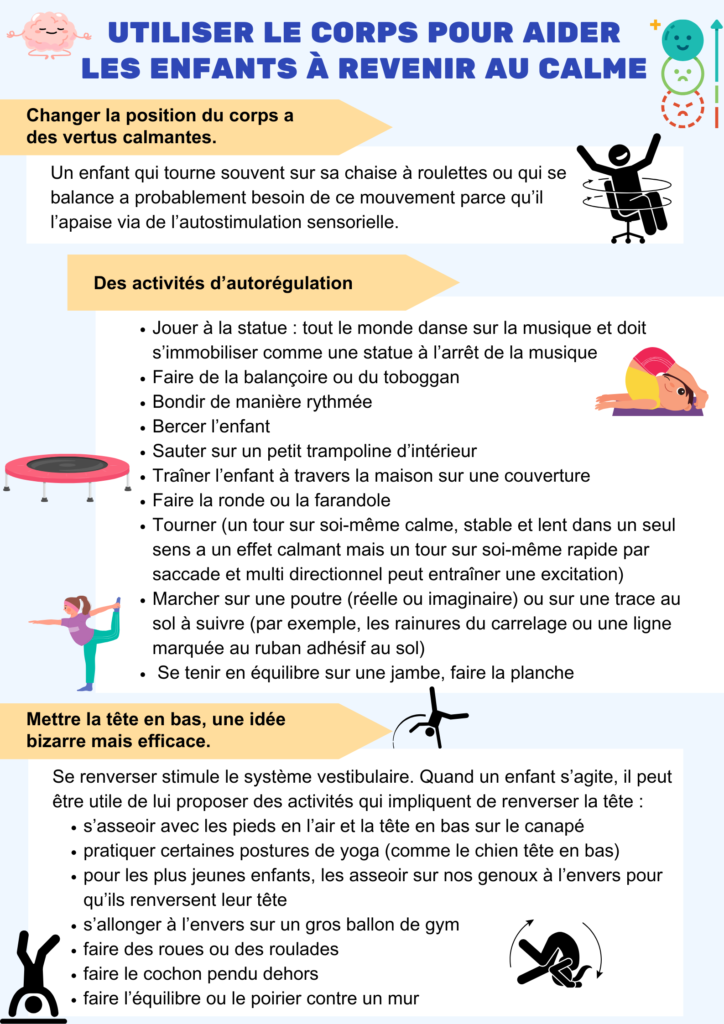
The idea is not to demand stillness but to move in a way that soothes. Inversion, in particular, stimulates the vestibular system, the sensory organ in the inner ear responsible for balance, spatial orientation and coordination of movement.

This guide explains why movement calms, how to prepare a safe space, and which activities to offer when children tend to get agitated or upset quickly.
Quick takeaways
- Changing body position has calming virtues and needs no equipment.
- Inversion stimulates the vestibular system, which governs balance and coordination.
- Avoid competition, obligation and rough play during calm-down moments.
- Secure the space, remove socks and adapt activities to each child.
- Offer short movement breaks several times a day to restless children.
- Guide a slow transition back to quiet activity afterwards.
Why body position changes the mood
Simply changing the position of the body has calming virtues. Movement also supports the harmonious development of a child's brain and body, so a short burst of activity is never wasted time. When emotions rise, a child often cannot reason their way out; the body is the easiest door to open.
This is why children with genius and highly sensitive kids benefit just as much from movement breaks as very energetic ones. The goal is to discharge energy without any notion of competition, obligation or anything that could lead to irritation, such as fear of failing or team problems.
Rough play and wrestling games are best avoided in these moments, because they tend to raise excitement rather than lower it. A calm, playful invitation works better than a command to calm down.
The vestibular system and the power of going upside down
Turning upside down is particularly relevant. When a child puts their head down, the vestibular system is stimulated. This sensory organ, located in the inner ear, contributes to the sensation of movement and to balance.
It is responsible for equilibrium, spatial orientation (knowing where the body is in space) and coordination of movements. This is why baby bathing and gentle rocking are so soothing for little ones: the same system responds to slow, predictable motion. The same principle explains why motherhood changes priorities, as parents naturally tune into these calming cues.
For older children, simple inversions such as bending forward, hanging the head low or rolling gently give this system something clear and calming to process. No equipment is needed, and the effect comes from the movement itself rather than from performance. Pairing this with the best toys can make movement play even more engaging.
| Check | Why it matters | Done |
|---|---|---|
| Clear floor space | Prevents falls and collisions | Yes / No |
| Sharp corners covered | Reduces injury risk | Yes / No |
| Socks removed | Bare feet grip better | Yes / No |
| Activity matches age | Keeps it safe and enjoyable | Yes / No |
| Adult present | Supervision at all times | Yes / No |
Preparing a safe indoor space
Indoors, the first prerequisite is finding a space that is large enough and free of danger: furniture with sharp corners, differences in floor height, and anything that could tip over. Take time to secure the area before inviting movement.
Ask children to remove their socks and stay barefoot, since socks can cause slipping. Adapt every motor activity to the age and abilities of each child, and stay close by to supervise.
If you are setting up a play area from scratch, the same care applies as when you choose outdoor toys for kids: check the surroundings first, then the activity. A few minutes of preparation protects both the child and the furniture.
When and how often to offer movement
Specific movement and inversion activities can be offered several times a day, for a few minutes at a time, to children who tend to get restless, irritated easily and quickly. Short and frequent beats long and exhausting.
Watch for the early signs: fidgeting, a rising voice, difficulty settling. Offering movement at that point is easier than waiting for a full meltdown. You might also notice that self-improvement in children grows when they learn to recognise these signals themselves. If falling asleep takes hours, a short movement break earlier in the evening can help.
Keep the invitation light and optional. A child who refuses one day may join the next, and the routine itself becomes a reassuring cue that calm is available. On trips, travel toys can offer the same gentle movement.

Simple inversion and movement ideas
Keep the menu small and familiar: bending forward to touch the floor, hanging the head off the edge of a mattress with supervision, gentle rolling, crawling on all fours, or rocking on the back. Each one changes the body's position and gives the vestibular system clear input.
You can frame these as playful challenges rather than exercises, the same way learning to ride a bike works best through play and repetition. Avoid timers and scores; the point is the sensation, not the result.
After a few minutes, guide the child back to a slower activity, such as sitting with a book or a quiet toy. The transition matters as much as the movement itself, because it teaches the body that calm follows effort.
Building calm into the daily routine
Rather than treating movement as a rescue measure, weave it into predictable moments: before homework, after school, before meals. Predictability reduces resistance and helps children anticipate the shift.
This is the same principle behind reusing old toys: familiar things, used in a new way, regain their value. A cushion, a mattress and a clear floor are enough to create a small movement corner.
Over time, children begin to ask for these breaks themselves, which is the real goal. The adult's role shifts from directing to simply making the space available and staying present.

My hands-on take
In my own home, the turning point was stopping the negotiation. Instead of asking my child to calm down, I started quietly clearing a space, taking off my own socks and bending forward to touch the floor. More often than not, curiosity won and my child joined in without a word about behaviour.
I also learned to keep it short. Two or three minutes of rolling and bending, followed by sitting down together with a book, did more than a long discussion. Some days it failed completely, and that was fine. The routine, repeated gently, is what slowly made the difference.
Frequently asked questions
How long should a movement break last?
Just a few minutes is enough. Short, frequent sessions work better than one long one, especially for children who get restless quickly.
What if my child refuses to join in?
Keep the invitation light and optional. Offer the activity again another day; the routine itself becomes a reassuring cue over time.
Is going upside down safe for young children?
With supervision and an adapted activity, yes. Always secure the space, match the movement to the child's age and abilities, and stay close by.
Can this replace talking about feelings?
No, it complements it. Movement helps the body settle first, which often makes a later conversation about emotions easier.
Product Reviews
 Best Toys for Dogs With High Prey Drive |
Best Outdoor Toys for 3-4 Year Olds |
Best Outdoor Toys for 6 Year Olds |
Best Harness for Poodle |
Best LEGO Sets for Adults |
Best Travel Toys for 4 Year Olds on Airplane |
Best Toy Stores in Washington DC |
Best Potty Training Toys |
Best Toys for Tripod Dogs |
Maillot equipe de france







