


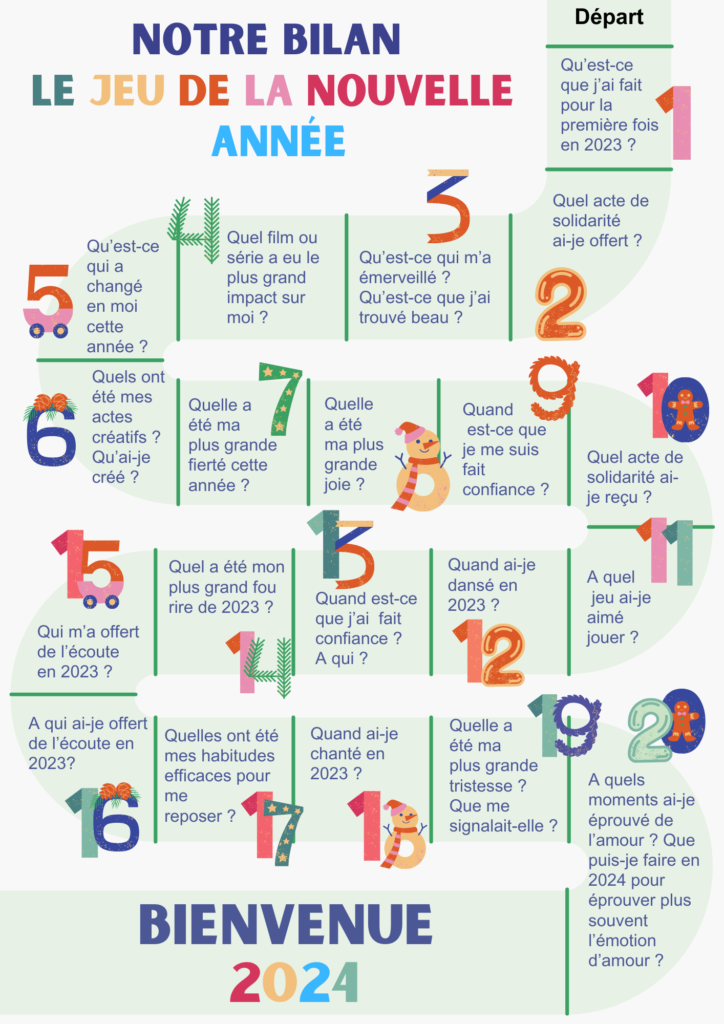
A family New Year game is a simple way to slow down at the end of December and look back on the year together before welcoming the next one. The idea is a printable board game, played like a classic goose game, where each square holds a question about the past twelve months.
The questions invite children and parents to feel grateful for small joys, to acknowledge the harder moments, and to set a direction and some wishes for the year to come. It is less about scoring points and more about conversation.

Everything you need is a board, a die and one token per player. The real value comes from how you hold the space around the table.
Quick takeaways
- Play it like a goose game: roll, move, answer, and land exactly on the final square.
- The aim is conversation and gratitude, not scoring or winning.
- State clearly that nobody has to answer in front of the group.
- Never force or tease a child into sharing a private thought.
- Let children add their own questions to keep the ritual theirs.
- Save the answers and revisit them the following December.
How the Year-End Board Game Works
Each participant chooses a token and places it on the starting square. Players take turns rolling a die and moving forward the number of squares shown on the top face. The goal is to land exactly on the final square, the welcome-to-the-new-year space.
That exact-landing rule is what makes it feel like a real game rather than a questionnaire. If your roll takes you past the finish, you move back the extra squares, which keeps everyone in play a little longer and gives the conversation room to breathe.
Because turns are short, even young children stay engaged. If you are playing with a mixed-age group, you can pair a younger child with an adult so nobody feels put on the spot when a question is read aloud.
Setting Up in a Few Minutes
Print the board, find a die and gather small objects as tokens. Nothing needs to be elaborate: the ritual of sitting down together matters more than the equipment, much like the shared values that Thanksgiving traditions bring to a family table.
Why Children Need to Feel Heard
The game shows children that adults care about their opinion, their tastes and their perspective, and that their voice counts in the family. When a child hears a parent answer a question honestly, it signals that the exchange goes both ways.
Answers are never judged as good, bad or silly. The point is to know the child more authentically and to share heart-to-heart moments on subjects that rarely come up in daily life. This kind of listening is part of a broader shift toward conscious parenting that many families are exploring, much like the care taken when choosing nipple creams for a newborn.
Questions That Open Real Conversations
Open questions do more work than yes-or-no ones. Asking what made someone laugh this year, or what they would like to try next, gives a child room to reveal what genuinely matters to them, and it lets you notice the personality traits shaping how they answer. Just as with sciatica in pregnancy, patience and honest conversation make all the difference.
| Element | What you need | Why it matters |
|---|---|---|
| Board and questions | Printed board with a question per square | Gives the conversation a structure |
| Tokens | One small object per player | Makes turns visible for young children |
| Die | One standard six-sided die | Keeps turns short and fair |
| Exact landing rule | Move back if you overshoot | Extends play and keeps everyone involved |
| Safe-space rule | Agreed before the first roll | Protects shy or private answers |
| Keepsake | Folder for notes or boards | Builds a yearly family tradition |
Creating a Safe Space to Answer
The safety framework matters and should be stated clearly before the first roll: nobody is obliged to answer in front of the others, and it is fine to keep an answer to yourself. You do not force a child, not even by teasing.
If a child prefers not to share, invite them to think about it silently and to place the answer in an inner treasure box, a private garden of their own. Respecting that boundary once makes it far more likely they will share freely another time.
Parents can model this too by passing on a question now and then. A family that accepts a polite pass without comment builds the trust that makes deeper talk possible later, in the same way that honest, calm conversations help when you need to address name mix-ups or other everyday tensions without blame.
Adapting the Game to Different Ages
With younger children, keep questions concrete and sensory: a favourite smell, a song, a moment that felt warm. With older children and teenagers, move toward wishes, goals and the parts of the year they found difficult.
You can also let each player add a question of their own to an empty square before starting. That small act of authorship gives children ownership of the ritual and makes next year's version feel like a family tradition rather than an adult's activity.
Some families play on New Year's Eve, others on the first quiet afternoon of the holidays, or even during Three Kings afternoon. Either works, as long as everyone is rested enough to enjoy it. If the mood is flat, a light, playful start helps, much as cause and effect toys ease a child into engagement through play rather than instruction. A quick check for baby hiccups beforehand keeps the youngest players comfortable too.
Building a Family Ritual Around Reflection
Reflection is a habit, and a yearly board game is a gentle way to build it. Keep the finished boards or notes in a folder and revisit them the following December; children are often fascinated to see what they cared about a year earlier.
The same spirit of looking back and naming what matters appears in many family traditions, from seasonal gratitude to the stories we tell about the year gone by. Books can extend the conversation afterward, including books about democracy that show children how opinions are shared and heard.
Over time the game becomes a small archive of your family's year, and the questions matter less than the habit of sitting down together and listening.

My hands-on take
I first tried this on a rainy afternoon between Christmas and New Year, mostly because the children were restless and I wanted something calmer than a screen. I printed the board, dug out a die from an old box and used buttons as tokens. What surprised me was not the big answers but the small ones: a favourite walk, a song from the car, a friend they missed.
One of my children passed on two questions in a row, and I let it go without a word. Half an hour later, while clearing the table, they came back to one of them on their own. That taught me more than any rule: the pass is part of the game, and the door stays open. We now keep the boards in a folder and read last year's answers before playing again.
Frequently asked questions
What age is this game suitable for?
It works from around six or seven, when a child can answer a simple question in a group, and it adapts upward for teenagers. With younger children, keep the questions concrete and about sensory memories.
Do we have to finish the board in one sitting?
No. You can pause and pick it up later, or shorten the board by removing a few squares. The conversation matters more than reaching the final space in one evening.
What if a child refuses to answer?
That is allowed and should be respected without comment or teasing. Invite them to think about it privately instead, and let them rejoin when they are ready.
Can we play with just two people?
Yes, though it is livelier with three or more. With two players, take turns reading each other's questions aloud so both voices are heard equally.
Product Reviews
 Best Toys for Dogs With High Prey Drive |
Best Outdoor Toys for 3-4 Year Olds |
Best Outdoor Toys for 6 Year Olds |
Best Harness for Poodle |
Best LEGO Sets for Adults |
Best Travel Toys for 4 Year Olds on Airplane |
Best Toy Stores in Washington DC |
Best Potty Training Toys |
Best Toys for Tripod Dogs |
Maillot equipe de france







