


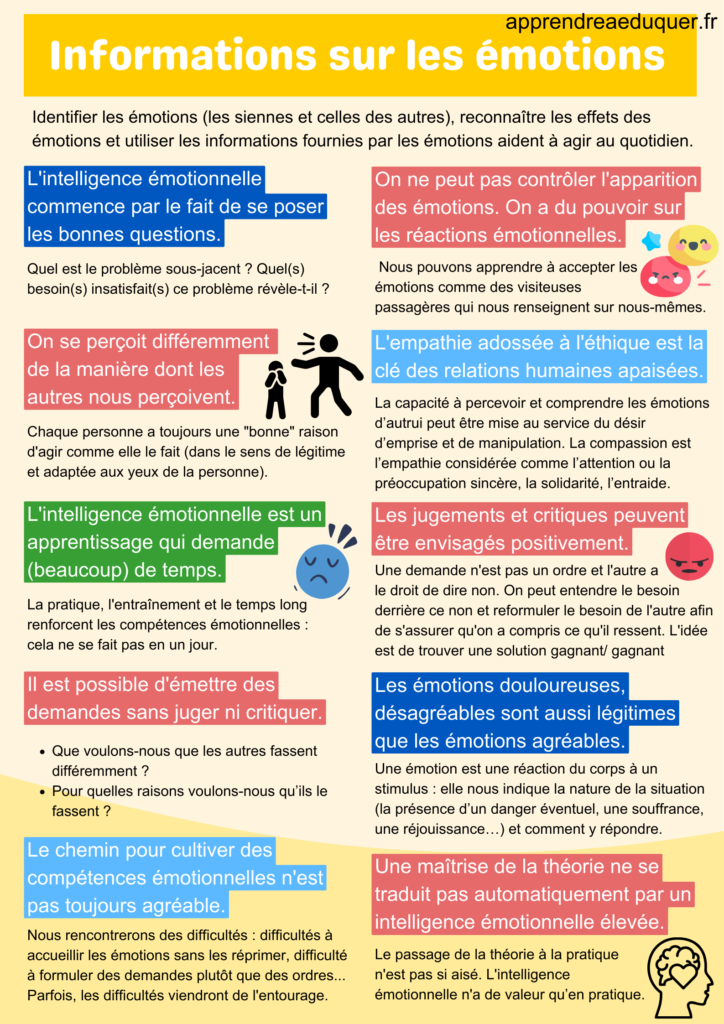
Emotional intelligence for kids starts with a simple idea: emotions are messengers, not problems to be silenced. Emotional intelligence is the ability to identify feelings in yourself and in others, to recognise the effects those feelings have, and to use that information to guide what you do next.
Most people name six primary emotions: fear, which alerts us to danger or the unknown; anger, which signals frustration, injustice or a threat to integrity; sadness, which points to loss and draws comfort; love, the emotion of connection; disgust, which warns of harm; and joy, the emotion of success and meeting.

These eleven insights are practical starting points for parents who want to raise emotionally skilled children, one ordinary conversation at a time.
Quick takeaways
- Emotions are messengers that point to unmet needs
- You cannot stop a feeling, but you can choose your response
- Everyone has a legitimate reason for their strategy
- Empathy helps, but only when anchored in ethics
- Emotional skills need repetition, time and regular practice
- “I” messages and clear needs replace blame
Emotional intelligence begins with asking the right questions
Instead of asking “why is my child behaving like this?”, try reasoning in terms of needs. Emotions draw attention to something that is missing or threatened. Ask yourself: what is the underlying problem, and which unmet need does it reveal?
Then ask a second question: how much power do I actually have over this problem? Naming your own limits is not defeat. It helps you focus on the part of the situation you can nourish, in yourself or in your child, rather than exhausting energy on what you cannot change. This shift in perspective is the foundation of all the work that follows.
You cannot control emotions, but you can shape your reactions
Nature would not have given us emotions if they had no role in survival. Their arrival is a chemical event in the body that we have no direct hold over. What we can learn is to welcome them as passing visitors that tell us something about ourselves.
This never means repressing, denying or minimising feelings, including anger, which has a repairing value when something unjust or harmful has happened. Anger and violence are not synonyms. You can acknowledge the emotion, recognise the unmet need it points to, and respond in a non-violent way.
Children learn this best by watching us. If you want to support self-improvement in children, model what it looks like to pause, name a feeling out loud, and choose a calmer response. The same everyday modelling applies to protecting children's eyes and to the messages we send about identity, as explored in gender stereotypes.
| Emotion | What it alerts us to | A helpful response |
|---|---|---|
| Fear | Danger or the unknown | Reassure and gather information |
| Anger | Frustration or injustice | Name the need, avoid violence |
| Sadness | Loss | Offer comfort and presence |
| Love | Connection | Nurture the bond |
| Disgust | Harm or violation | Protect and set limits |
| Joy | Success and meeting | Share and celebrate |
We see ourselves very differently from how others see us
Every human being is moved by fundamental needs and emotions. What differs is the strategy each person uses to meet those needs. Each person always has a “good” reason to act as they do, meaning a reason that feels legitimate given their personal history, cultural background, religion or even their level of fatigue.
Those strategies can clash. Meeting your own need may prevent someone else from meeting theirs. The other person then judges you as disrespectful or selfish, while you think exactly the same of them when their criticism blocks your own needs. A vicious circle of judgement and blame sets in.
Breaking that circle starts with curiosity. When a child melts down at the table, eating with the TV may be a demand for comfort rather than defiance. Looking for the need behind the behaviour changes the conversation entirely.
Empathy anchored in ethics is the key to calmer relationships
Empathy is the ability to recognise another person’s emotions while knowing that they are separate from you, and to understand why they feel what they feel. It can be used to help, but also to manipulate: the capacity to read feelings can serve a desire for control.
What makes the difference is moral sense and education. Some researchers use another word for empathy anchored in ethics: compassion, understood as sincere, disinterested concern for the other, solidarity and mutual help.
This is why empathy needs to be taught alongside values. Stories are a gentle way in, and there is plenty to draw on, from values from Heidi to everyday family discussions about fairness and kindness.

Emotional intelligence is a long apprenticeship
Neuroscience has shown that the human brain is plastic: we can create new neural connections at any age. Neurons that fire together wire together, forming pathways in the brain. Repeated behaviours strengthen those connections, while little-used ones gradually fade.
Think of a wild forest where paths appear only because people keep walking the same route. Practice, repetition and time are what build emotional skills, and without regular practice they can weaken again. This is why one calm conversation will not transform a household, but hundreds of small ones will.
Be patient with the pace. A child who is anxious about school may need steady, low-pressure support over months, much like the gradual approach described in teen test anxiety. The same slow logic applies to learning a language, as these tips for learning English show.
Judgements and criticism can be heard positively
Marshall Rosenberg, creator of Nonviolent Communication, suggested that all judgements and criticisms are the tragic expression of unmet needs. Hearing the need behind a criticism is therefore a step toward calmer communication. Hearing your own unmet need, and thinking about how to feed it, is a way to avoid criticising others in the first place. This same patience helps when your baby sleeps well through restless, overheated nights.
Nonviolent Communication invites us to express emotions as “I” messages (“I feel angry”, “I am sad”, “I am afraid”) and to state our needs (“I need safety, understanding, respect, connection, authenticity”) before making requests in positive, action-based language (“would you be willing to…?”, “I am asking you to…”).
The whole process unfolds with empathy: a request is never a demand. Practising this at home prepares children for bigger challenges, whether that means parenting TED talks you watch together or the social pressures of school life. It also eases physical strain such as sciatica in pregnancy.


My hands-on take
In our house, the biggest change came from swapping “why are you behaving like this?” for “what do you need right now?”. The first few times felt artificial, and my child just stared at me. But after a few weeks, he started answering with real information: he was tired, he was hungry, he wanted help with something he could not name.
I also had to admit how often my own reactions were about me. When I snapped after a long day, naming it out loud (“I am frustrated, I need a quiet minute”) did more for the atmosphere than any lecture. It is slow, unglamorous work, and some days I get it completely wrong. But the small repairs add up, and the house feels calmer for it.
Frequently asked questions
Can emotions be controlled?
The arrival of an emotion is a chemical reaction we cannot switch off. What we can influence is how we respond to it, by naming it and identifying the need behind it.
Is anger always a problem?
No. Anger signals frustration, injustice or a threat to integrity and can have a repairing value. The goal is to express it without violence, not to suppress it.
How long does emotional intelligence take to develop?
It is a long apprenticeship. Because the brain is plastic, repeated practice builds new pathways, but skills fade without regular use, so consistency matters more than speed.
What is the difference between empathy and compassion?
Empathy is the ability to recognise and understand another person’s emotions. Compassion is empathy anchored in ethics: sincere, disinterested concern for the other, solidarity and mutual help.
Product Reviews
 Best Toys for Dogs With High Prey Drive |
Best Outdoor Toys for 3-4 Year Olds |
Best Outdoor Toys for 6 Year Olds |
Best Harness for Poodle |
Best LEGO Sets for Adults |
Best Travel Toys for 4 Year Olds on Airplane |
Best Toy Stores in Washington DC |
Best Potty Training Toys |
Best Toys for Tripod Dogs |
Maillot equipe de france







