


Spanking children is never a "good" or "little" smack, and there is no such thing as a deserved one. The question worth asking is not whether a light slap can be acceptable, but why hitting is harmful at all, why the resistance to giving it up runs so deep, and how families can end the violence that hides behind the word education.
This article looks at what ordinary educational violence actually includes, what the law now says, and why so many caring parents still defend the gestures they received as children. It also offers concrete ways to move toward discipline without fear.

Quick takeaways
- Ordinary educational violence includes spankings, slaps, humiliation, shouting, threats and isolation.
- Brain imaging shows fear and stress from hitting harm a child's developing brain.
- The 2016 French law excluded all cruel, degrading or humiliating treatment, including corporal punishment.
- Resistance to change comes from imitation, loyalty and denial of our own childhood pain.
- Recognising the pain you felt as a child is what breaks the cycle for your own children.
- Calm limits, naming feelings and repair after conflict replace hitting far more effectively.
What Counts as Ordinary Educational Violence?
Parenting trainer Brigitte Oriol uses the word maltreatment for every educational method that touches a child's integrity. Others speak of ordinary educational violence to describe behaviour that goes beyond the visible abuse the justice system handles: spankings, slaps, punishments, humiliation, the naughty corner and isolation, brusqueness, shouting at a child, blackmail and threats.
Adults usually do not see maltreatment in a smack or a tap on the hand, because these gestures are simply equated with education. Yet human nature is good and a child is not born bad: it is precisely educational violence, mistreatment and humiliation that help turn a child into a disturbed individual.
The Legacy of "Black Pedagogy"
Ordinary educational violence claims to teach good manners, morality or politeness through violent means. Oriol borrows Alice Miller's term for this: "black pedagogy", the abuse of adult power over a child that mirrors how our own parents and grandparents were raised. For everyday tools that support a calmer home, many families turn to outdoor toys preschoolers and shared play rather than punishment.
What the Law Says About Spanking
Neuroscience has shown through brain imaging what happens inside a child's brain during a spanking or any other form of educational violence. The fear and stress that follow have damaging effects on brain development. Yet parents in France have little access to this scientific data, and little help to find support, to talk, or to learn non-violent educational tools.
The law against educational violence passed on 22 December 2016, and the task now is to raise awareness of its harms. The second paragraph of article 371-1 of the Civil Code was completed with the words "and excluding any cruel, degrading or humiliating treatment, including any recourse to corporal punishment". With this law, France became the 52nd country in the world to abolish violence against children.
The law should also be a chance to launch information campaigns, in maternity wards for example, or publications in health records, covering both the harms of this violence and tools for educating without it. Parents who want to understand how early experiences shape a child can also read about high risk pregnancy factors that call for extra support.
| Situation | Punitive reflex | Calmer alternative |
|---|---|---|
| Child hits a sibling | Slap or harsh punishment | Separate, name feelings, repair together |
| Child cries for attention | Shouting or ignoring | Offer connection and a clear limit |
| Child tests limits | Threat or blackmail | State the rule once, calmly and firmly |
| Parent loses control | Justify the smack | Pause, breathe, apologise afterwards |
| Child refuses to cooperate | Naughty corner | Choices, play and anticipation |
Why Is There Such Resistance to Ending Spanking?
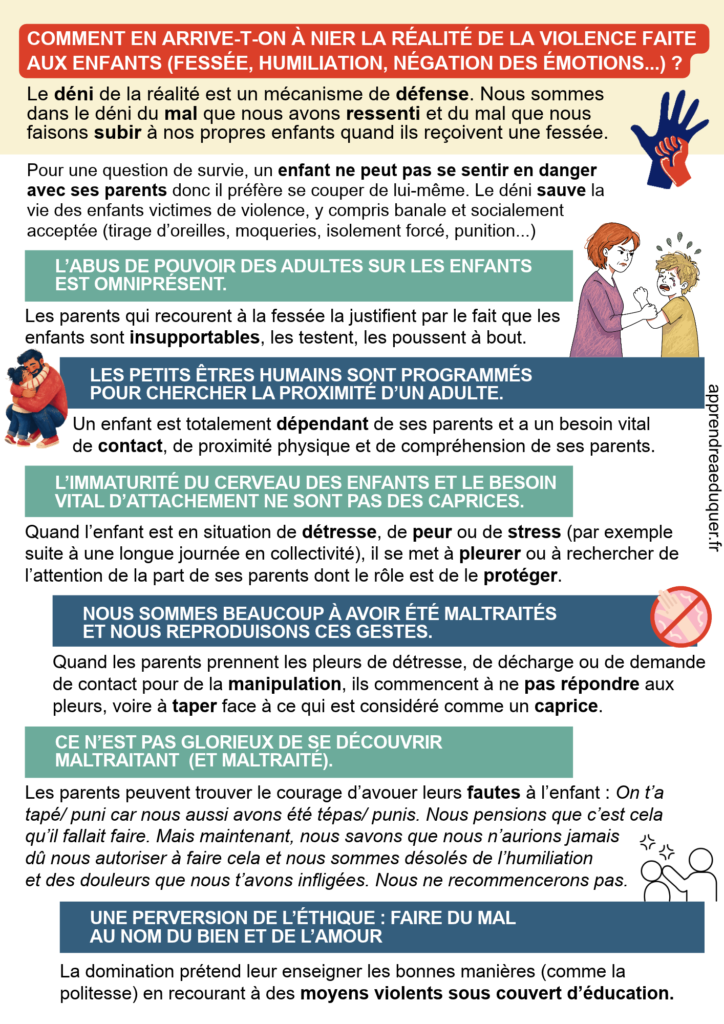
People who protest against anti-spanking laws justify both the blows they received ("I deserved it, it set me straight, I didn't die, I'm not traumatised") and the blows they give ("my child was asking for it, he's testing me, he needs limits, if you had the same child you'd do the same"). This resistance has several causes.
Many of us received spankings and reproduce these gestures through imitation and "loyalty": because it is impossible to tell ourselves our parents hurt us under the cover of love, we deny the pain we felt and the pain we inflict on our own children. The vast majority of today's parents, and of our parents, have used or still use spanking.
Feeling Caught Out
Oriol notes that discovering yourself to be maltreating is not very glorious, and it throws us back into the past. A parent who spanks and hears the anti-spanking message, however scientifically grounded and free of moral judgement, feels caught in the wrong. Anti-spanking arguments often meet annoyed or hurt people who cannot retain anything, because they move into a defensive position like a child caught misbehaving.

How Do We End Up Denying Educational Violence?
Denial of reality is a defence mechanism. As soon as a human being feels threatened or in danger, for example a child facing a raised hand or a shout, they set up this mechanism and cut themselves off from their state of fear. Blanking out the mistreatment suffered is a survival strategy.
By nature and for survival, a child cannot feel in danger with their parents, so they prefer to cut themselves off from themselves. Denial saves the lives of children who suffer educational violence, but when it persists into adult life it prevents a serene, balanced and empathetic life. A parent who was spanked will avoid spanking their own children if and only if they have become aware of the pain they felt then. Recognising the mistreatment or emotional neglect you suffered is what lets you spare your children and start looking for information and alternatives, though this inner work is extremely painful because it means admitting your parents could deceive you and hurt you.
Parents rebuilding their confidence often find small daily routines helpful, from children learn English through play to a thoughtful music for child choice at home.

Do Crying and Tantrums Justify a Deserved Spanking?
Parents who resort to spanking justify it by saying children are unbearable, test them, push them to the limit, only cry, or only demand attention. These moments are better read as signals of an unmet need than as provocations deserving punishment.
A child who cries is communicating hunger, fatigue, fear or a wish for connection. Responding with presence and clear, calm limits teaches emotional regulation far better than fear does, and it protects the trust that makes discipline possible.
Replacing the Smack With Tools
Concrete alternatives exist: naming feelings, offering choices, anticipating transitions, and repairing after a hard moment. Play is often the fastest route back to cooperation, whether through a speech therapy toys set for a child who struggles to express themselves or simple best fidget toys for restless hands. For families looking for calmer rituals, a board games feminism evening can open conversations about respect and equality, while a LEGO publicly traded trivia question is a light way to spark curiosity together. What matters is consistency, not perfection.

My hands-on take
I remember the first time I caught myself raising my hand in frustration, and the shame that followed. What helped me most was not a lecture but a simple pause: I started stepping into the hallway for ten seconds before responding, and I told my child afterwards that I was wrong to shout. That repair did more for our relationship than any punishment ever did.
I also learned to look for the need behind the tears instead of the provocation I imagined. It is slower, and some days it fails completely, but the house feels calmer and my child comes to me instead of hiding. Breaking the cycle is not a single decision; it is a hundred small ones.
Frequently asked questions
Is a light spanking really harmful?
Brain imaging shows that fear and stress from any spanking affect a child's developing brain. The intensity matters less than what the gesture teaches about power and fear.
What does the 2016 French law actually say?
It added to the Civil Code that parental authority excludes any cruel, degrading or humiliating treatment, including corporal punishment. France became the 52nd country to abolish violence against children.
Why do parents defend spanking so strongly?
Many received spankings themselves and reproduce them through imitation and loyalty. Admitting the pain would mean questioning their own parents, so denial protects them.
Can I change if I was spanked as a child?
Yes. Recognising the pain you felt is the turning point that lets you seek alternatives and spare your children, even though the inner work is painful.
Product Reviews
 Best Toys for Dogs With High Prey Drive |
Best Outdoor Toys for 3-4 Year Olds |
Best Outdoor Toys for 6 Year Olds |
Best Harness for Poodle |
Best LEGO Sets for Adults |
Best Travel Toys for 4 Year Olds on Airplane |
Best Toy Stores in Washington DC |
Best Potty Training Toys |
Best Toys for Tripod Dogs |
Maillot equipe de france







