


Play and learn are two words that adults often keep apart, yet in childhood they describe a single process. A child needs to handle something, to test it with every sense, in order to make it their own and truly understand it.
That is why unstructured free play, especially outdoors, carries so much weight. It is play the child leads, without an adult organising it, and it sits in direct contrast to activities planned for them. One useful reminder: playing and toys are not the same thing.

Quick takeaways
- In childhood, playing and learning are one process, not two separate activities.
- Free play is child-led and unstructured, the opposite of adult-planned activities.
- Playing and toys are not synonyms: the activity matters more than the object.
- Open materials such as sticks, boxes, string, tubes and earth have no assigned purpose.
- Adults prepare a safe environment, then step back so children can take real risks.
- Give enough time, enough space and an adapted environment.
Why free play comes first
Free play is unstructured play that the child leads, without adult organisation or intervention. It stands opposite to activities that adults plan and arrange in advance, and that distinction matters more than it might seem.
When a child plays freely, they choose, repeat, abandon and restart on their own terms. That freedom is what allows a game to become a genuine investigation rather than a task to complete. If you are looking for quiet toys or a calm corner at home, keep them open-ended so the child decides what happens next.
It also helps to remember that playing and toys are not synonyms. A toy can sit unused while a child builds an entire world from a cardboard box. The activity, not the object, is where the learning lives.

Nature is a teacher in itself
Nature teaches simply by being rich enough to experiment in. It offers textures, weights, sounds and spaces that no single toy can replicate, and children gravitate to them without instruction.
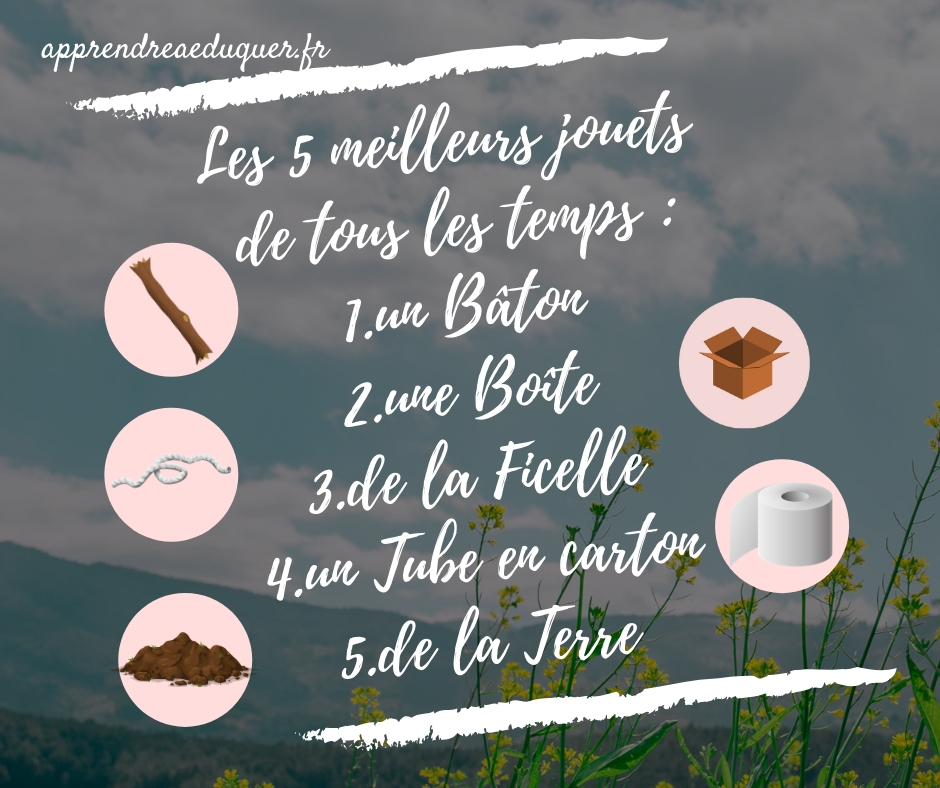
Childhood memories tend to be full of these “games of nothing”: a dandelion flower and three sticks. The developmental psychologist Scott Sampson, in his book on raising a wild child in the city, lists the five best toys of all time as a stick, a box, some string, a cardboard tube and earth. Water, leaves, pebbles and pine cones could easily be added, much like the best airplane toys that spark open-ended play.
What makes these objects so powerful
Their common point is that they are open: none of them has an assigned purpose. A stick can be a broom or a wand, a sword or a pencil, a walking cane or a cabin post. That ambiguity is exactly what keeps a child thinking, and it pairs beautifully with learning toys that leave room for invention rather than scripting the outcome. Even everyday gear like children’s sunglasses can become part of the adventure.
| Material | Possible uses | What it supports |
|---|---|---|
| Stick | Broom, wand, sword, pencil, cane, cabin post | Symbolic thinking and imagination |
| Cardboard box | House, vehicle, hiding place, tunnel | Spatial play and turn-taking |
| String | Fishing line, leash, bridge, decoration | Fine motor control and planning |
| Cardboard tube | Telescope, tunnel, trumpet, tower | Experimentation with sound and balance |
| Earth, water, leaves | Digging, pouring, sorting, building | Sensory exploration and causality |
What children actually learn while playing
Free play is the means nature uses to show children that they can be masters of their own destiny and to help them discover what they love. That formulation comes from Peter Gray, a developmental psychologist and author of a book on free learning.
In free play, children learn to make their own decisions, to solve their own problems, to create rules and respect them, and to negotiate with others on equal footing. They also learn to master their bodies and their tears, which is no small achievement.
This is why the adult role is best described as that of a “go-between” for nature: giving impulses, sparking something in a heart-to-heart transmission, sharing daily activities without turning them into lessons. The same spirit of shared, unhurried time runs through family memory time, where what children keep is the presence, not the programme. Hands-on projects like making tie dye t shirts and family health habits carry the same spirit.

Safety first, then freedom
The other side of the adult role is to secure the environment in advance, so the child can explore autonomously and take risks without being in danger. Preparing the space is what makes stepping back possible.
It is by making choices and mistakes that children learn causality: if I do this, then the consequence is that. Bit by bit, that understanding is what makes them capable of looking after their own safety. Practical preparation helps here, whether that means checking children's feet before a winter outing or dressing for the weather.
Watching without hovering is the difficult part. Safety measures should not permanently encroach on the child's freedom, or the exploration stops being theirs.

Three guidelines for accompanying a child
The work of Sarah Wauquiez, a kindergarten teacher in a Swiss forest, a psychologist and the author of a book on children of the woods, offers a simple framework for accompanying children at the right measure of their needs.
Time, space, environment
First, leave enough time: a rushed outing becomes an adult schedule imposed on a child's rhythm. Second, leave enough space, so the child can move away, circle back and choose a direction. Third, leave an environment adapted to the young child, which allows exploration while keeping an eye on safety without constant surveillance.
These three guidelines are modest, but they cover most of what goes wrong when adults try to help. If you want to extend the same logic to the toys you bring home, toys for toddlers chosen for openness will serve far longer than a single-purpose gadget, and basket toys can be assembled from what you already have.
My hands-on take
I learned this the slow way. For a long time I planned outings the way I planned lessons, with a goal and a route, and I could not understand why the interest faded within minutes. The day I simply put down a bucket of water, a few sticks and an old cardboard tube and then sat down without saying anything, the play lasted far longer than anything I had arranged.
What changed for me was not the materials but my own posture. I now spend the first few minutes checking the space for anything genuinely dangerous, then I let myself become uninteresting. The hardest part is resisting the urge to name what they are doing or to suggest the next step. When I manage it, the game goes somewhere I would never have thought of, and that is precisely the point.
Frequently asked questions
Is free play the same as letting children do whatever they want?
No. Free play is child-led, but the adult still prepares a safe environment beforehand and stays available. The difference is that the adult does not organise or direct the activity itself.
Do children need toys to learn through play?
Not necessarily. Playing and toys are not synonyms, and many of the most valuable play materials are open objects with no assigned purpose, such as a stick, a box or some string.
What does a child gain from taking small risks?
By making choices and mistakes, children learn causality, meaning that one action leads to a consequence. Over time this helps them judge situations and take care of their own safety.
How much adult involvement is too much?
When an adult constantly corrects, directs or monitors, the exploration stops belonging to the child. Aim to prepare the setting, then observe from a distance and intervene only for genuine safety.
Product Reviews
 Best Toys for Dogs With High Prey Drive |
Best Outdoor Toys for 3-4 Year Olds |
Best Outdoor Toys for 6 Year Olds |
Best Harness for Poodle |
Best LEGO Sets for Adults |
Best Travel Toys for 4 Year Olds on Airplane |
Best Toy Stores in Washington DC |
Best Potty Training Toys |
Best Toys for Tripod Dogs |
Maillot equipe de france







