


Heterosexual men are usually defined by who they desire, but that definition says little about how they love. One provocative essay by a French journalist and essayist opens with a quote from Marylin Frye arguing that saying straight men are heterosexual only means they have sex with women, while almost everything that belongs to love they reserve for other men.
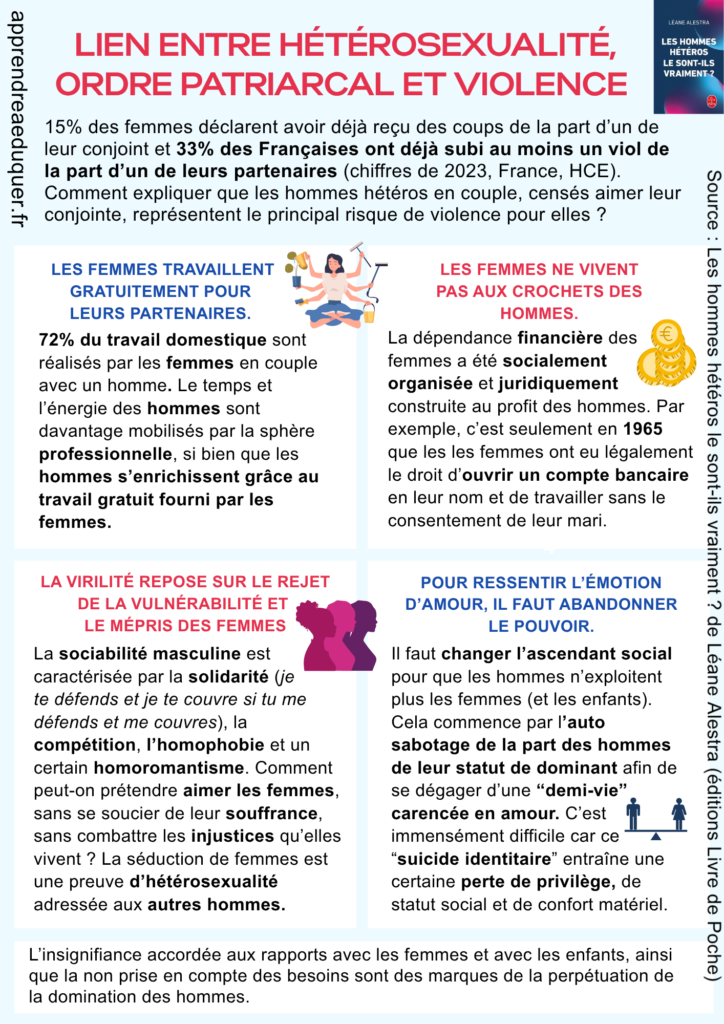
From there the author asks a harder question: how is it that men in couples, men who are supposed to love their partner, remain the main risk of violence for the women who live with them? The figures she cites for France are sobering, with a large share of women reporting blows from a partner and a third reporting at least one rape by a partner.

Quick takeaways
- Desire for women is not the same thing as love for women.
- Boys are taught to devalue the very qualities love requires.
- Male status is often measured in front of other men, not partners.
- Financial dependence was built into law, not chosen by women.
- Vulnerability and shared power are learnable, starting in childhood.
The Contradiction Behind the Question
The title question grows out of a simple contradiction: how can men love women they were taught to look down on since childhood? If a boy learns that listening and empathy are feminine and therefore lesser, then the qualities that make love possible are exactly the ones he is pushed to reject.
The author caricatures the double bind neatly. Men face a permanent injunction to distinguish themselves from women in order to be seen as men, which in practice means devaluing women and the qualities attributed to them. Yet to be recognised as men they also need female conquests, so they must desire and love what they were taught to despise.
What Love Actually Requires
Her definition of love is an intense feeling of affection and attachment toward a living being, pushing the person who feels it to seek physical and intellectual closeness. That love cuts both ways: it can motivate humanity or justify violence, as in the fallacious notion of a crime of passion. Her hypothesis is that a patriarchal society teaches men to possess women, not to love them, because feeling love means giving up power. Parents who want to raise children differently can start early, and even board games feminism can open the conversation at home. Small children are also shaped by everyday experiences, which is why children get car sick more easily when young, and the same early years matter for the lessons they absorb.

Homoromanticism and the Boys Club
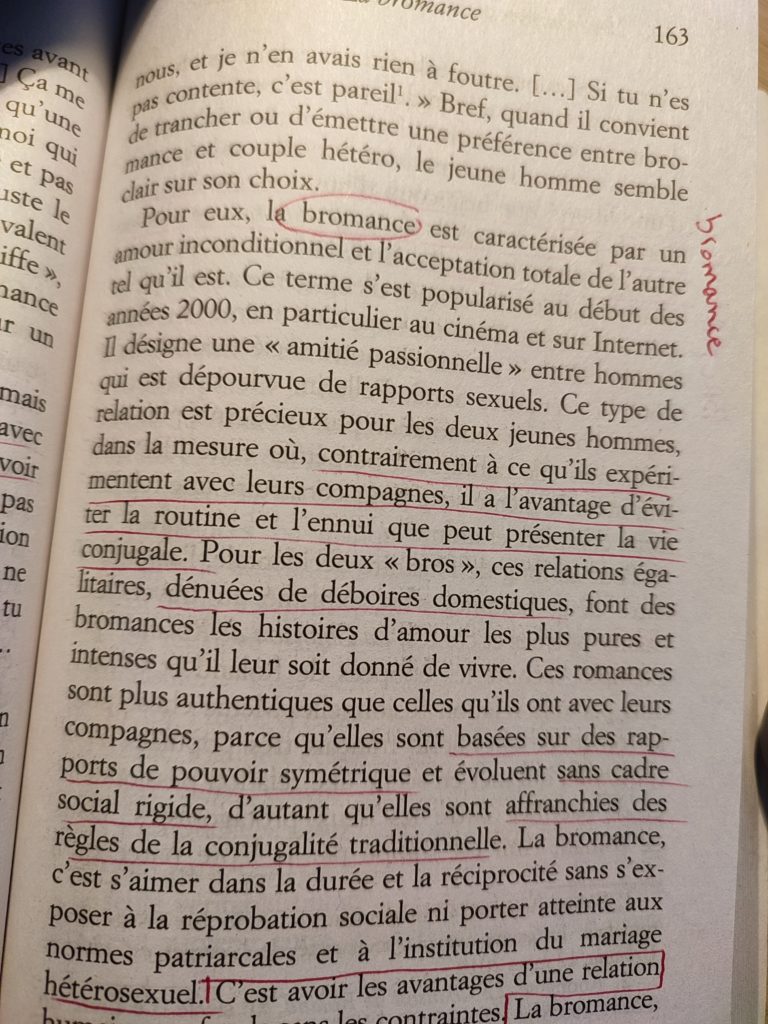
Male sociability, she observes, runs on solidarity, competition, homophobia and a certain homoromanticism. The boys club rewards loyalty of the “I cover you if you cover me” kind, and some of its relational texture could fairly be called romantic: the excitement of being together, admiring other men's performances and hoping to be admired in return.
What men most want to please, then, is other men. Seducing women becomes proof of heterosexuality addressed to the group, and multiplying conquests brings a man closer to hegemonic masculinity, the dominant position at the top of the pyramid. That model rests on self-control and the rejection of vulnerability, and every other man has to position himself against it.
Fascination and Repulsion
Hence the duality straight men maintain toward homosexuality, caught between fascination and repulsion, since gay people appear to betray the patriarchal order. The result is co-optation and male intimacy without real intimacy: sexual prowess gets told, feelings do not. Treating relationships with women and children as insignificant, and ignoring their needs, becomes a mark of complicity between men. Building a more equal home is a long project, and it helps to think about practical steps, from second child budget planning to the everyday habits modelled for children, as celebrities with large families often show. Even small rewards can reinforce new habits, much like LEGO Insider points add up over time.
| Dimension | Traditional script | Love-oriented practice |
|---|---|---|
| Affection | Reserved for male friends | Shared openly with partner |
| Status | Proved through conquests | Built on reliability and care |
| Emotions | Self-control, no vulnerability | Naming feelings honestly |
| Money | Control and dependence | Transparent, shared decisions |
| Children | Distant, secondary role | Present, hands-on parenting |
Who Really Depends on Whom
The stereotype says women live off men. The author dismantles it: women's financial and material dependence was socially organised and legally constructed by men, for men's benefit. In France, women only gained the legal right to open a bank account in their own name and to work without a husband's consent in 1965.
The consequence is that a woman's sexual and reproductive life can become a resource, a bargaining chip in marital transactions. Men can impose conditions, and the dependence is presented as natural rather than built. Naming that history matters, because a relationship entered from a position of financial weakness is not a free contract between equals.
Why the Detail Matters
Recognising the mechanism changes how couples talk about money, work and childcare. It also changes what children learn, since sons and daughters absorb these arrangements long before they can question them. Families who want to counter the pattern can look for small, concrete ways to share power at home, much as they would approach any other long-term project, whether Finnish education keys or a family budget.
From Analysis to Everyday Change
None of this is a verdict on individual men, and the essay does not claim to offer one. It is an invitation to notice the scripts that shape desire, status and affection, and to ask whether they leave room for real care. The gap between saying you love someone and paying attention to their suffering is where the work sits.
For parents, the practical takeaway is that children learn masculinity and femininity from the adults around them. Boys who are allowed to be vulnerable, to name feelings and to share chores grow into adults for whom love is not a performance for other men. Reading and discussing these ideas together, the way one might work through a LEGO Ideas project step by step, makes the abstract concrete. Sharing books about democracy can open similar conversations about fairness and care.
Questions Worth Asking Yourself
Do I reserve my tenderness for my partner or for my friends? Do I treat my partner's needs as equal to my own? Do I notice when a joke or a habit reinforces contempt? Honest answers, rather than grand declarations, are what shift a household over time. Family outings to must see attractions can also model shared attention and respect.


My hands-on take
When I first read these arguments, I found myself thinking about small moments rather than big declarations. I remember watching a group of fathers at a birthday party, all standing at the edge of the room while the mothers handled the cake, the tears and the coats. Nobody had decided that on purpose, yet the arrangement was perfectly clear to the children running around them.
What stayed with me is how easy it is to claim love while outsourcing the labour of care. I have tried since then to notice my own habits: who remembers the appointments, who apologises first, who gets to be tired out loud. None of it is dramatic, but I suspect these ordinary details are where the question in that title actually gets answered.
Frequently asked questions
Is the article saying all heterosexual men are violent?
No. It examines a social system that shapes how masculinity is learned and rewarded, not a claim that every individual man behaves the same way. The point is to notice patterns and question them.
What does homoromanticism mean here?
It describes attraction between men that is not necessarily sexual, expressed as excitement at being together and admiring each other's performances. It shows how much male status is negotiated between men rather than with women.
Why does financial dependence matter in a relationship?
When one partner has less money and fewer options, consent and negotiation are uneven. Recognising that history helps couples aim for transparency and shared decisions instead of assumed roles.
Can parents influence this?
Yes, mainly by modelling vulnerability, sharing chores and letting boys express feelings. Small daily habits teach children more about equality than any single conversation.
Product Reviews
 Best Toys for Dogs With High Prey Drive |
Best Outdoor Toys for 3-4 Year Olds |
Best Outdoor Toys for 6 Year Olds |
Best Harness for Poodle |
Best LEGO Sets for Adults |
Best Travel Toys for 4 Year Olds on Airplane |
Best Toy Stores in Washington DC |
Best Potty Training Toys |
Best Toys for Tripod Dogs |
Maillot equipe de france







