


Funny children's books are one of the easiest ways to turn a reluctant listener into a eager reader, and the three titles below have genuine laugh-out-loud appeal for both children and adults.
Each one works differently: a cumulative guessing game, a wordless story children narrate themselves, and a chain of absurd consequences about school. All three are short enough for bedtime and rich enough to reread many times.

You will find the recommended age, what makes each book funny, and simple ways to get more out of every reading session.
Quick takeaways
- Le Machin suits ages 4+ and works as a cumulative guessing game with a hilarious punchline.
- Chapillon is wordless, ages 3+, and invites children to narrate the story themselves.
- 20 Bonnes Raisons d'Aller à l'École uses absurd chain reactions to defuse school anxiety.
- Pause before repeated lines so children can predict and shout the answer.
- Reread favourites often; familiarity builds confidence and vocabulary.
- Borrow from libraries first to test which humour style fits your child.
Le Machin: A Silly Guessing Game for Ages 4 and Up
The title gives the joke away immediately: a "machin" is just a thing, and nobody knows what this particular thing is. Bobo the elephant turns it over and over and decides it must be a bonnet.
Then Kiki the alligator wanders past and mocks him: it is not a bonnet, it is a cape. When Zaza the sheep stumbles on Kiki, she cannot believe her eyes: it is not a cape, it is a skirt. The repetition invites children to predict the next wrong answer, which is exactly the kind of playful turn-taking that builds early narrative skills, much like the toddler toy choices that reward prediction and repetition.
A punchline children love
The ending is as funny as it is unexpected: a little man walks out of the lake completely naked and shouts, "Where are my underpants?" All the animals drop their pieces of the machin at once, crying "Yuck!" because the thing was the little boy's underwear all along.
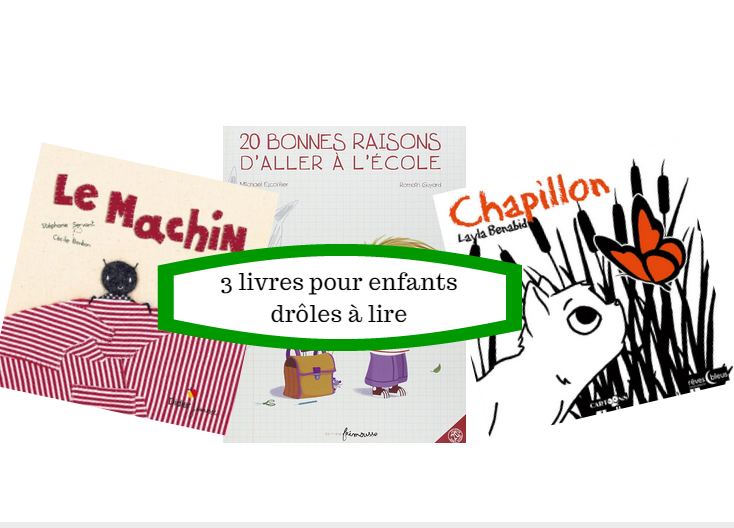
Chapillon: A Wordless Book for Ages 3 and Up
Chapillon contains only pictures, which makes it a genuine support for children to tell a story in their own words. A cat becomes fascinated by a butterfly, works out a strategy, tries several times, lands in one comical situation after another, and finally gets close only when the butterfly itself decides to settle.
The illustrations use just three colours, white, black and orange, and their softness makes them particularly easy to accompany with speech. It is a good support for teaching children to structure a narrative: lending intentions and feelings to characters, describing a scene, and making logical links between actions, all with plenty of humour. Just as every baby breastfeeds in their own way, each child will narrate this story differently.
A gentle message underneath
There is also a quiet moral: you can succeed without doing harm, since the cat ends up able to observe the butterfly without catching it, simply because the butterfly lands softly on its head. That message pairs naturally with conversations about team sports benefits and other activities where children learn to cooperate rather than grab, much like the keys to a happy family after a divorce.

| Title | Age range | Format | Best for |
|---|---|---|---|
| Le Machin | 4+ | Picture book with text | Prediction and repetition |
| Chapillon | 3+ | Wordless picture book | Storytelling and vocabulary |
| 20 Bonnes Raisons d'Aller à l'École | 4+ | Picture book with text | Easing school worries |
| All three | 3-6 | Read aloud | Shared laughter and routine |
20 Bonnes Raisons d'Aller à l'École: Ages 4 and Up
At the end of the school year, motivating a child to go to school gets harder, so this book was chosen to make a stressful subject funny. It opens with a simple statement: if I didn't go to school, I wouldn't know how to read or write. Then it piles on consequences, each one more ridiculous than the last.
If I couldn't read, I would confuse the labels on shampoo and soda bottles, so I would blow bubbles when I spoke, so I would float above the house, so the wind would carry me far from home. And if my bubble burst, I could land on pirates, until a shower of meteorites hits the Earth. But that is not possible, so the conclusion is clear: it is probably better to go to school.
Turning anxiety into laughter
Humour defuses worry, and this chain-of-events structure is easy for children to imitate. Ask your child to invent the next link in the chain; the sillier the better. For children who need to burn energy before sitting down to read, outdoor toys can help set up a calmer reading routine afterwards.

How to Get More Out of a Funny Read-Aloud
Read the same book several times and let your child take over the repeated lines. With Le Machin, pause before each animal speaks and let them shout the wrong answer. With Chapillon, hand the storytelling over entirely and ask open questions: what is the cat feeling now, what will it try next?
Keep the tone light and stop before fatigue sets in. A short, happy session is worth more than a long one, and the same principle applies to routines around the home, whether you are managing working from home or simply building a bedtime habit.
Where to find these books
All three titles are available in public libraries, on online retail sites or from your local bookshop. Borrowing first is a smart way to test which humour style suits your child before buying, and a library visit is itself a nice outing.

Building a Reading Habit Around Humour
Funny books are a gateway: once a child associates reading with laughing, they ask for more. Keep a small basket of picture books within reach and rotate the selection every week or two so the collection feels fresh.
Mix wordless books, which build vocabulary and narrative skills, with text-heavy ones, which stretch attention. If your child is drawn to characters and collectibles, the same enthusiasm can spill over into other interests, from LEGO Batman sets to outdoor play. You might even wonder how much as a collector keepsake.
Finally, do not underestimate the power of a shared joke. A phrase from a favourite book that your family repeats becomes a small ritual, and rituals are what make children come back to books again and again. Much like your first night away, a beloved story can become a comforting touchstone.



My hands-on take
In our house, the wordless one gets the most mileage. My child started by pointing at the cat and naming colours, and within a few weeks was inventing dialogue for it, complete with dramatic pauses and a very serious narrator voice. It is the book we reach for when everyone is tired, because I do not have to read anything aloud.
The underwear punchline in Le Machin still gets a genuine shriek every single time, even though we all know it is coming. That is the test I use now when choosing a funny book: does it survive the tenth reading? These three do.
Frequently asked questions
At what age can children enjoy these books?
Le Machin and 20 Bonnes Raisons d'Aller à l'École are recommended from age 4, while Chapillon works from age 3 because it has no text. Younger children can still enjoy the pictures and the silly voices.
Why is a wordless book useful?
Without text, the child has to build the story, choose words and link actions logically. That builds vocabulary and narrative skills, and it lets each reading be slightly different.
How do I handle a child who is anxious about school?
A funny book about school can open the conversation without pressure. Read it together, laugh at the absurd consequences, then let your child talk about what actually worries them.
Can we find these books without buying them?
Yes, all three are commonly available in public libraries, as well as online and in bookshops. Borrowing first is a good way to see which one your child responds to.
Product Reviews
 Best Toys for Dogs With High Prey Drive |
Best Outdoor Toys for 3-4 Year Olds |
Best Outdoor Toys for 6 Year Olds |
Best Harness for Poodle |
Best LEGO Sets for Adults |
Best Travel Toys for 4 Year Olds on Airplane |
Best Toy Stores in Washington DC |
Best Potty Training Toys |
Best Toys for Tripod Dogs |
Maillot equipe de france







