


Positive parenting for siblings starts long before the first argument over a toy, and it begins with the adults rather than the children. When a family grows, parents face two intertwined questions: how to prepare an older child for a new arrival, and how to keep the relationship between brothers and sisters warm once the baby is home.
This guide walks through the whole arc of building a family, from the desire for a child and preparation for birth to the everyday squabbles of a growing household. It draws on the approach of a long-time French voice in respectful parenting, whose book on growing families treats sibling life as something to be built deliberately rather than simply managed.

Quick takeaways
- There is no ideal age gap; the parents' self-work matters more.
- Do not sugarcoat the arrival of a baby for the eldest.
- Regression and attention-seeking are normal signals of need.
- Stop aggression physically, then listen to the older child's feelings.
- Protect your energy and build a support network of other parents.
- Cultivate optimism and notice family patterns you may be repeating.
Preparing the older child for a new baby
One of the most useful ideas is that there is no ideal age gap between children. What matters far more is the inner work parents do on themselves, because the arrival of a baby stirs up our own childhood memories. Preparing an older child is therefore less about a perfect timeline and more about honesty.
It is pointless to paint a rosy picture just to reassure the eldest. A brother or sister has every right to feel unenthusiastic. The baby will not share the older child's games for several years, will take up a great deal of time, and will cry in ways that are hard to bear. Listening to those emotions, rather than correcting them, remains the most effective tool for a respectful household. If you are curious about what a baby experiences before birth, it can help to understand baby in womb development when you talk about the newcomer.
Honest expectations beat cheerful promises
Naming the difficult parts out loud gives the older child permission to voice mixed feelings without shame.

Feeding, birth choices and sleeping arrangements
Growing families come in many shapes, and the book explores a wide range of options rather than a single template. It looks at what happens when a mother is still breastfeeding an older child, covering weaning, tenderness and pain, and co-nursing. It also addresses parents who choose a home birth, and the practice of sleeping together as a family.
These choices are presented without judgement, as part of the diversity of family life. If night feeding is part of your reality, practical strategies can make it gentler for everyone, and you can read night breastfeeding tips for handling the wakings without turning them into a battle. Parents weighing a home birth may also want to understand how a surgical birth affects future plans, which is where an explanation of cesarean section and subsequent pregnancies can inform the conversation.
Whatever you decide, the guiding principle stays the same: the emotional needs of each child come first.
| Situation | What it usually means | A respectful response |
|---|---|---|
| Older child regresses | Checking they are still loved | Offer closeness, avoid mockery |
| Constant attention demands | Emotional tank running low | Give focused one-to-one time |
| Older child hits younger | Overwhelmed, cannot express anger | Stop the act, then listen |
| Sibling jealousy | Fear of losing their place | Name the feeling, reassure belonging |
| Parent feels drained | Real need for support | Build a network, cut energy drains |
Understanding regression and attention-seeking
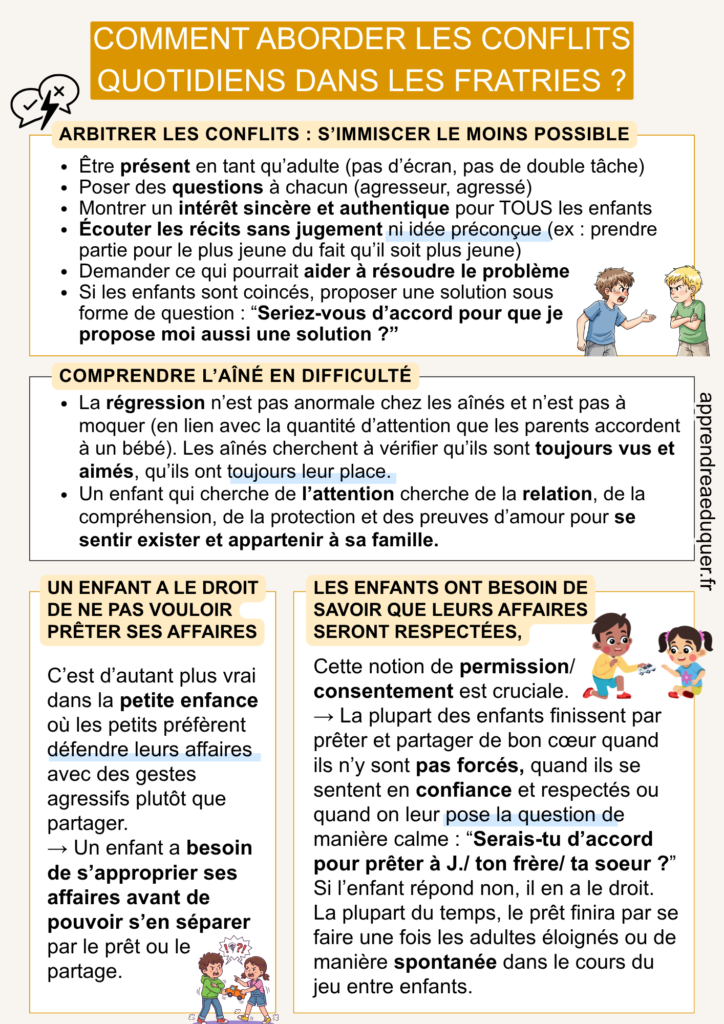
Regression is normal in older children and should never be mocked. A new baby receives an enormous amount of attention, so it is entirely justified for the eldest to check that they are still seen, accepted and loved, and that their place in the family is secure.
The way a child asks for attention tells you something about how full their emotional tank is. A child seeking attention is often seeking relationship, understanding, protection and proof of love, simply to feel that they exist. Recognising this reframes clinginess as communication rather than manipulation.
Parents can support this by naming feelings and offering closeness before behaviour escalates. Learning to read those signals is part of the broader work of reading and writing development in children, since both rely on adults noticing what a child is trying to express. A calm, predictable rhythm at home, much like the structure described in the Montessori method pillars, gives children a sense of security they can lean on.

Handling aggression and daily conflict between siblings
When siblings fight, it helps to remember that the aggressor is struggling too. A child who lashes out is suffering enough that they cannot find another way to be heard. This does not mean letting violence run free; it means reasoning in terms of emotions and needs rather than punishment alone.
The practical response is clear. State your disagreement, and physically stop the older child from hurting the younger one. Then listen to the older child's emotions, because they need your help to discharge their anger and sadness. Staying close through the storm teaches regulation far better than isolation does.
Consistency matters here, and the same respectful stance applies to other adults in a child's life, as explored in helping children respect a caregiver. It also shapes how children treat one another in play, which is why choosing pretend play toys that invite cooperation can quietly reduce friction.

The parent's own resources and inner work
The difficulties of parents, and especially of mothers, are never denied. Supporting several children is genuinely hard, and cutting out unnecessary drains on your energy is a real help. Building your own support network matters too: other parents and friends whose company recharges you are not a luxury but a necessity.
Our childhood wounds and traumatic memories are significant obstacles on the path to gentle parenting. Asking questions about your own upbringing helps you spot what comes from your family pattern and gets repeated with your children, such as always defending the eldest or always siding with the youngest.
Optimism is also presented as a value worth cultivating deliberately. Small rituals of connection, from a shared story to a calm bedtime, echo the reassuring routines described in enjoy your newborn advice and help the whole family breathe. For new babies, practical steps such as learning register a newborn smoothly remove one more source of stress.

My hands-on take
In our house, the honesty advice was the one that changed things. Before our second arrived, I had rehearsed cheerful speeches about how wonderful a little brother would be. It went far better when I simply said that the baby would cry a lot and would not be much fun at first, and that it was fine to feel annoyed about that. My eldest looked almost relieved.
The other lesson I keep relearning is about attention. When my older child starts hovering, interrupting and clinging, my first instinct is irritation. Remembering that this is a request for connection, not a nuisance, usually gets me to sit down on the floor for ten minutes. Those ten minutes prevent far more conflict than any lecture about sharing. I still get it wrong plenty of times, but the direction feels right.
Frequently asked questions
Is there an ideal age gap between siblings?
No. The approach described here holds that no gap is inherently better. What matters most is the parents' own inner work and their ability to listen to each child's emotions.
How should I prepare my older child for a new baby?
Be honest rather than reassuring with cheerful promises. Explain that the baby will not play for a while and will take time and attention, and allow your child to feel unenthusiastic without shame.
What should I do when siblings fight physically?
State your disagreement and physically prevent the older child from hurting the younger one. Then listen to the older child's emotions so they can release the anger and sadness behind the behaviour.
Is regression in an older child a problem?
It is normal and should not be mocked. It usually signals that the child wants to confirm they are still seen, accepted and loved after a new baby arrives.
Product Reviews
 Best Toys for Dogs With High Prey Drive |
Best Outdoor Toys for 3-4 Year Olds |
Best Outdoor Toys for 6 Year Olds |
Best Harness for Poodle |
Best LEGO Sets for Adults |
Best Travel Toys for 4 Year Olds on Airplane |
Best Toy Stores in Washington DC |
Best Potty Training Toys |
Best Toys for Tripod Dogs |
Maillot equipe de france







