


Positive instructions are often presented as the magic key to cooperation, yet many parents discover that a kindly worded request still lands on deaf ears. The problem is rarely the wording itself. Focusing only on the phrases we use leaves out everything else that shapes a child's behaviour.
When a child ignores a gentle request, it helps to look beyond the sentence and ask what is really going on. Emotions, unmet needs, the layout of the room and the child's stage of development all play a role. Understanding these layers turns a frustrating moment into useful information.

Quick takeaways
- Positive phrasing is one tool, not a magic wand for obedience.
- Look for the emotion and need driving the behaviour.
- Redesign the environment to reduce conflict before it starts.
- Check whether your expectations match the child's development.
- Question inherited limits and grant autonomy where you safely can.
- Treat missing cooperation as a skill to teach, not a label to apply.
Why Positive Wording Is Not Enough
Positive instructions are not magic wands, and it is completely normal for a child not to respond to them. The goal is not blind obedience but cooperation built on understanding. When we fixate on how we phrase a request, we overlook the child's fatigue, the environment and whether our expectations match their abilities.
Picture a nursery team carefully crafting gentle sentences to keep toddlers out of a forbidden room. The words are kind and well chosen, yet the children still gravitate toward the door. The phrasing was never the real obstacle. Something else was driving the behaviour, and that something deserves our attention.
This is why positive parenting goes further than a script of nice phrases. It invites us to search for the positive function behind a behaviour and to respect the child's own free will and dignity. Only then can we set limits that are genuinely updated and adapted to the situation.
Start With Emotions and Needs
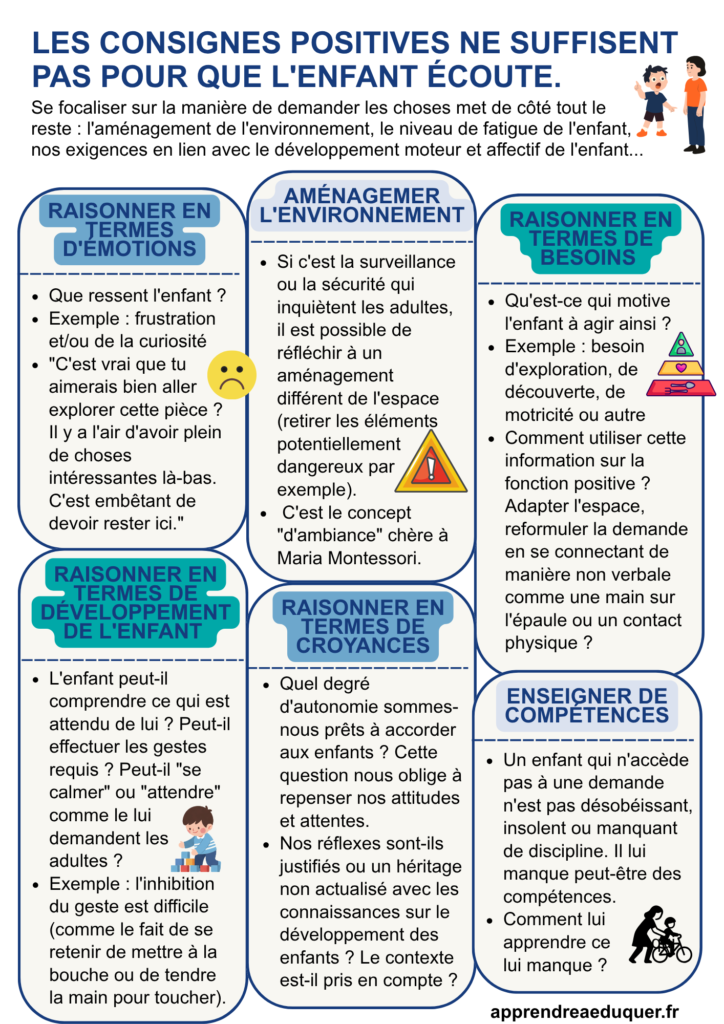
Before changing what we say, it helps to reason about what the child feels. In the forbidden-room example, curiosity and frustration are likely at work. Reflecting those feelings through empathetic listening, such as acknowledging that the room looks fascinating and that staying away is annoying, shows the child we understand.
Next, ask what need is driving the behaviour. A child may be seeking exploration, discovery or movement. Once we identify that positive function, we can respond to it rather than simply repeating a request. A hand on the shoulder or a gentle physical connection often communicates more than words alone.
This reflective approach echoes the way we read other signals from children, much like noticing when a little one is unwell and needs comfort, as with vomiting in children. Behaviour is a message, and our job is to decode it before reacting. The same attentive reading applies to everyday details, such as choosing sunglasses that protect a child's eyes.
Meeting the Need Behind the Act
When a need for movement or discovery is recognised, we can offer an alternative that satisfies it. That might mean redirecting to a safe space full of interesting things to explore, or simply naming what the child wants so they feel seen. Remember that children improve our lives, and their behaviour often reflects that growth.
| Lens | Question to ask | Possible response |
|---|---|---|
| Emotions | What is my child feeling? | Reflect the feeling out loud |
| Needs | What need is behind this? | Offer a safe alternative |
| Environment | Can the space be changed? | Remove hazards, allow access |
| Development | Can my child do this yet? | Simplify or practise the skill |
| Beliefs | Is this limit truly justified? | Revisit habits and reflexes |
Rethink the Environment First
Sometimes the simplest solution is to change the space rather than the sentence. If a room is forbidden only because of safety worries, consider removing the dangerous items and letting children explore under supervision. The environment itself can do much of the work of guiding behaviour.
This is close to the Montessori idea of a prepared environment, where obstacles are reduced to a minimum. Toys and objects sit at child height, are few in number, made of natural materials and chosen to match developmental needs. A well-designed space supports concentration and movement without constant correction.
The same logic applies to playthings. Choosing open-ended items that match a child's stage, such as the options in this guide to pretend play toys, reduces frustration and the battles that come with it. A thoughtfully arranged room is quietly doing the parenting alongside you.
Match Expectations to Development
Ask yourself whether the child can actually understand and carry out what you are asking. Can they perform the required gestures, wait, or calm down on cue? Sometimes our expectations simply exceed what a young child is capable of, and the request is doomed before it is spoken.
Inhibiting a gesture is genuinely hard for young children. Resisting the urge to touch or put something in the mouth goes against impulses they cannot yet control. Recognising this reframes the moment from defiance to a developing skill that needs practice and patience.
It also helps to notice how quickly children grow and change. Just as you would adjust expectations for a newborn learning to settle, as explored in newborn adaptation, you adjust them for a toddler learning self-control. The same patience applies when choosing learning toys that match their stage. Development, not willpower, sets the pace.
Examine Your Own Limits and Beliefs
As adults, we can question the legitimacy of certain limits we impose. How much autonomy are we truly ready to grant? This question forces us to revisit our habits and reflexes and to ask whether they are justified or simply inherited assumptions that no longer fit what we know about child development.
A confident, encouraging and reassuring posture tells the child we trust them and are there if needed. At the same time, the space must be secured, balancing children's needs with adults' need to relax enough to allow free exploration. Safety and freedom are not opposites when the environment is designed well.
This reflective stance is part of a broader shift in how we see our role, one that treats children as capable and worthy of respect rather than as problems to manage. It is a mindset change more than a technique.
Teach Skills Instead of Labelling
A child who does not follow a request is not automatically disobedient, insolent or lacking discipline. Often they are simply missing a skill, and we can help build it. This reframing is kinder and far more useful than attaching a label to a developing person.
Teaching a skill might mean practising how to wait, showing how to ask for a turn, or modelling what to do instead of grabbing. It takes repetition and patience, much like any learning. Over time, these small lessons accumulate into real competence.
The early years are full of these developmental leaps, and understanding them helps us respond with perspective. Whether you are navigating the social world of a six-year-old, as discussed in six-year-old cruelty, or the first steps of independence, skills grow through guidance rather than punishment. The same patient approach applies when you start searching or help a child follow LEGO instructions online.

My hands-on take
I remember repeating the same softly worded request to my child about a cupboard I wanted left alone, and feeling baffled when it changed nothing. What finally helped was stepping back and asking what was actually drawing them there. It turned out to be curiosity about the shiny objects inside, so I moved the breakables up and gave them a low shelf of their own to explore.
Since then, I try to run through a quick mental checklist before I repeat myself: what are they feeling, what do they need, and is the room working against me? It does not solve everything, and some days I still lose my patience. But shifting from "how do I phrase this" to "what is really happening" has made our home calmer and my expectations far more realistic.
Frequently asked questions
Does positive parenting mean never setting limits?
No. Positive parenting is not about avoiding limits but about setting limits that are thoughtful, updated and adapted to the child. The aim is cooperation and respect, not blind obedience.
Why does my child ignore gentle requests?
Often the wording is not the issue. Fatigue, unmet needs, an unsuitable environment or expectations beyond the child's development can all explain why a request is ignored.
What if a room simply must stay off-limits?
If safety is the concern, secure the space and remove hazards so adults can relax. When access is possible, a prepared environment lets children explore safely and reduces constant correction.
How do I teach a skill my child lacks?
Break it into small steps, model the behaviour and practise patiently. Treating it as learning rather than misbehaviour keeps the tone encouraging and builds real competence over time.
Product Reviews
 Best Toys for Dogs With High Prey Drive |
Best Outdoor Toys for 3-4 Year Olds |
Best Outdoor Toys for 6 Year Olds |
Best Harness for Poodle |
Best LEGO Sets for Adults |
Best Travel Toys for 4 Year Olds on Airplane |
Best Toy Stores in Washington DC |
Best Potty Training Toys |
Best Toys for Tripod Dogs |
Maillot equipe de france







