


Fun writing activities for kids work best when they feel like play rather than a lesson. The aim is simple: let the child write calmly, at their own pace, and let questions come naturally, such as "how do you spell this word?" or "what goes at the end of plural words again?"
Below you will find ten ideas that introduce children to the diversity of writing, from tracing letters in sand to filling speech bubbles in a comic. None of them requires a formal workbook, and most use things you already have at home.

Quick takeaways
- Let the child write calmly and ask questions when they are ready.
- Sand, semolina and steamy windows make letter shapes physical and easy to correct.
- Start Montessori letter Memory with five letters, not the full set of 52.
- Real readers, such as grandparents or penfriends, give letters a purpose.
- Shopping lists, invitations and entry forms turn writing into a useful task.
- Automatic writing releases pressure by removing the fear of mistakes.
Trace letters in sand, semolina or on a steamy window
Start with the body before the pencil. Children can trace letters, words and even whole sentences in a tray of sand or semolina, which makes the shape of each letter physical and easy to correct with a gentle shake. Writing on windows or a mirror works the same way, and chalk markers are perfect for it because they wipe off very easily.
This is also a low-pressure way to revise. Why not practise the words of a spelling test by writing them on the glass? The child can rub out a mistake without crumpling paper, and the novelty of writing somewhere unusual keeps attention longer than a worksheet would.
Keep it short and playful
Two or three words are enough for a first session. If your child enjoys hands-on materials, the same principle of learning through touch sits behind many Montessori toys and other sensory tools you may already own. For outdoor practice, pair these activities with outdoor toys, and if you head outside, check whether anti mosquito bracelets are worth packing.

Play Memory with Montessori rough letters and picture cards
This game uses the rough letters from a Montessori box, together with picture cards. It works with two or more players, as soon as the children know the sound each letter makes.
You can play with all 52 cards, 26 letters and 26 pictures, but it is wiser to begin with just five letters. Each player turns over two cards in turn, one letter and one picture, which are easy to tell apart because the backs differ. If the two cards match, meaning the picture begins with that letter, the player keeps them and plays again. If not, both cards go back face down and the next player takes a turn. The game ends when all cards are collected, and the winner is the one with the most pairs.
Why the matching matters
Matching a sound to a shape is the first step towards spelling, and it pairs well with the fine motor practice children get from fine motor toys that ask the hand to work precisely. For more playful ways to build early literacy, try these English games, and for curious older siblings, these science toys keep hands and minds busy.

| Activity | Best age range | Main benefit |
|---|---|---|
| Sand or window tracing | 4-6 years | Letter shapes and motor control |
| Montessori letter Memory | 5-7 years | Linking sounds to letters |
| Letters and postcards | 6-10 years | Writing for a real reader |
| Comic bubbles and captions | 8 years and up | Story structure and imagination |
| Lists and invitations | 6-10 years | Everyday purpose |
| Automatic writing | 8 years and up | Freedom from perfectionism |
Write letters and correspond with other people
A letter gives writing a real reader. Children can write a love note for a family birthday, copy out a poem for Mother's Day or Father's Day, send a holiday postcard to grandparents, or write to an imaginary character or a penfriend anywhere in the world.
At first, the adult can write while the child dictates. Gradually the child writes more and more words, and the parent leaves blanks for the words the child can spell. Later, the older child leaves blanks for the parent to fill in or correct a word whose spelling they do not know.
Finding a penfriend
If you would like to try correspondence at a distance, the site postcrossing.com lets you receive real postcards from around the world. The site is in English, but you can correspond in French simply by saying so when you sign up: you create an account, request an address, send a postcard there, and receive one back from somewhere in the world.
Caption anti-colouring pages and fill comic bubbles
Anti-colouring books are drawings to complete rather than to colour in, designed so children develop their imagination. Instead of being handed a picture to fill, the child is invited to invent a story from an image: guided, but not restricted. Once the drawing is finished, the child can write the caption for it. Anti-colouring books are sold in shops or can be printed online, and festive prompts like these Christmas recipes show how everyday activities can feed a child's creativity.
Comics are another natural route in. A workshop book such as the second volume of the Hergé comic workshop, which teaches how to tell a story, can help you get started: what is a scenario, how do you organise a page, what shape should a panel take? Young comic readers from about eight who dream of making their own will find guidance there, especially on building a plot and the rules of narration. As my pediatrician reminds us, parents are the mirror in which children reflect themselves every morning.
Making a book
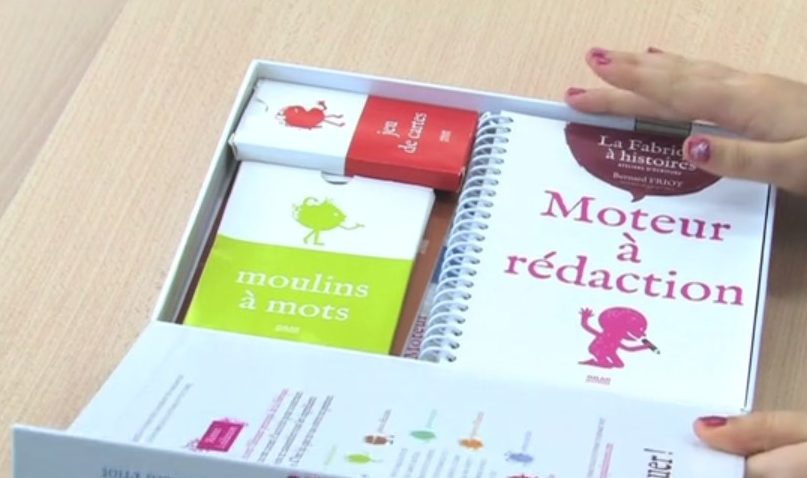
A story-making kit, presented as a case with pictures, drawings, words, a notebook and sentence starters, offers ideas for building stories from primary school to secondary. The prompts are varied, funny and original, so they suit children short of inspiration as well as those who love inventing tales. For more open-ended prompts, these creativity games work in the same spirit.

Give writing a real purpose: lists, invitations and competitions
Purpose is a powerful motivator. Ask your child to write the shopping list, and the task becomes useful rather than academic. In the same way, children can write the invitation cards for a birthday, the menu for a Christmas meal, or the place cards for a family dinner.
Competitions with an entry form to send by post work surprisingly well. You will find them on children's TV channels and in children's magazines, and you can also create one yourself to match your child's tastes. I once made a sweets-themed spy competition for a pupil: six questions to answer in writing, then the whole thing sent to an address, my mother's in fact. He usually disliked writing, yet he stayed focused and careful for over an hour, answered every question and wrote both the recipient's and the sender's address on the envelope. Children are delighted to receive a reply, whether they win or lose.
Automatic writing to finish
Automatic writing starts like a classic school exercise. The adult can even play the serious, strict teacher: "Take a sheet of paper and a pencil. At my signal, write without stopping, even if it is nonsense, without thinking."
My hands-on take
In my own experience, the biggest shift comes when writing stops being an exercise and starts being a message to someone. I have watched a child who avoided pencil work sit happily for an hour filling in a competition form because there was an envelope to address and a reply to expect. The same happened with postcards: choosing the picture, writing three lines and sticking on the stamp turned a chore into a small event.
I also learned to keep sessions short and to let the child lead. When a question about spelling comes from them, the answer sticks far better than when I announce a rule. If you want to go further, remember that you can learn with children as much as you teach them: their curiosity often shows you which activity to offer next.
Frequently asked questions
My child hates writing. Where should I start?
Begin with something physical and short, such as tracing a few words in sand or on a window. Then move to a task with a real purpose, like a shopping list or an entry form, so writing produces a visible result.
Do I need special materials?
No. Sand, semolina, chalk markers and paper cover most activities. A Montessori letter box is helpful for the Memory game, but you can start with homemade letter cards.
How long should a session last?
Keep it short and stop while the child is still enjoying it. Ten to fifteen minutes is plenty for younger children, and interest will grow if the activity never feels like a chore.
Should I correct spelling mistakes?
Not during the writing itself. Let the child finish, then look at one or two words together, or leave a blank for a word they cannot spell and fill it in later.
Product Reviews
 Best Toys for Dogs With High Prey Drive |
Best Outdoor Toys for 3-4 Year Olds |
Best Outdoor Toys for 6 Year Olds |
Best Harness for Poodle |
Best LEGO Sets for Adults |
Best Travel Toys for 4 Year Olds on Airplane |
Best Toy Stores in Washington DC |
Best Potty Training Toys |
Best Toys for Tripod Dogs |
Maillot equipe de france







