


Reasoning in terms of needs is a simple but powerful habit: instead of reacting to a child's behaviour, you look for the unmet need behind it. Every action, whether it comes from a child or an adult, is driven by a positive intention — to feed a fundamental need that is not being satisfied.
Michel Claeys-Bouuaert, a therapist and trainer specialising in emotional education, argues that children need help and positive models as they learn. Communication becomes far more effective when we can identify and express our own needs, and name the unmet needs hiding in other people's messages.

This guide explains how emotions work as signals, how to separate needs from strategies, and how to respond to tantrums, hitting or shouting without sliding into power struggles or verbal violence.
Quick takeaways
- Every behaviour, even an inappropriate one, is driven by a positive intention to meet a need.
- Separate the need from the strategy: many actions can satisfy the same fundamental need.
- Emotions are alarm signals pointing to an unmet need in you or in your child.
- Express your own needs with authentic, positive I-statements rather than complaints.
- Translate your child's screams, hits and demands into words to lower the tension.
- Reasoning in terms of needs can be learned at any age and is a first step toward non-violence.
Needs Behind the Tantrum
Every human being shares the same basic needs, and satisfying them produces pleasant emotions while leaving them unmet produces unpleasant ones. The key distinction is between a need and a strategy: a strategy is the action we take to meet a need. One person may meet their need for rest by going to bed early, another by taking a nap. Both are valid routes to the same need.
This matters because parents often argue about the strategy rather than the need. A child who refuses to get dressed is not attacking you; something underneath is asking for attention. Learning to read the child language development behind a demand helps you hear what is really being asked, and the same patience applies when you help a child write or master any new skill. Just as stories make maths fun, a little playfulness can ease the tension.
Same Needs, Different Strategies
When you separate the two, you stop fighting the behaviour and start solving the real problem. That shift alone removes a great deal of daily friction, and family health habits benefit too.
Emotions Are Alarm Signals
Emotions emerge to draw attention to an unmet need. In a sense, they warn us that we have lost touch with what we actually require. Your emotions point to a need that is unmet in you, and your child's emotions point to a need that is unmet in them.
The more practised you become at linking your own emotions to your own needs, the better you will be at linking your child's emotions to theirs. This is the heart of emotional education: finding the unmet need hidden behind a feeling, because needs are life seeking expression.
This is why emotional regulation deserves the same attention as physical care — just as you would track baby sleep hours or understand what it means to breastfeed on demand, you can learn to read emotional signals before they escalate. The same attentive care applies to pregnancy monitoring and to little ones backs.

| Situation | Possible unmet need | A response that translates the need |
|---|---|---|
| Child screams when a toy is taken | Fairness, consideration | "You wanted your turn. That felt unfair." |
| Child hits at bedtime | Closeness, rest | "You want me near you. Bedtime feels hard." |
| Child demands loudly | Autonomy, being heard | "You want to choose. Let's find a way." |
| Child refuses to get dressed | Autonomy, play | "You'd rather keep playing. Two more minutes." |
| Child cries after a busy day | Rest, calm | "So much happened today. You need quiet." |
Two Plans for Parents
Reasoning in terms of needs can be learned at any age and is a first step toward non-violence. In an adult-child relationship, you can work on two levels at once.
First, express your own needs as a parent in personal language (I-statements), authentically and vulnerably, and positively — saying what you need rather than what you don't need. Second, learn to translate your child's messages into words, especially when those messages are inappropriate: a rage crisis, a slap, a scream, an unreasonable demand.
Modelling What You Want to See
The more children are in contact with adults who express their own needs and translate inappropriate requests into needs, the more those children develop their own ability to communicate about needs. This mirrors how children absorb so much from daily life, from the baby's space in the onwards through every stage of growth.

Turning Behaviour into Words
Consider a few everyday scenes. A child screams because a sibling took a toy: behind the scream may sit a need for consideration or fairness. A child hits at bedtime: perhaps a need for closeness or rest. A child demands something loudly: often a need for autonomy or to be heard.
Your job is not to guess perfectly but to offer a hypothesis in words and let the child correct you. "You really wanted that turn, and it felt unfair" opens a conversation; "stop shouting" closes it.
Children under stress need calm adults, and this holds in every setting, whether you are managing swimming with a child with or simply navigating a supermarket meltdown.

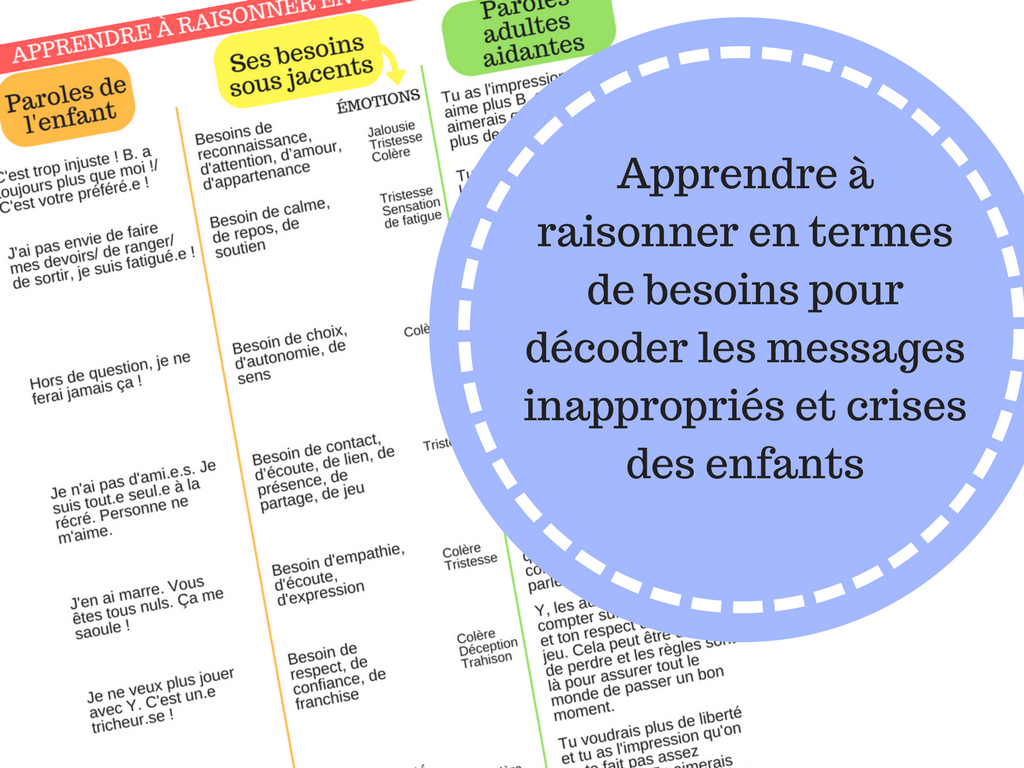
A Working Poster of Examples
A useful exercise is to build a simple poster of everyday situations that serves as a working base for finding the unmet need behind a behaviour. This base is not meant to declare what you "must" do or to offer a copy-and-paste model — it is an illustration of what an exchange founded on needs and emotions can look like.
You are invited to find other ways to respond in the situations shown, or to imagine other tricky moments that could be approached from this angle, in order to avoid escalation toward power games and verbal violence.
Keep the poster visible where conflicts tend to happen, and revisit it together. Small, repeated rituals like this do more for family peace than any single perfect response.

My hands-on take
In our home, the biggest change came from pausing before I replied. When my youngest would shout for something across the room, my reflex was to correct the tone. Instead, I started naming what I thought was underneath: "You really want my attention right now." Sometimes I got it wrong, and that was fine — being corrected was itself a conversation.
I also began using I-statements about my own limits, honestly and without drama: "I'm tired and I need ten quiet minutes." It surprised me how often that worked better than repeating an instruction louder. The poster idea appealed to me because it turns theory into something visible on the wall, something the whole family can point to when words get hard.
Frequently asked questions
What does "reasoning in terms of needs" actually mean?
It means looking past a behaviour to the fundamental need it is trying to satisfy. Instead of judging the action, you identify the need and respond to it, which is far more effective than punishment or negotiation.
Is this only for children?
No. Adults have the same fundamental needs, and the same habit works in couple and family relationships. The more you connect your own emotions to your own needs, the easier it becomes to read your child's.
Does this mean I never set limits?
Not at all. Limits remain necessary; the difference is that you set them while acknowledging the need underneath, which reduces escalation and keeps the relationship intact.
Can I start even if my child is already older?
Yes. Reasoning in terms of needs can be learned at any age. Start with one recurring conflict and practise translating it into needs before you respond.
Product Reviews
 Best Toys for Dogs With High Prey Drive |
Best Outdoor Toys for 3-4 Year Olds |
Best Outdoor Toys for 6 Year Olds |
Best Harness for Poodle |
Best LEGO Sets for Adults |
Best Travel Toys for 4 Year Olds on Airplane |
Best Toy Stores in Washington DC |
Best Potty Training Toys |
Best Toys for Tripod Dogs |
Maillot equipe de france







