


Nonviolent Communication offers parents a different way to talk about rules: instead of imposing limits from above, it invites us to express our own personal limits honestly. The approach, developed by Marshall Rosenberg, shifts the focus from controlling a child's behavior to naming what is happening inside us.
This matters because children are not simply testing us for the sake of it. They are exploring their own capacity to act while secretly looking for a boundary to push against. Our job is to separate their legitimate aspiration from the strategy they use to reach it.

When we speak from our feelings and needs rather than from blame, we stay connected while still saying a clear no. The phrases below are simple, repeatable, and surprisingly effective.
Quick takeaways
- Express your own limits rather than imposing rules from above.
- Separate the child's healthy aspiration from the strategy they use.
- Name your feeling and need instead of blaming or punishing.
- Use short, honest phrases such as "this is what it does in my heart."
- Always close with a question about how the child feels.
- Keep the tone warm and firm at the same time.
Listening to the Child's Needs
Nonviolent Communication begins with understanding the motivation behind behavior. A child who mocks, answers back, searches for a reaction or provokes is usually trying to test their own power of action while looking for a limit to meet. That aspiration is healthy; the way they go about it may not be.
The parent's task is to differentiate the aspiration from the modality, the strategy used to reach it. Being disrespectful is one strategy a child uses to meet two needs at once, but it is not pleasant for the parent, and the parent has to say so.
Separating intent from strategy
This distinction keeps us from labeling the child as rude or difficult. Instead, we can acknowledge the need underneath while naming the strategy that does not work for us. If aggression keeps showing up in these moments, it can help to look at control his aggression with calm, practical tools rather than punishment.
Listening does not mean accepting everything. It means understanding first, then responding from a place of clarity rather than reaction.
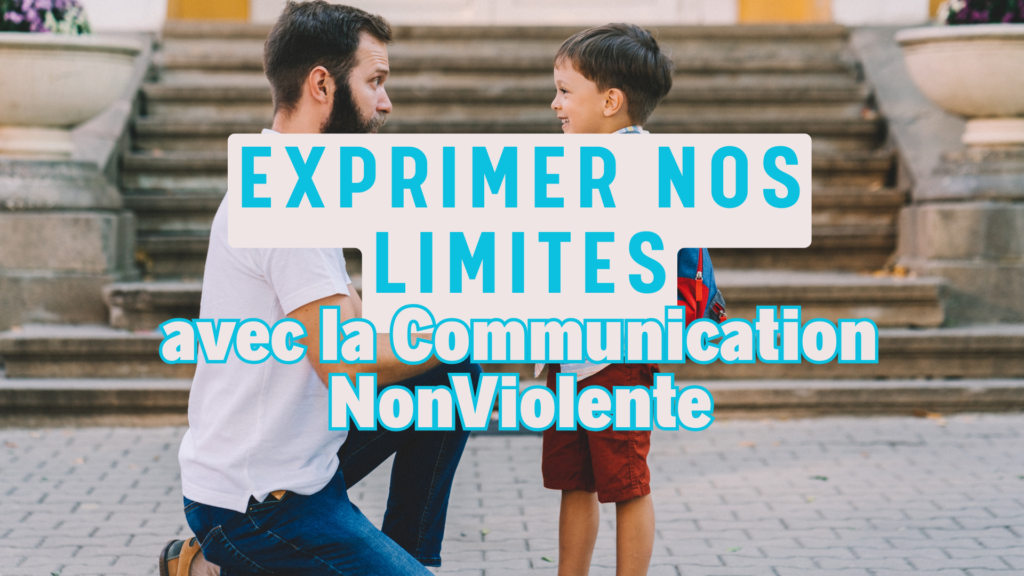
Expressing Your Own Needs and Feelings
As a parent, the aim is to measure the consequences of actions in ways other than punishment or reward. Nonviolent Communication does this by turning the spotlight on our own experience: what we feel, and what we need.
A simple formula works well: describe the situation, name your feeling, then state your need. "It is not pleasant for me when… I love you and I want to help you, but this way of doing things really does not suit me." The statement is firm and warm at the same time.
Words that carry the message
You can also say: "When you do that with me, I feel sad, it hurts my heart, I feel something closing in my heart. So I don't feel like playing with you, I no longer feel joy reading you a story." The consequence is relational, not punitive.
Another version: "I love you, I love being with you, I love taking care of you. But when you mock me or pull faces, the consequence is that I no longer feel like it, I feel less joy beside you." These sentences stay honest without shaming the child. The same calm, connected tone also helps when a hip sprain makes a child irritable and limits play.

| Approach | What the parent says | Effect on the relationship |
|---|---|---|
| Punishment | "Go to your room, that's enough." | Child feels rejected, focus on consequence |
| Reward | "If you behave, you get a sticker." | Behavior becomes transactional |
| Blaming | "You are being rude again." | Child defends or shuts down |
| Expressing a limit | "It hurts my heart when you mock me." | Child hears impact, stays connected |
| Inviting dialogue | "And you, how do you feel?" | Child names their own experience |
Six Key Phrases to Keep in Mind
These short phrases become anchors you can reach for in the middle of a tense moment. They translate the Nonviolent Communication process into everyday language a child can actually hear.
Here is what they sound like: "This is what it does in my heart." "It makes me sad." "I no longer feel the tenderness between us." "My desire goes away." "And for you, how is it?" "And you, how do you feel?"
Why the last two matter most
The final two questions turn a monologue into a dialogue. After expressing your limit, you invite the child to name their own experience, which keeps the door open rather than shutting it. This is where trust is built, one small exchange at a time.
If your child is going through a phase of harsh words, hate you, mom moments can be met with the same calm honesty instead of escalation. The phrases do not always land perfectly, and that is fine. What counts is the direction you are moving in, again and again.

Making It Work Day to Day
Expressing limits this way takes practice, and it works best when the rest of family life supports it. Predictable routines, calm transitions and a little preparation all make those hard moments easier to handle.
For younger children, choosing toys that invite focus rather than overstimulation helps reduce friction, and a look at quiet toys can give you ideas for calmer play. Play itself is a powerful outlet, so outdoor toys are worth keeping in rotation for burning off energy before difficult transitions.
Building the environment around the words
For babies and toddlers, the physical setup matters too; six month old toys and similar guides help you match stimulation to developmental stage. As children grow, Montessori climbing toys offer a safe way to test physical limits, which can reduce the need to test relational ones.
Older children benefit from structured play as well, and knowing LEGO instructions or how to find them keeps them engaged in focused building. For those curious about the people behind the bricks, it is worth asking how much master builders earn. None of this replaces the conversation, but a supportive environment makes the conversation far easier to have.
My hands-on take
I started using these phrases almost by accident, during a week when my patience was thin and punishments were piling up without changing anything. One evening, instead of sending my son to his room, I said quietly that it hurt my heart when he mocked me and that I no longer felt like reading his story. He went very still, then asked if I was really sad. We talked for ten minutes, and the story got read after all.
It does not work every time. Some days I fall back into old habits and hear my own sharp voice before I can stop it. But the phrases have become a kind of reflex I can reach for, and the questions at the end, "and you, how do you feel?", have opened more conversations than any consequence ever did. My advice is to pick one phrase and practice it for a week before adding another.
Frequently asked questions
Does expressing my limits mean I never set rules?
No. It means you state your personal limit honestly instead of imposing a rule from above. The boundary is still clear; only the way you communicate it changes.
What if my child laughs when I say it hurts my heart?
That reaction is common and does not mean the message failed. Stay calm, repeat the limit simply, and avoid turning it into a debate or a punishment.
Is this approach only for older children?
It works from early childhood onward, adapted to the child's language level. With very young children, keep sentences short and pair words with a calm tone.
Do I have to use these exact phrases?
Not at all. The phrases are examples to help you find your own words. What matters is naming your feeling and need honestly, then inviting the child to share theirs.
Product Reviews
 Best Toys for Dogs With High Prey Drive |
Best Outdoor Toys for 3-4 Year Olds |
Best Outdoor Toys for 6 Year Olds |
Best Harness for Poodle |
Best LEGO Sets for Adults |
Best Travel Toys for 4 Year Olds on Airplane |
Best Toy Stores in Washington DC |
Best Potty Training Toys |
Best Toys for Tripod Dogs |
Maillot equipe de france







