


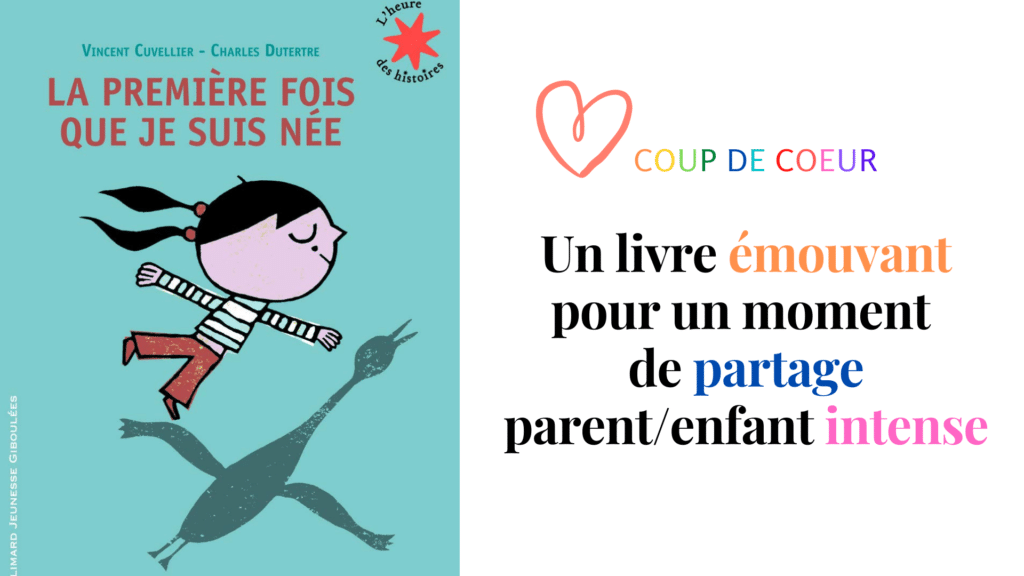
La première fois que je suis née is a deeply moving and poetic picture book to discover as a pair, creating an intense moment of sharing between parent and child. Written by Vincent Cuvellier, it belongs to that rare category of books that stay with you for life.
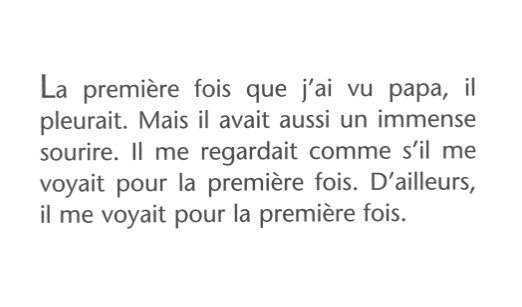
With tenderness and humour, it retraces a child's first times: birth and the first meeting with the parents, a father's tears of joy, the first bath, the first step, the first dream, the first holidays, the first friendships and loves, the first outings, the first adolescent heartaches, right up to the moment the grown woman carries a child of her own.

Quick takeaways
- A poetic, emotional picture book by Vincent Cuvellier, published by Gallimard Jeunesse.
- Traces a child's first times from birth to adulthood, closing with the grown child becoming a parent.
- Illustrations blend magic, humour and tenderness, often all at once.
- Can be read as the mother's story, the parent's projection, or the cycle of life itself.
- Recommended from age six; best read aloud, slowly, with room for questions.
- A meaningful gift for a birth, a birthday, or a family expecting another child.
What Makes This Book So Special
Each page describes one first time, and each is illustrated sometimes with magic, sometimes with humour, sometimes with tenderness, and often with all three at once. Reading it often drifts close to poetry and philosophy, which is exactly why it works so well as a shared short Christmas stories style ritual rather than a book simply handed over.
The book can be read from several points of view. Is it the mother telling her own story to the child? Is the parent telling the child's story and projecting into the future? Or is it about the cycle of life in general, and that unconditional love which unites a parent and a child? It pairs beautifully with quiet reflections on the mother's sleep in those early days.
A Book That Says I Love You
However you interpret it, the book is a way of saying I love you and of passing on a message of confidence, in oneself and in life. It is read with a great deal of emotion, perhaps even tears, and it tightens the bonds between parents and children.
The First Times It Retraces
The journey begins before words: the arrival, the encounter, the joy that overwhelms a father. From there the book moves gently through the small landmarks of early life, the first bath, the first step, the first dream, the first holiday, the first friendships and first loves, then the first outings and the first heartaches of adolescence.
For parents in the thick of the newborn stage, those early pages resonate differently. If you are wondering whether the baby hear sounds and voices before birth, or how much a newborn actually takes in, this book gives you a gentle, non-technical way to talk about it with an older sibling. It also pairs well with reflecting on holding the baby close in those first days.
Because the story ends with the grown woman carrying her own child, it quietly closes the circle. That makes it a natural companion to conversations about stronger bonds between siblings and about how a family's story keeps being passed down, and it echoes the words mothers hear along the way.
| Age | What the child notices | How to read it |
|---|---|---|
| Around 6 | The pictures and the funny moments | Read aloud, pause often |
| 7 to 8 | Their own first memories | Ask what they remember |
| 9 to 10 | The idea of growing up | Talk about the ending |
| Parent reading alone | The cycle of life | Expect some tears |
Reading It Together, From Age Six
The book is recommended from age six, which is roughly when children begin to grasp the idea of their own past and to ask questions about their own first times. Reading it aloud invites exactly those questions, and the illustrations give children something to point at while they think.
It also works as a bridge to other shared reading, whether you are building a shelf of open ended toys and books for toddlers or looking for stories that suit an older child's growing curiosity. Keep it somewhere reachable rather than on a high shelf; children often return to it on their own.
How to Get the Most Out of It
Read slowly, pause on the pages your child lingers over, and let them tell you about their own first memories. You do not need to explain the philosophical layers; children absorb the feeling of the book long before they can name it.

Why It Works as a Gift
This is a book that suits a birth, a birthday, or simply a quiet evening. It sits comfortably alongside the practical side of early parenthood, the new mother's medicine cabinet, the creams, the night feeds, as the emotional counterpart to all that logistics.
It also makes a thoughtful present for a parent expecting a second child, since it speaks to the whole arc of a childhood rather than to a single stage. Paired with something small and tactile, such as one of the toys for newborns, it becomes a genuinely useful gift rather than a decorative one.
For a family with older children, it can be wrapped alongside party favor toys for a birthday, or simply given on its own with a note about a first memory you remember yourself.

Where to Find It
La première fois que je suis née by Vincent Cuvellier, published by Gallimard Jeunesse, is available in libraries, in bookshops, and online. It is widely stocked, so a librarian or bookseller can usually order it if it is not on the shelf.
If you are shopping in person, independent bookshops are the best place to ask for a recommendation for a specific age. If you prefer browsing online, check the edition and language carefully before ordering, and read a few sample pages if the retailer offers them.
Once you own it, treat it as a keepsake rather than a library borrow. It is the kind of book that gets read again at different ages, and each reading lands differently.
My hands-on take
I first read this one on a rainy afternoon with a child who was far more interested in the illustrations than in the words. We ended up spending twenty minutes on two pages, because every picture prompted a question about something she half-remembered from when she was small. That, for me, is the real value of the book: it does not deliver a message so much as open a door.
My practical advice is to keep it off the main shelf and bring it out deliberately. When it becomes an ordinary bedtime book it loses some of its weight; when it appears once every few months, it still lands. I also stopped trying to finish it in one sitting, which made the reading far better for both of us.
Frequently asked questions
What age is this book suitable for?
It is recommended from age six, when children start to think about their own past and ask about their first times. Younger children can still enjoy the pictures, but the full meaning lands later.
Is it a sad book?
Not sad, but emotional. Many parents find it moving to the point of tears, because it compresses a whole childhood into a few pages. Children usually experience it as warm rather than melancholy.
Who is the author and publisher?
Vincent Cuvellier wrote it, and it is published by Gallimard Jeunesse. It is available in libraries, bookshops and online retailers.
Can it work as a gift for a new parent?
Yes, it is a common choice for a birth or a first birthday, and it also suits a family expecting a second child. Pair it with something practical if you want the gift to be useful as well as meaningful.
Product Reviews
 Best Toys for Dogs With High Prey Drive |
Best Outdoor Toys for 3-4 Year Olds |
Best Outdoor Toys for 6 Year Olds |
Best Harness for Poodle |
Best LEGO Sets for Adults |
Best Travel Toys for 4 Year Olds on Airplane |
Best Toy Stores in Washington DC |
Best Potty Training Toys |
Best Toys for Tripod Dogs |
Maillot equipe de france







