


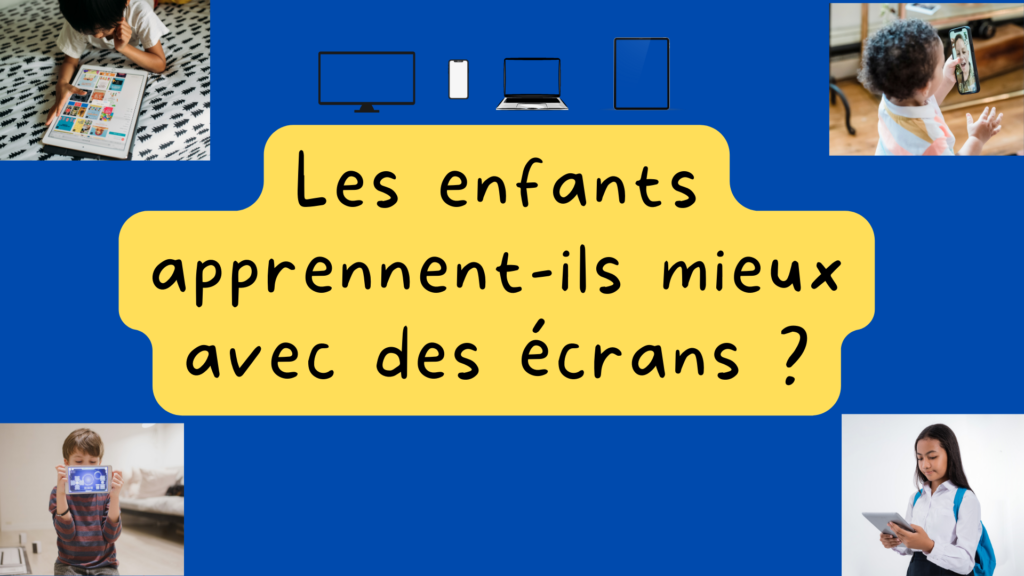
Do children learn better with screens? That question sits behind a lot of family arguments, and the honest answer is more interesting than a simple yes or no. A screen does not stop a child from learning, but it does shrink the amount of physical and emotional experience that fills the same minutes.
Many parents working inside the technology industry deliberately keep their own children's screen time modest. They are not afraid of gadgets. They simply believe children learn more by making real things and by having real conversations full of emotion and live interaction.

Quick takeaways
- Screens don't block learning, but they crowd out sensory and emotional experience.
- Live conversation, not interactivity, is what builds new vocabulary.
- Using a device makes a child a user, not a skilled task-doer.
- The "educational" label rarely matches what children actually play.
- Disadvantaged children are often the most surrounded by screens.
- Decide limits from your values, not from fear or marketing.
Learning Happens Through the Senses and the Hands
Children learn best when every sense is engaged and when their hands are busy. Filling a bottle with water, watching the bubbles escape, noticing how volume and mass relate, or threading beads in alternating colours already builds the early foundations of mathematical thinking.
Time on a screen takes away from richer sensory experience: toys, tools, textures, plants, animals, soil and all kinds of materials. A child colouring with a finger on a small screen does not develop in the same way as a child who grabs a pencil, takes off the cap, walks to fetch paper and then colours. Those small movements build the connection between the brain's two hemispheres and train eye-hand coordination.
This is why open-ended play matters so much. Simple construction sets and Rubik's cube puzzles let a child manipulate, test and fail safely, while fine motor skill toys give small hands the grip-and-release practice a swipe never provides.
The Myth of Screen Interactivity
Young children learn best through interaction with people, not with screens. One researcher compared three ways children could absorb new words: hearing them in a recorded programme, hearing them in a video chat, or hearing them in a face-to-face conversation. Only the live conversation gave children the leverage to actually use the new words afterwards.
A video call is still warmer than a cartoon, because a real person responds. But the lesson holds: the back-and-forth is the engine. That is also how speech develops in the early years, step by step, through how they learn to talk with a responsive adult rather than a screen.
So before you worry about which app to choose, think about who is talking with your child. A shared snack and a chat about the day beats an hour of silent tapping, and it costs nothing.
| Situation | What the child gains | What may be missing |
|---|---|---|
| Finger colouring on a tablet | Quick visual feedback | Grip, reach, eye-hand coordination |
| Colouring with a real pencil | Motor control and planning | Instant animation |
| Recorded word programme | Exposure to new sounds | Live back-and-forth |
| Face-to-face conversation | Usable new words | Nothing essential |
| Block building | Spatial and fine motor skills | Fast-paced stimulation |
The Unfounded Fear of Falling Behind
When a toddler touches a tablet or a phone, parents often tell themselves the child is getting a head start in technology. We end up calling geeks children who are simply full of screen time. Learning to use a tool is not the same as learning to complete a task.
Listening to a recording in a foreign language to understand it is a real task, and it has little to do with operating an MP3 player to hear music in that language. Using new technology mostly makes a child a user. Parents in the tech sector tend to argue that whatever world their children inherit, they will need a flexible brain able to explore what is still unknown today. Mastery of current tools is secondary, because companies keep making technology easier to use and the tools themselves will change many times.
If you are wondering when to step in, hooked on TV behaviour is a useful signal to watch rather than panic over.
The "It's Educational" Alibi
Marketing teams praise the educational appeal of tablets and games: virtual instruments, reading games, museum tours without leaving home. In practice, the apps children use most are often the ones where you feed a cat, kill zombies or flip coloured gems.
One university study found that babies aged eight to sixteen months who watched a popular baby video series had a smaller vocabulary than babies who had not watched it. The viewers had learned something, but the non-viewers had discovered more. The "educational" label does more harm when lower-income parents believe devices will help their children catch up. The digital divide has run in reverse: children from less advantaged homes are often the most surrounded by screens, while more advantaged children play with wooden blocks.
That is a good moment to look at motivate children through hands-on challenges instead of passive content, and to remember that a little wooden house can spark more pretend play than any app.

Ban Screens, or Think It Through?
What should concern us is less what screens do to children than what children are not doing while they sit in front of them. Screens can also support genuine learning: slowing down a gymnastics move, watching a pianist's hands, following a maths lesson from a teacher's channel.
There is no single answer that fits every family. The work is a constant search based on your values, your family culture and what your children ask for. Ask yourself what feels fair and acceptable, and when to release the brakes: is a tablet fine on a train or plane journey, do you set a daily or weekly limit, and what do you do when a child prefers screens to everything else?
Outdoor time is a strong counterweight. A few good outdoor toys for younger children or outdoor toys for four-year-olds can pull a child away from a screen without a battle, and when he travels without you, a familiar toy or book is often more comforting than a device.
My hands-on take
In my own home, the screen question changed once I started watching what happened after I switched it off. My child did not ask for more screen; she asked for the water, the funnel and the bottle we had used the week before. That told me more than any article.
What works for us is simple. Screens live in one room, we talk about what we watched, and we keep a basket of building toys and puzzles within reach so hands have somewhere to go. On long journeys we relax the rule and nobody panics. I still get it wrong some days, but treating screens as one option among many, rather than as a teacher or an enemy, has made our household calmer and our play richer.
Frequently asked questions
Are screens bad for children's learning?
No, but they limit it. A screen does not prevent learning; it reduces the physical and emotional experiences that fill the same time, so balance matters more than bans.
Is a video call as good as talking in person?
It is warmer than a recorded programme because a real person responds, but face-to-face conversation remains the strongest lever for helping children use new words.
Should I buy "educational" apps?
Be sceptical. The apps children use most are often simple games, and one study linked a popular baby video series to smaller vocabularies than non-viewers had.
How do I decide on limits?
There is no universal rule. Reflect on your values and family culture, then decide when screens are acceptable, such as travel, and whether to set a daily or weekly limit.
Product Reviews
 Best Toys for Dogs With High Prey Drive |
Best Outdoor Toys for 3-4 Year Olds |
Best Outdoor Toys for 6 Year Olds |
Best Harness for Poodle |
Best LEGO Sets for Adults |
Best Travel Toys for 4 Year Olds on Airplane |
Best Toy Stores in Washington DC |
Best Potty Training Toys |
Best Toys for Tripod Dogs |
Maillot equipe de france







