


A calm down workbook gives children a concrete toolkit they can reach for when they feel ready to explode or collapse. This printable booklet gathers ten activities designed for children from around eight years old, and it works best when kids fill it in themselves with their own ideas and preferences.
The goal is to develop socio-emotional skills so children can strengthen their capacity for self-regulation. Rather than being told to "calm down," they move through a series of small steps that help them notice what is happening inside and choose a response.

Over time, children discover that they have power over their emotions. When they learn to tame them the way they might tame an animal, emotions become faithful and useful friends that tell them what is good for them, and for others too.
Quick takeaways
- A calm down workbook gives children a prepared toolkit instead of asking them to improvise mid-meltdown.
- Ten short activities cover body awareness, breathing, refocusing, asking for help and problem-solving.
- Children should fill the pages themselves with their own ideas and preferences.
- The workbook suits children from around eight years old and can be printed, bound or stapled.
- Display key pages, such as the well-being poster, so children can return to them easily.
- The final step is acting calmly and non-violently once the emotion has been heard.
Why a Calm Down Toolkit Helps Children
Every child meets moments when feelings rise faster than words can follow. A toolkit prepared in advance means the child does not have to invent a strategy in the middle of a storm. It also sends a clear message: big emotions are normal, and there are things you can do with them.
The workbook is built around ten short points, each one a skill children can practise. They learn to recognise the signs that they are losing their calm, to use their breath, and to use their body. They also learn to refocus, to ask for help, and to manage that small inner voice that narrates everything.
Parents sometimes wonder whether naming emotions gives them too much weight. In practice, the opposite happens: a child who can say "I am frustrated" has less need to show it through behaviour. The same principle applies when slapping a child is replaced by a calm conversation about what went wrong.

Recognising the Moment Calm Slips Away
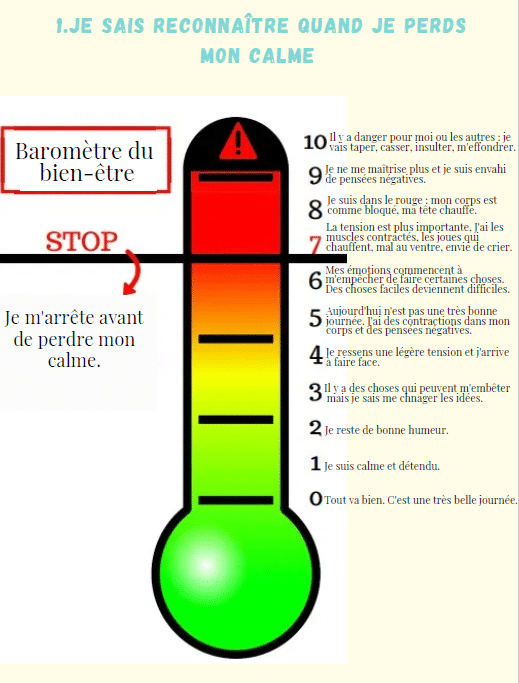
The first activity invites children to notice their own warning signs. Perhaps the jaw tightens, the voice gets louder, or the hands turn into fists. Writing these signals down turns them into information rather than a surprise, and a child who spots the early signs has far more options than one who only notices the explosion.
This is also where breathing comes in. The second activity shows children how to use slow, steady breaths as a first tool, something they can do anywhere without anyone noticing. It is a simple skill, but it needs repetition to become automatic.
Using the Body and Refocusing
The third activity turns to the body: stretching, pressing the feet into the floor, or shaking out the arms. The fourth helps children find their way back to concentration, for example by naming what they can see and hear around them. A child who struggles to settle may simply need the right conditions, and small adjustments at home can help, as with babies who eat poorly and sleep badly. Learning to ride a bike also builds steady focus, and the right gear matters too, so see these tips to help and our guide to sunglasses for children.
| Activity | Skill developed | How to use it at home |
|---|---|---|
| 1 | Recognising warning signs | List your child's early signals together |
| 2 | Using the breath | Practise slow breathing when calm |
| 3 | Using the body | Stretch, press feet down, shake arms |
| 4 | Refocusing | Name what can be seen and heard |
| 5 | Finding help | Write down trusted people and words |
| 6 | Inner voice | Notice the commentary and answer kindly |
| 7 | Pleasant soothing | List comforting objects and songs |
| 8 | Movement | Offer a physical outlet when needed |
| 9 | Choosing a strategy | Let the child pick what truly works |
| 10 | Problem-solving | Review the situation once calm returns |
Asking for Help and Quieting the Inner Voice
Some children believe they must manage everything alone. The fifth activity gives them permission to find support, and it helps to name the people they can turn to and the words they might use. Knowing exactly who to approach removes one more obstacle in a difficult moment.
The sixth activity deals with the little inner voice, the commentary that can be harsh or panicky. Children learn to notice it and to answer it more kindly, which is a skill that serves them well beyond childhood.
Then comes comfort: the seventh activity invites children to list pleasant things that soothe them, from a favourite blanket to a song. The eighth recognises that sometimes a child needs to move rather than sit still, and that physical activity can be the fastest route back to calm. For children who need company while they settle, an imaginary friend can even become part of the ritual. Calm, steady breathing is especially valuable for children born early, as explained in this piece on premature babies fragile lungs.

Choosing a Strategy and Solving Problems
Not every tool works for every child, and the ninth activity asks them to choose the strategy that is genuinely effective for them. This is an important shift: the child becomes the decision-maker rather than the recipient of advice. Parents can support this by offering options without insisting on their favourite.
The tenth activity moves towards problem-solving. Once the body is calmer, the child can look at what happened and think about what to do next. The final page of the workbook is dedicated to exactly this: passing to action once calm has returned, so that the child can act non-violently from a calm space while still taking account of the messages their emotions were sending.
Children who find it hard to sit with a workbook often do better when their hands are busy, and building something quietly can serve the same purpose as a breathing exercise. The same is true of movement-based learning, which is why learning to ride a bike teaches patience as much as balance.

Printing, Binding and Using the Workbook at Home
The workbook can be downloaded free of charge, printed, and then bound or stapled. Children are invited to write in it, so it should feel like their own possession rather than a worksheet imposed by an adult. A cover they have decorated themselves makes a surprising difference to how willing they are to return to it.
Some pages work better as tools displayed where they can be seen. The well-being poster on page eleven, for example, is worth keeping visible so the child can come back to it whenever needed. A spot on the bedroom wall or inside a kitchen cupboard door keeps it within reach.
Adults can use the same approach for themselves, and it fits naturally into the daily juggling that comes with parenting twins or a busy household. Reading about how other families handle these moments can also help, and there are plenty of motherhood blogs worth following for ideas. Parents dealing with sciatica in pregnancy may find calm, low-effort routines especially useful, and it is worth avoiding Machiavellian toys that add stress rather than comfort.



My hands-on take
I first printed a booklet like this one on a rainy afternoon, expecting my eldest to fill in a page or two and lose interest. What actually happened was that she spent an hour decorating the cover and then asked whether she could keep it in her bedside drawer, which turned out to be the most useful part of the whole exercise.
What I learned is that the workbook works best when I stay out of it. When I suggested answers, she closed it; when I left the room, she wrote things I would never have guessed, including the exact tone of voice that makes her angriest. I now keep my own short list of calming strategies on the fridge next to hers, which has made the whole thing feel less like a lesson and more like something we do together.
Frequently asked questions
What age is the calm down workbook for?
It is designed for children from around eight years old, since it relies on reading and writing. Younger children can still use the ideas with an adult reading the pages aloud.
Is the workbook free?
Yes, it can be downloaded free of charge in PDF format, printed at home, and then bound or stapled. Some pages are best displayed so the child can return to them easily.
How do I introduce it to my child?
Present it as a personal toolkit rather than a punishment or a lesson. Let the child fill it in with their own ideas, and use it together during calm moments so the strategies are familiar before they are needed.
What if my child refuses to use it?
Leave it available without pressure and model the strategies yourself. Many children come back to it on their own once they have seen a parent use breathing or movement to settle.
Product Reviews
 Best Toys for Dogs With High Prey Drive |
Best Outdoor Toys for 3-4 Year Olds |
Best Outdoor Toys for 6 Year Olds |
Best Harness for Poodle |
Best LEGO Sets for Adults |
Best Travel Toys for 4 Year Olds on Airplane |
Best Toy Stores in Washington DC |
Best Potty Training Toys |
Best Toys for Tripod Dogs |
Maillot equipe de france







