


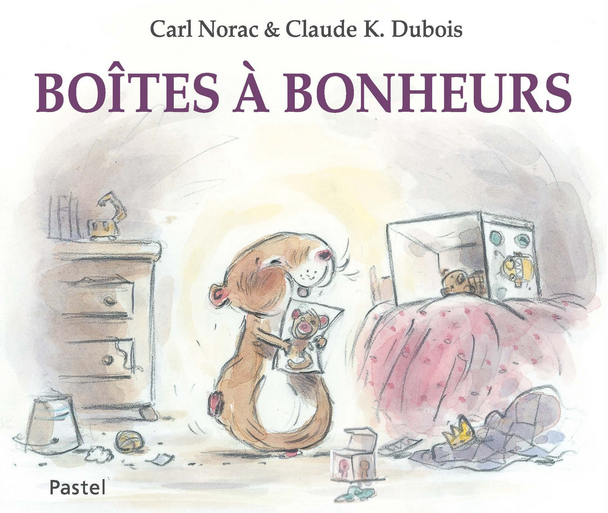
Boîtes à bonheurs is a soft, tender picture book that will make children want to gather up the small and big happiness of everyday life. I like it because it invites everyone to pause on the tiny moments that make life joyful: a pebble given as a gift, a leaf picked up on the way home, a postcard in the mail, a kiss.
These are the kinds of treasures that settle in the heart and stay there. The story follows Lola, who asks her mother for a present and chooses something unexpected: not a teddy bear and not a doll, but two boxes, one large and one small, to fold and build herself.

Quick takeaways
- Lola chooses two boxes instead of a toy and fills them with everyday joys
- Small happiness counts as much as big happiness in the story
- Teasing at school leads Lola to hide in her big-happiness box
- A parent cuddle and story help her see that some joys cannot be boxed
- Her brother leaves a box of apologies, showing repair without words
- Families can invent boxes for anger, shouting, smiles, or apologies
A present that is not a toy
Lola refuses all help with assembling her boxes. She proudly announces to her parents that she will call them her happiness boxes: the small one for little joys and the large one for big ones. Then she starts filling them, placing her comfort blanket in the big-happiness box and her shell collection in the small one.
Before bed she tells her mother that if she has a beautiful dream, she will draw it and put the drawing in a box. It is a lovely way to show children that a box can hold something invisible, and that a drawing can preserve a feeling. If your child enjoys stories that open doors to art and imagination, you might also enjoy these books about art for young readers. For another way to explain change and growth to little ones, try this lice life cycle guide.
Why the two-box idea works
Splitting happiness into small and big gives a child a simple language for feelings. A tiny pebble can count as much as a birthday party, and that message is quietly reassuring.
Hunting for happiness at school
The next day at school, Lola looks for big and small joys to fill her boxes: leaves, the craft she made with her teacher, and a little heart-shaped stone that Arthur gave her. A small stone, but a big happiness. The scene is a gentle nudge to help children notice what goes right in an ordinary day.
You can play the same game on the walk home from school, asking your child to name one small joy and one big joy before you reach the front door. It costs nothing and turns a routine trip into a shared ritual. Families who like turning everyday moments into little traditions may also enjoy reading about the values of Thanksgiving and how gratitude can be passed on. For bigger conversations, these books about politics can help, and if a child is facing a first sleepover, this guide to your first night away offers reassurance.

| Box idea | What goes inside | When to use it |
|---|---|---|
| Happiness box (small) | Pebbles, leaves, drawings of small joys | Anytime a little moment feels worth keeping |
| Happiness box (large) | Comfort blanket, big events, proud memories | Weekends or special days |
| Apology box | A drawing or note saying sorry | After an argument or a misunderstanding |
| Smiles box | Kind notes to give away | When someone in the family feels sad |
| Shouting or anger box | Scribbles made when cross | When feelings need an outlet |
When other children laugh
At the school gate, a group of children tease Lola because her brother told them about the happiness boxes. She is furious with him, especially when she catches him in her room rummaging through her boxes. She decides to shut herself inside her big-happiness box and declares that she will not move until she is happy again.
Fortunately, her father and mother offer her a cuddle and a story. Lola then realises something important: plenty of happiness cannot be put in a box at all, like kisses from parents. That realisation is the heart of the book, and it opens a natural conversation about what comfort looks like for each child. For children who need help naming big feelings, stories can be a safe starting point, much like the ones in this selection of stories about togetherness. Bedtime routines can also steady a child after a difficult day, as these calming bedtime tips suggest.
Talking about teasing
Ask your child what Lola could have said to the children who laughed. It is a low-pressure way to rehearse a response before it is needed.

A box full of apologies
Later that night, while Lola sleeps deeply, her brother has an idea of his own: he gently places a box of apologies on her bed. It is a quiet, wordless gesture, and it shows children that making up does not always need a long speech.
The book closes with a suggestion that families can invent all kinds of boxes together: a box for hurtful words, a box for shouting when you are cross, a box for anger when you want to break everything, a box of apologies, and a box of smiles to give to someone who is sad. These are simple, open-ended projects, the sort of play that grows with a child, much like the ideas in this guide to open ended toys.
Building the boxes yourself makes the activity even more personal. A little folding and decorating turns a plain sheet of paper into something a child will keep and use.

Making your own boxes at home
All you need is card or thick paper, a ruler, and something to decorate with. Fold, cut the corners, and tape the sides; a child old enough to hold a crayon can help decorate even if an adult does the folding. Let your child decide what each box is for, and resist the urge to correct the choice.
Keep the boxes somewhere your child can reach without asking, so the ritual stays theirs. Some families bring a box out only at bedtime, others leave it on a shelf all week. Either way, the point is not to fill it quickly but to notice the moments worth keeping. If you are looking for more screen-free activities to share, these backyard toys for toddlers pair nicely with an afternoon of box-making outdoors.
Keeping it light
Do not turn the boxes into a chore or a test. If a week goes by with nothing inside, that is fine; the box will still be there.

Why this story matters now
Boîtes à bonheurs feels essential in a busy, sometimes unsettled period, because it reminds us that big happiness is simply an accumulation of small ones. The illustrations are delicate and soft, and the story works well for children from around three years old.
It also gives parents an easy opening for conversations about jealousy, teasing, and repair, without ever feeling like a lesson. Read it slowly, pause on the page where Lola shuts herself in her box, and let your child react. You may find that the box idea follows you home, and that is exactly the point.

My hands-on take
We started our own happiness box after reading this book, and I quickly learned to keep it simple. The first week my child put in a bottle cap and half a biscuit, and I had to bite my tongue about the biscuit. The box is now a shoebox on the kitchen shelf, and the rule is that anyone can add something but nobody empties it without asking.
What surprised me most was the apology box. After a rough evening, my child drew a scribble and slid it under my door, and that small gesture did more than any conversation we had tried. I would say read the book first, then let your child decide what the boxes are for. Do not plan it too much; the ritual works better when it belongs to them.
Frequently asked questions
What age is Boîtes à bonheurs suitable for?
The story is written for children from around three years old. Younger children will enjoy the illustrations and the rhythm of the read-aloud, while older children can talk about the teasing and the apology.
Who wrote and illustrated the book?
Boîtes à bonheurs is by Carl Norac and is published by L'Ecole des Loisirs. It is available from bookshops, libraries, and online retailers.
Can we make the boxes without special materials?
Yes. Card or thick paper, a ruler, and tape are enough, and children can decorate with whatever you already have at home. The value is in the choosing and filling, not in the craft itself.
Is the book only about happy feelings?
No. It also shows anger, jealousy, and teasing, and it ends with a quiet apology. That balance is what makes it useful for talking about emotions with young children.
Product Reviews
 Best Toys for Dogs With High Prey Drive |
Best Outdoor Toys for 3-4 Year Olds |
Best Outdoor Toys for 6 Year Olds |
Best Harness for Poodle |
Best LEGO Sets for Adults |
Best Travel Toys for 4 Year Olds on Airplane |
Best Toy Stores in Washington DC |
Best Potty Training Toys |
Best Toys for Tripod Dogs |
Maillot equipe de france







