


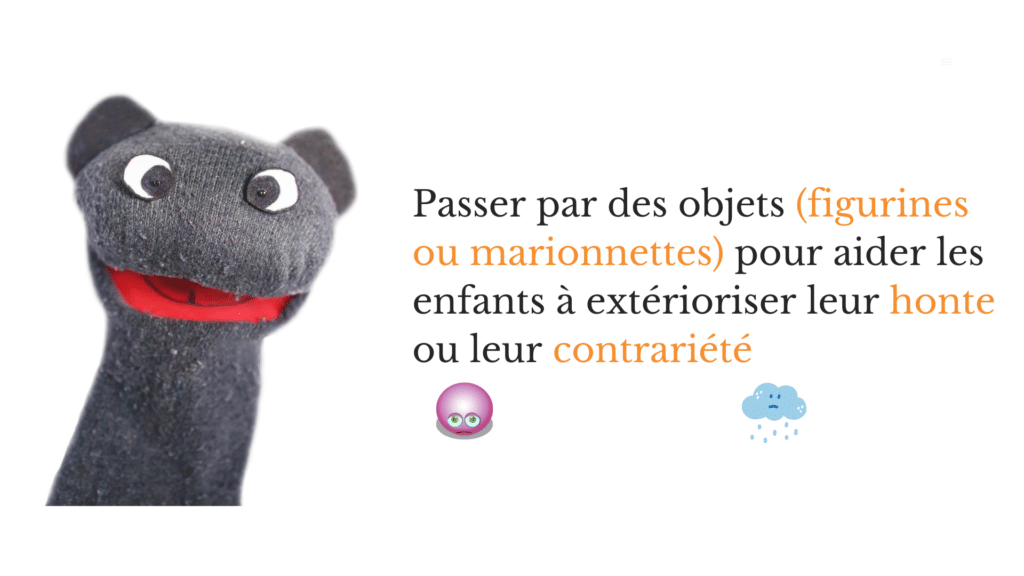
Using toys and puppets to help children express shame or frustration is a gentle, play-based approach that any parent can try at home. In art therapy, "spokesperson" objects are sometimes used to help people who feel ashamed express the unspeakable. When you sense that a child wants to say something weighing on their heart but is blocked by the shame of an act they regret, figurines or puppets can open the door.
These objects let the child reveal what troubles them through symbolism and play rather than direct confession. The toy speaks, not the child, and that small distance makes honesty feel safer.

Quick takeaways
- Puppets and figurines let a child speak through a character instead of confessing directly.
- Shame and fear of judgment make direct apologies hard; symbolic play lowers the stakes.
- Introduce a scenario around the issue you sense, then let the child decide what happens next.
- Characters can exaggerate and misbehave safely because it is "pretend."
- Your calm, accepting response during the scene is the real message.
- Keep the toys accessible so the child can return to them when feelings get hard.
Why spokesperson objects help children express shame
Saying "I'm sorry" or "I regret being cruel" feels threatening to the ego and comes with fear of judgment, rejection, or even punishment. Staging characters and presenting them as the "bad guys" is far easier than saying "I was mean." Through a scene in which the puppet or figurine has every right to speak, feelings become easier for the child to externalize and therefore easier for parents to welcome and support.
This is the same principle behind many playful parenting tools that lower a child's guard. When you sense your child wants to raise something shameful but cannot find the words, invent a scenario around the issue you perceive. It will carry the child along without pressure, much like the gentle encouragement that helps a child master new skills.
A wolf speaks for the group
Art therapist Sylvie Batlle describes a workshop for people who had committed acts of violence. One participant chose the wolf puppet and made it say: "Hear ye, good people, I can't stand being rejected this much! You only love little rabbits with soft fur! Only birds with light songs! Is it because I'm clumsy that you flee from me? It hurts when you run away like that. And then you cry scandal if I become mean? And you, do you think you're kind, staring and fleeing from me constantly?"
Playing through frustration and big changes
Spokesperson objects make it possible to name the suffering of rejection and to connect that suffering with meanness. This kind of insight helps both sides: the child can tame inner "monsters," and parents can understand the child's internal motives and show empathy for difficult emotions. The same holds for frustration, such as a divorce or a move. Replaying the situation with dolls, building figures, or any imitation toy can help. If you're wondering when to talk about sex, the same gentle, playful approach applies.
If you are choosing a first set for a toddler, our guide to best toddler toys covers options that invite this kind of open-ended play. Without forcing a particular scene, introduce the events during play and let the child decide what happens next: ignore them, or amplify them? These tips for learning English show how play makes hard things easier.
Let the characters misbehave
Parenting expert Lawrence Cohen describes a mother and daughter playing dolls after a tense day full of shouting. As they put the dolls to bed, the mother said to one, "The day was rough, there was a lot of yelling in this house." The girl scolded a doll: "Naughty one, you disobeyed today, you'll sleep on the floor!" The mother replied, "You know, I think she didn't do it on purpose; she probably needs a cuddle to be comforted after her hard day."
Because it is "pretend," the characters can have every right. The child can exaggerate and extrapolate without fear of reprisal, regaining confidence through play with an open, caring adult.
| Approach | What the child does | Best for |
|---|---|---|
| Puppet or figurine scene | Speaks through a character | Shame, regret, fear of judgment |
| Doll or figure replay | Re-enacts a real event | Divorce, a move, a tense day |
| Drawing or art | Shows feelings visually | Children who resist talking |
| Direct conversation | Names the feeling aloud | Children already comfortable with words |
How to set up a puppet or figurine session
Start with a small basket of three or four characters rather than a whole toy box. Too many choices scatter the story; a few familiar faces let the child focus. Sit on the floor at eye level and let the child pick who speaks first, even if that means you stay quiet for a while.
Offer one opening line and then stop talking. A phrase like "Something happened today that felt bad" is enough to launch a scene. Resist the urge to correct the puppet's version of events; the point is expression, not accuracy. If your child goes quiet, keep the toy moving and narrate gently in the third person.
Watch for the moment the story turns toward repair, and let the child lead it. You might have a character apologize, or ask for a hug, but only if it fits. When the scene winds down, thank the child for the story without analyzing it. The play did its work; a lecture would undo it. For more everyday emotional tools, see these gentle discipline.
Reading what the play is telling you
A child who makes a figurine shout, hoard, or hit is not necessarily rehearsing bad behavior. They are often testing whether a difficult feeling can be shown and still be accepted. Your calm face during the scene is the real message. If a character is punished harshly in the story, you can have another character wonder aloud whether kindness might help.
Keep sessions short, ten or fifteen minutes is plenty, and let them end naturally. Some children return to the same theme for weeks; others move on after one story. Both are normal. If a scene worries you, note it and watch for patterns rather than reacting in the moment. For broader emotional support, these social confidence ideas pair well with puppet play. Busy parents can also lean on helpful parenting apps to stay consistent.

Keeping the door open over time
The value of spokesperson objects grows with repetition. Keep the puppets where the child can reach them, and let them bring a character to you when something is hard to say. Over time the toy becomes a familiar shortcut to honesty, one the child can use before a feeling becomes a blow-up.
Pair the play with ordinary routines: a quiet moment after school, bath time, or the wind-down before bed. These are natural windows for a short scene. If your child is not ready, do not push; leave the basket out and try again another day. Patience is part of the method.
Finally, model it yourself. Let a puppet admit that you were tired or short-tempered that morning. Hearing a parent use the same safe channel shows the child that everyone has hard feelings, and that no one has to carry them alone.

My hands-on take
I first tried this after a rough bedtime when my child had shouted at me and then gone silent. I picked up two small figures and had one grumble about how unfair the evening had been. My child watched, then took the other figure and made it stomp and yell. I let it happen without correcting anything.
A few minutes later, the yelling figure asked the first one for a hug. I did not plan that, and I did not comment on it. The next morning my child brought up the argument calmly, almost as if the puppet had done the hard part. Now the figures live on a low shelf, and every so often one of them has something to say.
Frequently asked questions
What if my child refuses to play along?
Do not force a scene. Leave the toys out and play nearby yourself, letting a character talk aloud. Curiosity often brings the child in on their own terms.
Can this work for everyday frustration, not just shame?
Yes. Replaying a move, a divorce, or a shouting match with dolls or building figures helps children process events they cannot yet put into words.
Should I interpret what the puppet says?
Rarely in the moment. Note themes and watch for patterns, but keep the session about expression. Analysis too early can shut the play down.
How long should a session last?
Ten to fifteen minutes is usually enough. Let it end naturally and thank the child for the story without turning it into a lesson.
Product Reviews
 Best Toys for Dogs With High Prey Drive |
Best Outdoor Toys for 3-4 Year Olds |
Best Outdoor Toys for 6 Year Olds |
Best Harness for Poodle |
Best LEGO Sets for Adults |
Best Travel Toys for 4 Year Olds on Airplane |
Best Toy Stores in Washington DC |
Best Potty Training Toys |
Best Toys for Tripod Dogs |
Maillot equipe de france







