


Understanding adult domination is the first step towards emancipating childhood and ending the ordinary educational violence that shapes so many young lives. A collective book built from contributions to a 2023 gathering on ordinary educational violence sets out to do exactly that.
Its fifteen texts, each written by a different author, are organised around three movements: understanding, bearing witness, and resisting. Together they explore semantics, law, history and psychosocial dynamics, and they make room for young people to describe their own feelings about the infantilisation they experience.

What follows is a practical tour of the book's key ideas, translated and expanded for English-speaking parents who want to think harder about the power they hold.
Quick takeaways
- Infantilisation denies children's rights, agency and abilities in small everyday ways.
- Adults often "perform authority" and justify coercion with an educational goal.
- The book uses "young people" to expose an adultist social hierarchy.
- Educational violence is relational and extends far beyond the family.
- The label "educable" has been used to dominate many groups, not only children.
- "Education" can work as virtue signalling that legitimises control.
What infantilisation actually looks like
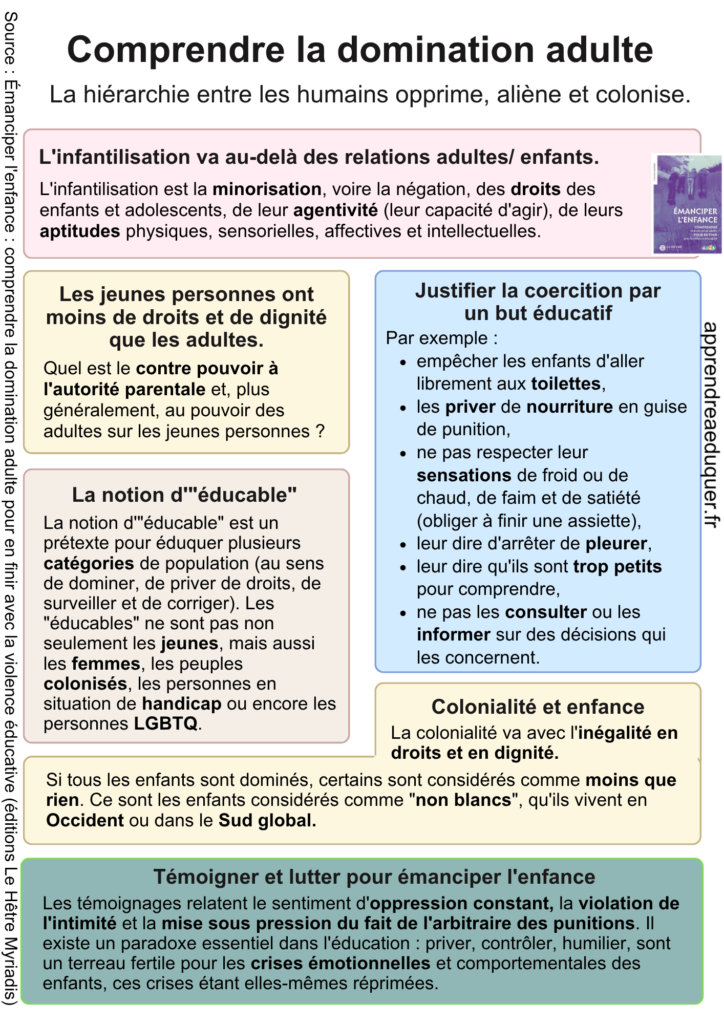
Infantilisation means minimising, or even denying, the rights of young people, their agency, and their physical, sensory, emotional and intellectual abilities. It shows up in small, everyday moments: stopping a child from going freely to the toilet, withholding food as punishment, ignoring whether they feel too cold or too hot, telling them to stop crying, or declaring them too little to understand and therefore leaving them out of decisions that concern them.
The result is that young people hold less rights and less dignity than adults, while adults feel entitled to intervene in every aspect of a child's life. Philosopher and editor Daliborka Milovanovic describes this as "performing authority": what matters is that adults intervene, however they do it, as long as the coercion can be justified by an educational goal.
Why the words matter
The book defines ordinary educational violence as the set of adult practices and behaviours that harm young people's physical and psychological integrity, dignity and fundamental rights. The authors deliberately say "young people" for everyone under eighteen, the age of majority in France, to highlight an adultist value system that places minors lower in the social hierarchy. That same instinct to correct and control can creep into how we potty training toys are introduced, turning a normal milestone into a power struggle.
Counter-power and the rights of young people
Rodolphe Dumouch, a secondary school teacher, asks what counter-power exists against parental authority and, more broadly, against adult power over young people. He points to the way young people are prevented from carrying weight in decisions that concern them. In France, for instance, opinion polls exclude minors even when the subject directly affects them, and progress on youth political rights stalls, including proposals to lower the voting age to sixteen.
Young people who do engage in politics are often mocked rather than taken seriously. This is worth remembering whenever we discuss how reading and writing develop: a child who is never consulted learns that their voice carries no weight.
Violence baked into the idea of educating
Milovanovic argues that violence is inherent to the educational relationship itself, because it always involves a dominant party and a dominated one. Once you see education as a relationship rather than a private family matter, the circle of potential victims widens considerably.

| Situation | Infantilising response | Alternative |
|---|---|---|
| Toileting | Deciding when and whether a child may go | Let the child judge and go freely |
| Food | Withholding food as punishment | Keep meals neutral and predictable |
| Temperature | Forcing a coat on or off | Trust the child's sensation, offer options |
| Crying | Telling the child to stop | Stay close and allow the feeling |
| Decisions | "You're too little to understand" | Explain simply and consult the child |
| Politics and voice | Excluding minors from polls | Ask young people what they think |
From the family to the wider world
Gabriel Allégret, a doctoral researcher in social sciences, argues that the label "educable" is a pretext for educating whole categories of people, in the sense of dominating them, stripping their rights, surveilling them and correcting them. The "educable" are not only the young but also women, colonised peoples, people with disabilities and LGBTQ people. Re-education camps borrow the language of education while serving racism, colonialism and political ends against opponents.
This relational view stretches the notion of educational violence beyond the family and beyond childhood itself. Anyone treated as "educable" or caught in an educational relationship is exposed: a young adult at university, a professional in training, a resident in a care home.
Recognising that pattern helps us notice when a helping relationship tips into control. The same sensitivity applies when we think about how children Autism spectrum are supported, or when we plan inclusive play with outdoor toys so that every child gets real choices rather than instructions.
Coloniality, childhood and the language of virtue
The authors compare adult domination with the colonisation of countries and peoples. The coloniality of power goes hand in hand with inequality in rights and dignity: one group is assumed to know better, the other is assumed to need guiding.
In contemporary usage, the word "education" seems to function as virtue signalling, a way of showing that our intentions are good and virtuous, much like the words "democracy" or "freedom". Dominant Western nations are fond of using it to legitimise non-commercial actions towards indigenous populations of economically dominated countries, actions that produce cultural and intellectual colonisation.
Watching our own vocabulary
The point is not to abandon the word education but to notice when it is doing the work of justification. When we say "it's for their own good", we may be performing authority rather than reasoning with a person. That habit shapes everything from how we handle a slap during conflict to how we explain a new sibling's arrival with a baby sex announcement.
Bringing it home: dignity in daily decisions
Emancipating childhood does not require grand gestures. It starts with consulting children about matters that concern them, informing them honestly, and respecting their physical sensations instead of overriding them. It means letting a child finish crying with company rather than silencing them, and asking before we touch, move or decide for them.
The book's witnesses make the emotional cost of infantilisation vivid: young people describe feeling unheard, underestimated and quietly angry. Those accounts are the strongest argument for treating dignity as non-negotiable, at every age.
A practical mindset
Think of yourself less as an authority performing its role and more as a person with more experience and more responsibility. That shift keeps the educational relationship intact while removing the assumption that coercion is the default. Even everyday choices, such as which LEGO custom builds a child leads or which birds and children project they shape, become chances to practise agency rather than obedience.

My hands-on take
I remember the first time I caught myself performing authority. My child was crying over something small and I heard my own voice say "stop, it's nothing". I had said that phrase a hundred times without thinking. Reading about infantilisation made me realise I was not calming anyone; I was telling a person that their feelings did not count.
Since then I have tried a smaller, slower habit: asking instead of announcing. Do you want your coat? Can I help, or would you rather do it? It sounds trivial, and sometimes it is, but the shift in tone is real. My child argues with me more now, and I have decided to treat that as a sign that their voice is being taken seriously rather than as a problem to correct.
Frequently asked questions
What is ordinary educational violence?
It is the set of everyday adult practices that harm a young person's physical or psychological integrity, dignity or fundamental rights. It includes things often dismissed as normal, such as shaming, punishing with food or ignoring a child's stated sensations.
Is the book against education itself?
No. It questions the assumption that education must involve domination and coercion. The authors argue that adults can hold responsibility and experience without denying children's agency or dignity.
Why do the authors say "young people" instead of "children"?
The term covers everyone under eighteen and highlights that minors are placed lower in a social hierarchy that grants them fewer rights. It is a way of naming adultism rather than treating it as natural.
What can parents do differently tomorrow?
Start by consulting children on decisions that concern them and respecting what they say about their own bodies. Notice when you justify a reaction with "it's for their own good" and ask whether reasoning could replace coercion.
Product Reviews
 Best Toys for Dogs With High Prey Drive |
Best Outdoor Toys for 3-4 Year Olds |
Best Outdoor Toys for 6 Year Olds |
Best Harness for Poodle |
Best LEGO Sets for Adults |
Best Travel Toys for 4 Year Olds on Airplane |
Best Toy Stores in Washington DC |
Best Potty Training Toys |
Best Toys for Tripod Dogs |
Maillot equipe de france







