


The Painting Game is a way of painting with no expectation of a result, honouring a universal and vital act: making a mark. Rather than teaching art, it protects something children already carry inside them.
Arno Stern was neither a teacher nor a painter. While working with orphaned children after the Second World War, he noticed their enthusiasm for simply playing at painting, and the striking similarities in the shapes they made, wherever they came from and whatever their history.

From this he built an approach where the goal is to paint for yourself, in spontaneity. He chose the word game because the act alone matters, and because it brings intense pleasure.
Quick takeaways
- The Painting Game values the act of marking, not the finished picture.
- Formulation is described as a universal code tied to organic memory.
- The Clos Lieu removes outside views and keeps materials within a few steps.
- A servant prepares materials and encourages without judging or instructing.
- Never ask a child to explain, exhibit or comment on their painting.
- No one is gifted or incapable; the game is open to everyone.
Trace, Formulation and Organic Memory
In the Painting Game, formulation is the emanation of organic memory. Stern describes formulation as a universal code made of elements that work like the vocabulary of a language shared by all humans. These components impose themselves on every person, born of a common necessity.
For them to appear, particular conditions are required. Formulation is both natural and unexperienced. In art, a trace carries a message; in formulation, the trace addresses no receiver at all. Only when a mark is freed from the role of communication can it carry what organic memory holds.
Why the mark must not be judged
Facing the sheet, each person expresses what has been recorded in that memory. Events from life in the womb and early childhood are not erased; traces of them remain, which is why the baby in the womb experiences parents share with children matter so much. Spontaneity, non-directivity through the absence of instructions, and non-judgement let acts arise that reason did not induce.

The Conditions Needed for the Trace to Emerge
For formulation to occur, the person must be able to free themselves from everything coming at them. Then they reach the memory of their own beginning, a beginning that was unknown because ordinary recollection cannot reach that far. This is why Stern created the Clos Lieu, the closed place.
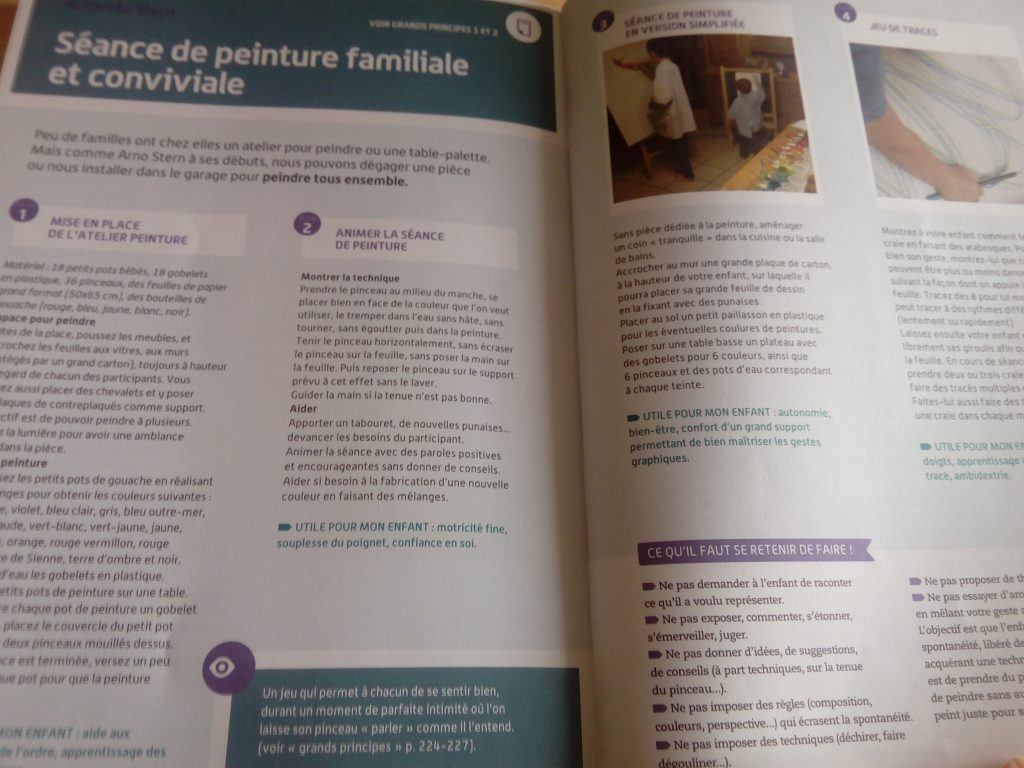
This space has no view outward: openings and windows are covered. The walls are covered in paint traces. Blank sheets of paper are fixed directly to the walls, vertically. A palette table stands in the centre, a long narrow table holding pots of paint with cups of water beside them and brushes in two different sizes. The room is arranged so that each person can walk back and forth between sheet and table in a few steps.
The role of the servant
A servant of the Painting Game prepares the material, fixes the paper, refills the paint pots and encourages depth: you have only just started, keep going, your brush will know. Nobody judges another person's production, and nobody fears being judged. In the quiet permanence of the place, the person gives themselves to the unspeakable and gains an unexpected fullness.

| Element | Do this | Avoid this |
|---|---|---|
| Paper and paint | Fix blank sheets vertically, refill pots | Handing out a model to copy |
| Adult role | Prepare, refill, encourage gently | Giving ideas or suggestions |
| Talking | Stay quiet and available | Asking what the child meant |
| Display | Keep paintings private | Exhibiting or commenting |
| Rules | Only technical guidance | Rules that crush spontaneity |
A Book Missing Its First Pages
Anyone who lives their trace feels enormous happiness, because they find something that had escaped them and seemed lost. Stern compares us to a book whose first pages have been torn out: when we read it, we start somewhere, but not at the beginning. If those pages are found, we begin at the beginning, and this is what happens to a human being through formulation.
This accomplishment is precious but threatened by the influences imposed on children, which turn them away from spontaneity. That is why Stern insists the Painting Game is within everyone's reach: there is no gifted or incapable person, and no painting should be exhibited or commented on. Children are crushed by learning, he says, and especially by artistic education that crushes their spontaneity.
Freeing children from pressure
A child of five or fifty holds nothing back; they play with their whole being. Through the game, children can free themselves from the influences that restrain them. The Clos Lieu is not a place of therapy or healing, but it helps players shed a weight that crushes them, for greater serenity. The same logic of letting children feel and recover applies when you help children disappointment without rushing to fix everything.
The Painting Game at Home or at School
Adapting the spirit of the Painting Game outside a real Clos Lieu is possible, provided you protect the essentials. A session works best when the adult prepares everything in advance, stays calm, and resists the urge to direct. Think of it as close to the unhurried mood of baby bathing relaxation, where the point is the experience, not the outcome.
What to avoid
Do not ask the child to explain what they wanted to represent. Do not exhibit, comment, marvel, or judge. Do not give ideas, suggestions or advice, apart from technical help such as holding the brush or using the central table. Do not impose rules that crush spontaneity.
At school, this sits naturally alongside other alternative practices, and even a busy parent working from home can protect a quiet slot for it, much like planning around virtual babysitters telework schedules. If you are setting up a corner for creative and physical play, our guide to outdoor toys kids can help you choose durable equipment. For families preparing a calm room, the tips on adaptation to nursery apply just as well to a painting corner. And when siblings share the space, ideas for stronger bonds siblings help keep the atmosphere peaceful. Rewards have no place here, so it is worth reading about whether children's good actions should ever be rewarded at all.

My hands-on take
When I first tried this at home, I made every mistake in one afternoon. I asked my daughter what the blue swirl was, told her it was beautiful, and suggested she add a sun. She stopped painting within minutes and wandered off. The next week I said nothing at all. I taped paper to the wall, put the pots on a low table nearby, and sat quietly refilling water cups. She painted for nearly an hour, talking to herself, and never once looked at me for approval.
What surprised me most was how hard the silence was for me, not for her. Holding back comments takes practice. Now I treat my job as practical only: tape, paint, water, and a calm room. The paintings stay on the wall until she decides otherwise, and nobody comments on them.
Frequently asked questions
Is the Painting Game only for children?
No. Stern insists it is within everyone's reach, and he speaks of the child who may be five or fifty. Adults benefit from the same freedom from judgement and results.
Is it a form of art therapy?
No. The Clos Lieu is not a place of therapy or healing. It simply helps players release a weight that crushes them, which brings more serenity.
Why should paintings not be displayed?
Exhibition turns the trace back into communication and invites judgement. Keeping the work private protects spontaneity and lets the mark carry what organic memory holds.
Do I need a special room?
Not necessarily, but the spirit matters: cover distractions, fix paper to the wall, keep paint within a few steps, and let an adult quietly handle the material.
Product Reviews
 Best Toys for Dogs With High Prey Drive |
Best Outdoor Toys for 3-4 Year Olds |
Best Outdoor Toys for 6 Year Olds |
Best Harness for Poodle |
Best LEGO Sets for Adults |
Best Travel Toys for 4 Year Olds on Airplane |
Best Toy Stores in Washington DC |
Best Potty Training Toys |
Best Toys for Tripod Dogs |
Maillot equipe de france







