


There is no reason to suffer in order to learn and progress, yet the no pain no gain ideology still shapes how many adults raise and teach children. We are trained to believe that only violent effort earns merit and reward, and that leaving our comfort zone at any cost is the price of success.
Learning of any kind, including physical learning, is more effective and more respectful when it happens gently and with self-awareness. This approach, borrowed from strategic strength training, applies to every kind of learning: there is no reason to hurt yourself in order to move forward.

The no pain no gain belief has no biological or psychological foundation. Its roots are purely cultural and educational, and they run straight through traumatic memory.
Quick takeaways
- The no pain no gain ideology is cultural, not biological or psychological.
- Traumatic memory stores violence unconsciously when no repair follows.
- Under extreme stress the thinking brain and hippocampus are inhibited.
- A hypersensitive amygdala relives violence at the slightest reminder.
- Safety and a lucid witness allow memory to be filed and repaired.
- Gentle, respectful learning is more effective than fearful learning.
Traumatic memory and the no pain no gain ideology
Traumatic memory is an unconscious memory where physical and verbal violence and emotional shocks have been stored when no remediation followed. Almost all of us are colonised by it, because ordinary educational violence is widely used and even valued as a method: letting a baby cry, smacks, slaps, withdrawal of parental love, forced isolation, threats, mockery, punishment.
Parents want happiness and social integration for their children but often know no other way than what they themselves endured. Beliefs such as “life is not easy” or “children must be hardened” keep the cycle turning, and many parents simply do not realise the reach of their acts on a child's psychic construction.
Why the cycle repeats
Few parents have met what Alice Miller called a “lucid witness”, someone who shows indignation and empathy for the child's wounds without excusing the parents or minimising the suffering. Without that witness, the pattern passes on quietly. A conscious parenting approach begins precisely here, with noticing what we repeat.

How traumatic memory works in the brain
Extreme stress can kill, and children subjected to ordinary educational violence live extreme stress, so the brain sets up exceptional survival mechanisms. These come at a high cost: they install traumatic memory, in which violence is relived identically, like a hellish time machine.
In the normal alarm system, the amygdala reacts first, then the higher brain reasons, then the hippocampus records the memory consciously, so thunder becomes linked to a storm rather than to a threat to life. Under violence, the second and third stages are inhibited: the amygdala floods the body with stress hormones while the thinking brain and hippocampus stay offline.
Sidération and dissociation
This is traumatic dissociation, a kind of memory-erasing machine, because the hippocampus cannot record the event consciously. Everything blocked in the hypersensitive amygdala resurfaces at the slightest reminder, a sound, a sensation, a caress. Victims then build avoidance strategies to escape, controlling, isolating, or using dissociating products. Gentle daily routines, such as the bath products you choose or the after sun care you give, are small ways to reduce unnecessary stress.
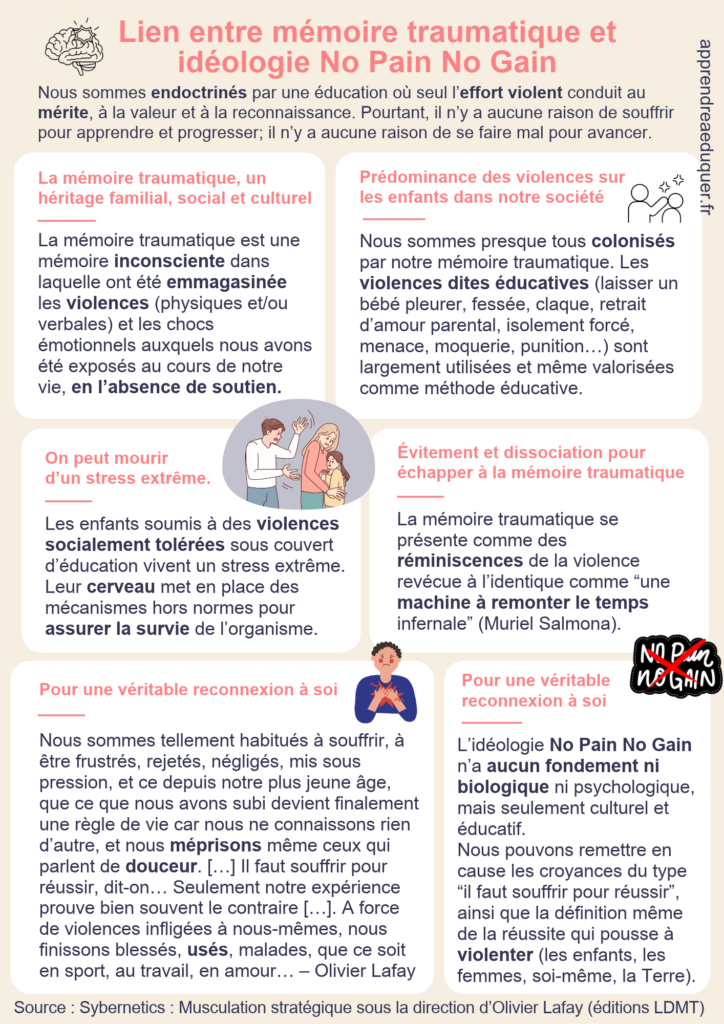
| Stage | Normal response | Under violence |
|---|---|---|
| First stage | Amygdala sounds the alarm | Amygdala floods the body with stress hormones |
| Second stage | Higher brain reasons and relativises | Higher brain is inhibited |
| Third stage | Hippocampus records a conscious memory | Hippocampus cannot record the event |
| Result | Thunder is linked to a storm | The event is relived identically |
| Long-term effect | Calm, adaptive learning | Avoidance, dissociation, hypervigilance |
Why gentleness teaches better than suffering
The ideology of violent effort has no biological grounding. Learning works better in safety, because a calm nervous system can record, associate and remember, while a flooded one can only survive. This is why a child who feels respected learns faster than one who is afraid.
The same logic applies to play and to physical practice. A simple box offers hours of open-ended play without pressure, and a metal fidget toy can help a child channel restlessness without being scolded for it. Even a travel toy for a plane trip works best when it is chosen for pleasure rather than performance.
Rethinking effort at home and at school
Effort is not the enemy; suffering is. We can invite effort while removing humiliation, comparison and threat, and we can let children recover between challenges. A kindergarten day built on play and rhythm shows how much children absorb when they are not frightened.
Repairing traumatic memory and rebuilding trust
Traumatic memory is not a life sentence. What helps is safety, predictability and the presence of a lucid witness who believes the child's experience without dramatising it. Naming what happened, gently and without blame, allows the hippocampus to file the event where it belongs.
Parents can also protect the early months, when stress is most costly. Understanding what a postpartum doula does, or how tummy time toys support calm, responsive interaction, helps build a foundation of security rather than endurance. Feeding choices matter too: breastfeeding and its rhythms are one more place where gentleness beats pressure.
Small daily repairs
Repair does not require perfect parents, only available ones. Acknowledging a harsh word, offering comfort after a fright, and keeping routines steady all tell the child's brain that danger is over. Play remains one of the best repair tools, and even a 10 Best Transformer Toys Reviews shared on the floor can rebuild connection.
Raising children without the no pain no gain myth
Choosing gentleness is not permissiveness. It means setting limits without violence, holding boundaries without humiliation, and trusting that a child can grow without being broken first. The no pain no gain ideology survives because it is transmitted, and it can stop with us.
Everyday moments are opportunities to practise this. A How to do Butterfly makeup session or a The best primary school notebooks chosen together can be relaxed and joyful instead of a test of obedience. What children remember is not the lesson we drilled, but how we made them feel while learning it.

My hands-on take
I used to believe that if I was not exhausted, I had not really tried. That belief followed me into parenting, and I caught myself pushing my child through activities he was clearly dreading, telling myself it would build character. What changed things was watching him shut down completely after one stressful afternoon, unable to explain what had upset him.
Since then I have tried a quieter approach: fewer activities, more warning before transitions, and a genuine apology when I snap. I still set limits, but I no longer confuse fear with respect. The difference in how willingly he comes to me with problems has been the most convincing argument I have found against the no pain no gain myth.
Frequently asked questions
Is the no pain no gain idea scientifically proven?
No. It has no biological or psychological foundation; its roots are cultural and educational, passed down through generations.
Can a child really feel their life is threatened by ordinary violence?
Yes. Ordinary educational violence such as smacks, threats or forced isolation triggers a real sense of life danger, and the body responds with a total alarm.
What helps someone recover from traumatic memory?
Safety, predictability and the presence of a lucid witness who shows empathy without excusing or minimising the suffering.
Does gentle learning mean no effort at all?
Not at all. Effort is welcome; what we remove is humiliation, threat and comparison, so the brain can stay calm enough to learn.
Product Reviews
 Best Toys for Dogs With High Prey Drive |
Best Outdoor Toys for 3-4 Year Olds |
Best Outdoor Toys for 6 Year Olds |
Best Harness for Poodle |
Best LEGO Sets for Adults |
Best Travel Toys for 4 Year Olds on Airplane |
Best Toy Stores in Washington DC |
Best Potty Training Toys |
Best Toys for Tripod Dogs |
Maillot equipe de france







