


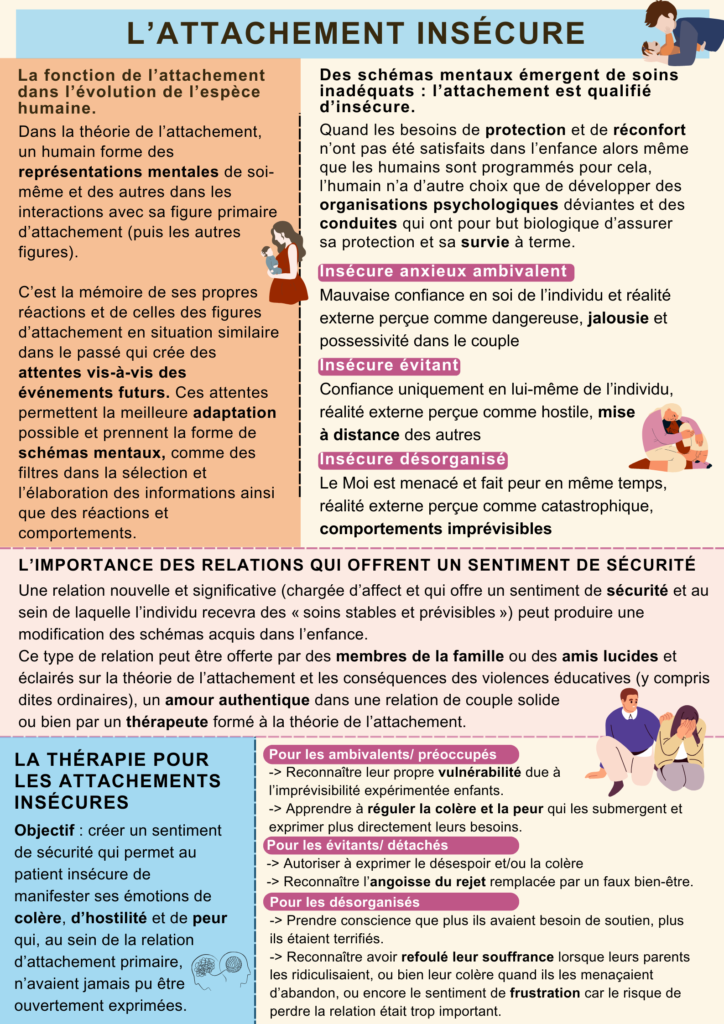
Insecure attachment is one of the four patterns described in adult attachment theory, and it covers three of them: anxious-ambivalent, anxious-avoidant and disorganized. Secure attachment is the fourth.
The theory describes how a person builds mental pictures of themselves and of others through early interactions with a primary caregiver, then with later figures. Memory of past reactions creates expectations, and those expectations work like filters that guide how we read situations and respond to them.

This article explains what happens when protection and comfort were missing in childhood, how each insecure style shows up, and which relationships and therapy can help rewrite those old patterns.
Quick takeaways
- Insecure attachment covers three adult styles: anxious-ambivalent, anxious-avoidant and disorganized.
- Insecure patterns are adaptations to unmet needs for protection and comfort, not personal flaws.
- Each style carries a distinct view of the self and of the outside world.
- A stable, predictable, affectionate relationship can modify childhood schemas.
- Teachers, coaches and activity leaders can act as secondary attachment figures for children.
- Therapy aims to let anger, hostility and fear be expressed safely at last.
Why Attachment Matters in Human Development
Attachment theory holds that a child forms inner representations of self and others through interactions with the primary attachment figure, and later with other close figures. The memory of how everyone reacted in similar situations becomes a set of expectations about what will happen next. Those expectations support the best possible adaptation and take the form of mental schemas.
These schemas act as filters: they influence which information we notice, how we interpret it, and which reactions and behaviors follow. In everyday parenting, that is why a calm, predictable response to a frightened child matters so much — it feeds the child's picture of others as available. If you are still working out your own reactions, it helps to look at child personality traits and at forms of aggression that adults sometimes normalize without noticing.
When Care Is Inadequate, Attachment Becomes Insecure
Humans are programmed to need protection and comfort. When those needs go unmet in childhood, a person has little choice but to develop deviant psychological organizations and behaviors whose biological aim is to secure protection and survival over time. In other words, the insecure pattern is not a flaw; it is an adaptation to an environment that did not reliably provide safety.
That reframing matters for parents who worry about their own history. Understanding your pattern is not about blame, it is about seeing the filter. Practical support around you — from a midwife's available support in the early months to a speech therapist assessment if communication worries arise — can reduce the pressure that feeds insecurity in the whole family.
| Style | View of self | View of others | Typical pattern |
|---|---|---|---|
| Secure | Worthy of care | Reliable and available | Comfortable with closeness and independence |
| Anxious-ambivalent | Low confidence | Perceived as dangerous | Jealousy, possessiveness, fear of loss |
| Anxious-avoidant | Self-reliant | Perceived as hostile | Keeps distance, trusts only self |
| Disorganized | Threatened and frightening | Perceived as catastrophic | Unpredictable behavior |
| What helps | Stable, predictable care | A safe relationship or therapy | Schemas can be revised over time |
The Three Insecure Attachment Styles
Each style carries its own view of the self and of the outside world, and each shows up differently in close relationships.
Anxious-ambivalent or resistant
The person has poor self-confidence and perceives external reality as dangerous. In couples, this often appears as jealousy and possessiveness, driven by fear of losing the relationship.
Anxious-avoidant
Here the person trusts only themselves, sees external reality as hostile, and keeps others at a distance. Closeness feels risky, so self-reliance becomes the safest strategy.
Disorganized
The self is threatened and frightening at the same time, external reality is perceived as catastrophic, and behavior becomes unpredictable. This pattern is the most unsettled of the three.
Recognizing which style fits is a first step. So is noticing how your child handles fear and new situations — see, for example, overcoming fear or what to do when a child seems unusually shy — because the same safety-building principles apply at every age.
Relationships That Offer a Sense of Security
A new and meaningful relationship — one charged with affection that offers a sense of security and in which the person receives stable, predictable care — can modify schemas acquired in childhood. This is the hopeful core of attachment theory: patterns are not fixed for life.
Such a relationship can come from family members or friends who understand attachment theory and the consequences of educational violence, including so-called ordinary violence. It can also come from authentic love in a solid couple relationship, or from a therapist trained in attachment theory. For children and teenagers, teachers and other professionals who spend time with them — a sports coach, a drama or singing teacher, a leisure-center leader — can serve as secondary attachment figures. Even a shared hobby or a hormone game played with a trusted adult can be a small, repeated moment of predictability.

What Therapy Aims to Do
The goal is to create a sense of security that lets the insecure patient express emotions of anger, hostility and fear that could never be openly expressed within the primary attachment relationship. The therapist's task is to make room for what was once forbidden.
With avoidant or detached patients, it is essential to allow them to express despair and/or anger; these patients lived through the anguish of rejection and replaced it with a false sense of well-being. For ambivalent or preoccupied patients, the first step is to recognize their own vulnerability caused by the unpredictability they experienced with the attachment figure. Only then can they regulate the anger that overwhelms them and ask more directly for what they need. Remembering that avoidance of certain places or situations was linked to fear of losing the attachment figure can reduce the phobia built up around those places and situations.
For disorganized or unresolved patients, it matters to realize that the more they needed support, the more terrified they were. Parents exploring this work often find it pairs well with reading about children's book authors who respect a child's inner world, or with simple guidance on sports and children when choosing activities that build confidence.

My hands-on take
When I first read about these styles, I recognized myself in the avoidant description and felt a little exposed. What helped me most was not labeling myself but noticing the moment I pulled away: a short message I did not answer, a plan I quietly cancelled. Naming that small reflex, without judging it, made it easier to stay in the conversation a little longer.
With my own child, I try to be the predictable adult I needed — same calm tone, same answer to the same fear, even when I am tired. I do not always manage it. But I have learned that repair after a sharp word matters as much as the word itself, and that a steady routine, a story at bedtime, a familiar game, quietly teaches that people come back.
Frequently asked questions
Is insecure attachment permanent?
No. Attachment theory describes patterns, not fixed destinies. A new and meaningful relationship that offers stable, predictable care, or therapy with a trained professional, can modify schemas acquired in childhood.
How do I know which insecure style I have?
Look at your default view of yourself and of others. Poor self-confidence with jealousy points toward anxious-ambivalent; trusting only yourself and keeping distance points toward avoidant; unpredictable reactions and a sense of both threat and fear point toward disorganized.
Can a teacher or coach really help a child?
Yes. For children and teenagers, adults who spend regular time with them, such as teachers, sports coaches or activity leaders, can serve as secondary attachment figures when they offer steady, predictable care.
What does therapy focus on first?
It focuses on creating a sense of security so that anger, hostility and fear can finally be expressed. The next steps differ by style: allowing despair in avoidant patients, recognizing vulnerability in ambivalent ones, and naming terror in disorganized ones.
Product Reviews
 Best Toys for Dogs With High Prey Drive |
Best Outdoor Toys for 3-4 Year Olds |
Best Outdoor Toys for 6 Year Olds |
Best Harness for Poodle |
Best LEGO Sets for Adults |
Best Travel Toys for 4 Year Olds on Airplane |
Best Toy Stores in Washington DC |
Best Potty Training Toys |
Best Toys for Tripod Dogs |
Maillot equipe de france







