


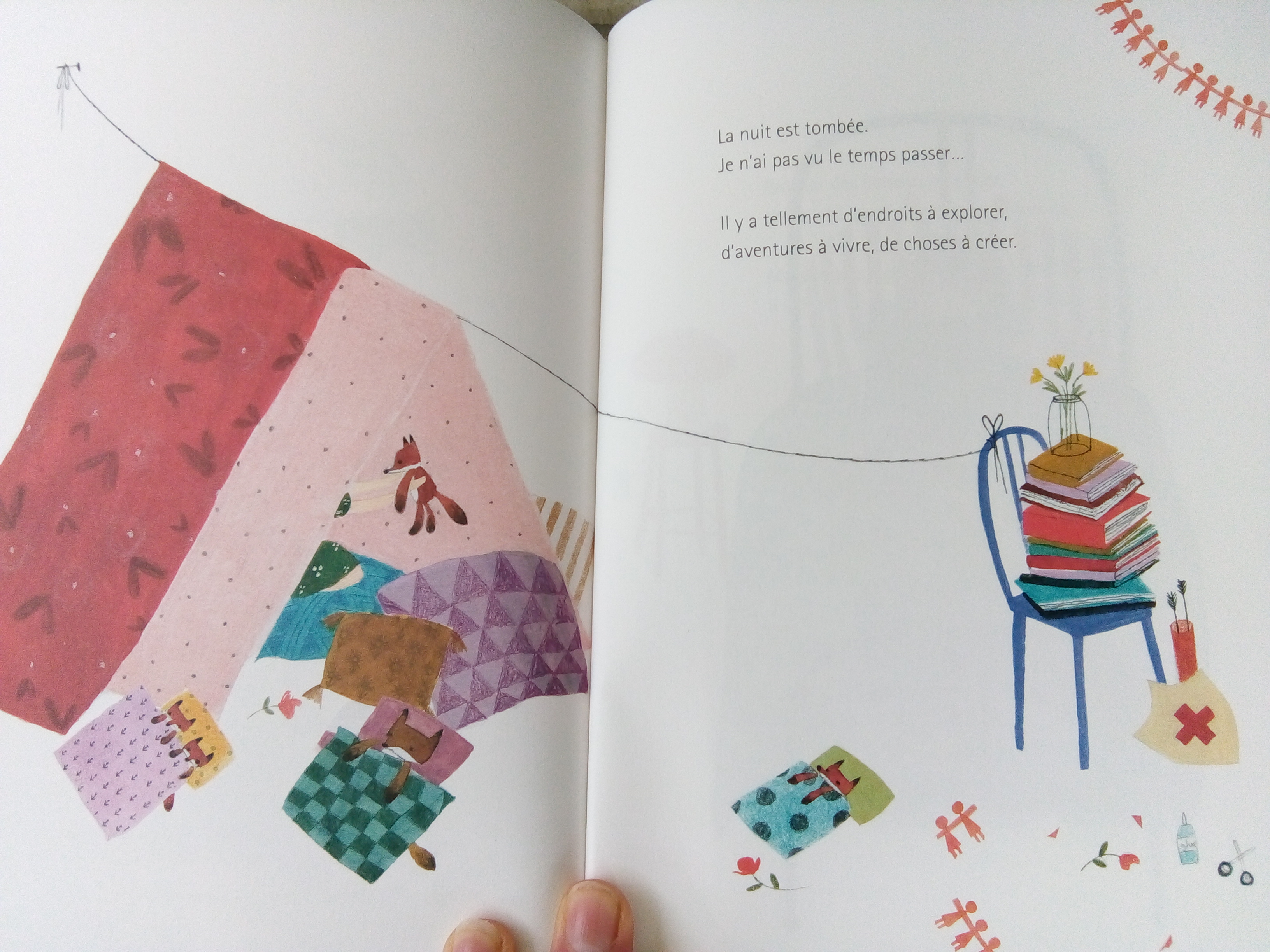
Il Était Une Fois Lily is a picture book that turns an ordinary day into a voyage, and it does so with the lightest of touches. Cushions become castles, the floor becomes an ocean, and a small girl with a restless imagination leads us from one adventure to the next.
With Lily we board a huge ocean liner, take tea in Wonderland and fly above the treetops. This album, with its delicate and fanciful illustrations, celebrates childhood and shows young readers, and nostalgic parents too, that play and inventiveness open the doors to marvellous worlds.

Quick takeaways
- A cushion-and-cardboard adventure that celebrates everyday imagination.
- Lily is adventurous, creative and free, a strong and enterprising heroine.
- The text invites a journey; the illustrations are soft and poetic.
- Fairy-tale references to Alice, Grimm, Andersen and The Jungle Book.
- A gentle nudge to feed children living, inspiring stories.
- Enjoyed by nostalgic parents and by children who love to invent.
A Day That Becomes a Voyage
The premise is simple and that is exactly its strength. Lily does not need a screen or a ticket to travel; she needs a few household objects and a story to step into. One moment she is a cabin boy on a sailing ship, the next a mermaid in the ocean, then a boy raised by wolves or a rider in the land of fairy tales.
What she loves most, along with building cardboard boats and cushion castles, is inventing stories out of almost nothing. That appetite for make-believe is worth protecting, and it sits alongside the everyday work of happy childhood foundations that parents quietly build at home.
Why the Ordinary Becomes Extraordinary
Because a child's attention is generous, a sofa can be a ship's deck and a blanket can be a sail. The book never mocks this; it simply follows Lily and lets the transformation happen.

The Strengths of Il Était Une Fois Lily
There are several reasons this album works so well. The text reads as an invitation to an imaginary journey rather than a plot to be followed, and the illustrations carry an uncommon softness and poetry. Lily herself has an adventurous, creative and free spirit that is genuinely appealing, and she offers the image of a strong, enterprising girl.
Readers meet slices of the life of a mischievous child who moves from adventure to adventure without asking permission. She can be anything she wants, and nothing and no one bridles her imagination. That freedom is the kind of supportive parental gaze many of us hope to offer, and it is also a reminder of how much shared parental allies matter when a child is allowed to lead the play.
A Girl Who Decides
Lily is not waiting to be rescued. She chooses the ship, the sea and the ending, which makes her a quietly empowering heroine for both girls and boys.

| What Lily does | What you need | What your child practises |
|---|---|---|
| Sails a huge liner | Cushions, a sheet, a cardboard box | Sequencing and role play |
| Takes tea in Wonderland | Cups, a scarf, a teddy guest | Turn-taking and language |
| Flies above the trees | Arms, a stool, a lot of noise | Balance and confidence |
| Rides in fairy tales | A broomstick or a stick horse | Story structure and memory |
| Builds a castle | Sofa cushions, pegs, a blanket | Problem solving and patience |
Fairy Tales Behind the Story
The album is threaded with references to popular tales: Alice in Wonderland, the Brothers Grimm, Andersen's stories, The Jungle Book. These echoes are not decoration; they remind us how important it is to feed a child's imagination with living, inspiring stories.
The same principle underpins the Charlotte Mason approach, which holds that our work as educators is to expose children to as many beautiful and great ideas as possible, because they need a large quantity of noble material to build their own lives. A bookshelf is therefore not a luxury but a workshop, and a few simple playthings beside it complete the tools.
Stories That Stay
Children who hear tales repeatedly begin to borrow their structures, their heroes and their language. That borrowing is the beginning of their own storytelling.
Who Will Enjoy This Book
The album will please parents, who will recognise their own memories in it as well as traits of their own child in this endearing little girl. It will please children too, who know as well as Lily does that stories and imaginary adventures are what happiness is made of.
It reads beautifully aloud at bedtime, and it works just as well as a springboard for an afternoon of den-building. Pair it with a basket of outdoor play equipment or a rainy-day corner of cushions, and the book becomes an activity rather than a single sitting. Grandparents will find it a gentle bridge too, especially during stays with grandparents when new rooms need new games.
Reading It Together
Pause on the illustrations and ask what your child would add to the scene. The answer is usually better than the page.

How to Turn the Book into Play
You do not need a plan, only permission to be a little silly. Let your child choose the destination, then gather whatever is within reach: cushions, cardboard, a scarf, a wooden spoon. Follow Lily's logic and let the story run until it runs out.
Keep the props few and open-ended, because a plain object asks more of the imagination than a finished toy. If you are building a first library for a baby, the same principle applies: choose toys for newborns and board books that invite rather than instruct, and let the collection grow with the child through toys for one year olds as attention stretches.
A Small Ritual
End each session by asking what happened in the story. Naming the adventure helps a child keep it.

A Gentle Reminder for Grown-Ups
Il Était Une Fois Lily is not a manual, and that is why it lands. It simply holds up a mirror to the way children already think before we teach them to be sensible, and it asks us not to hurry that thinking away.
If you want a companion volume for the shelf, look for picture books that trust the reader and leave room for wonder. The best of them, like this one, treat teething toys and treasure ships as equally serious business when a small person is in charge of the afternoon.
My hands-on take
I have read this one more times than I can count, and what stays with me is how little it asks of the adult. There is no craft to prepare and no outcome to reach. The first time we read it, my daughter disappeared into the hallway and came back with every cushion from the sofa, announcing that the living room was now the sea. I sat on the floor and was promptly told I was a passenger.
Since then I keep a cardboard box in the corner and try not to tidy it away too quickly. The book did not teach me a technique; it reminded me to get out of the way. If you read it aloud, I would suggest leaving a long pause after the last page, because that is usually when the real story begins.
Frequently asked questions
What age is Il Était Une Fois Lily suitable for?
It works best as a read-aloud for preschool and early primary children, who can follow the shifts from one imaginary world to the next. Older readers can enjoy the fairy-tale references on their own.
Who wrote and published the book?
It is written by Sara O'Leary and published by Belin Jeunesse. It is available in libraries, bookshops and online retailers.
Does the book have a message for parents?
Yes, gently. It suggests that play and inventiveness open the doors to marvellous worlds and help a child become the hero of their own story, which is a message about trust rather than instruction.
Can it be used as a starting point for activities?
Absolutely. The cushion castles and cardboard boats in the story translate easily into an afternoon of den-building, and the fairy-tale references invite you to read the classics alongside it.
Product Reviews
 Best Toys for Dogs With High Prey Drive |
Best Outdoor Toys for 3-4 Year Olds |
Best Outdoor Toys for 6 Year Olds |
Best Harness for Poodle |
Best LEGO Sets for Adults |
Best Travel Toys for 4 Year Olds on Airplane |
Best Toy Stores in Washington DC |
Best Potty Training Toys |
Best Toys for Tripod Dogs |
Maillot equipe de france







