


Finding your life purpose starts with a few honest questions rather than a grand plan. To be genuinely happy, we need a life project that gives our days meaning, and reflection is the simplest way to uncover it.
The eight questions below are designed to be sat with rather than answered in a hurry. They ask why you are here, what you are meant for, and what the world would lose without you. None of them requires a dramatic answer.

In fact, the responses can be tiny: a kind word to a colleague, a smile to a neighbour. The point is to begin a change with small steps, because the world is the sum of our individual acts.
Quick takeaways
- Purpose begins with honest questions, not a grand plan.
- Ask why you are here and what you are destined for.
- Consider what the world would lose without you.
- Name what you want to be recognised for, then what people would say in fifty years.
- Contribution grows from small, repeated gestures.
- The one-week exercise reveals what you would actually keep.
Start With the Questions That Anchor You
The first questions are the broadest, and they set the direction for everything else. Ask yourself why you are here and what you are destined for, without expecting a tidy answer straight away. These two questions work best when you return to them over several days rather than forcing a conclusion in one sitting.
Then turn to the people around you. In what way would the world be less beautiful without you? What can you do to leave something worthwhile behind tomorrow? Framing purpose this way keeps it close to daily life instead of floating in abstraction.
If you are raising children, this reflection often overlaps with the way you guide them. Thinking about child's personality helps you see what you already contribute simply by paying attention.
Think About Recognition and Your Legacy
We all want to be seen, and admitting that is not vanity. Ask yourself what you want to be recognised for, then ask what people would say about you if your life were told in fifty years. The gap between those two answers is often where the real work lies.
Legacy does not require a monument. It can be a habit passed on, a relationship repaired, or a small contribution that quietly outlasts you. Writing your answers down makes the gap visible and turns a vague wish into something you can act on.
Parents often find that this question reshapes how they spend evenings at home. A simple shift, such as communicate effectively with your children instead of scrolling, is itself a trace you leave. The parent child relationship is shaped by these small daily choices, much like the true cost adds up from tiny pieces.
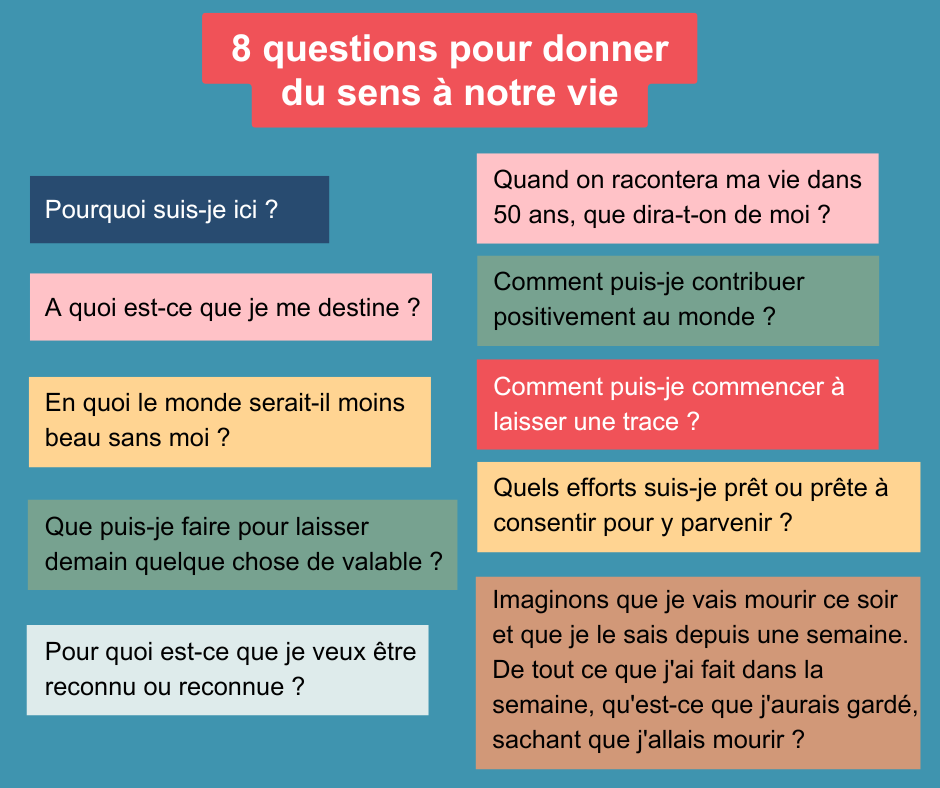
| Question | What it explores | Practical next step |
|---|---|---|
| Why am I here? | Core direction | Write an answer, revisit in a week |
| What would be missing without me? | Your unique contribution | List three things others value in you |
| What do I want to be recognised for? | Values and identity | Compare with your fifty-year question |
| How can I contribute positively? | Action in the world | Choose one gesture to repeat this week |
| What effort am I willing to make? | Realistic commitment | Set a limit you can sustain |
| What would I keep from this week? | Priorities under pressure | Remove one activity you would not keep |
Turn Reflection Into Contribution
Once you know what matters, the next question is how you can contribute positively to the world. Keep it concrete and modest: what is within reach this week? Contribution grows from repeated small gestures far more reliably than from one grand resolution.
Then ask how you can begin to leave a trace, today rather than someday. The answer might be a phone call, a shared skill, or a few hours of volunteering. The scale matters less than the fact that it actually happens.
Small Acts, Real Effects
This is why the source insists on small steps: the world is the result of the sum of our individual acts. A single kind gesture looks insignificant, but repeated across a neighbourhood or a family it changes the atmosphere. Purpose is built the same way, one ordinary decision at a time.
Ask What Effort You Are Willing to Make
Meaning without effort tends to stay a nice idea. Ask yourself honestly what you are prepared to give up or take on to reach what matters to you. Time, comfort and habit are usually the real currency here, not money.
Being realistic protects you from burnout. A purpose that demands everything at once rarely survives a busy month, whereas a modest commitment you can keep builds momentum. Write down the effort you can sustain, not the one you admire.
Practical constraints are part of the picture too. If your days are already full, something like teleworking with children shows how small adjustments, rather than heroic ones, make room for what you value. The same holds for organizing at home with little ones underfoot.
Use the One-Week Exercise
The final question is the most striking. Imagine you will die tonight and have known it for a week. Of everything you did in that week, what would you have kept, knowing you were going to die?
This exercise cuts through noise quickly. It reveals which activities, people and moments you actually treasure, and which ones you would not miss at all. Most people find the list is shorter and simpler than expected.
The answers usually point toward relationships and small pleasures rather than achievements. If you want to protect that clarity, best apps can help you notice how much of your attention goes to a screen instead of the people on your list.
Make the Answers Part of Family Life
These questions are not only for solitary reflection. Sharing a simplified version with children teaches them that their actions matter and that purpose is something you build rather than inherit. Ask them what they would like to leave behind, and listen without correcting.
Everyday family moments carry this weight quietly. A shared story, a repaired toy, a walk without a phone: these are the raw material of a meaningful life. Even something as ordinary as washing stuffed animals together becomes a small lesson in care and responsibility. Small milestones, like a baby's first hello, remind us how quickly these shared moments shape a child.
Keep the eight questions somewhere visible and revisit them once or twice a year. Answers change as life changes, and that is the point. Purpose is not a destination you reach once but a direction you keep choosing. Knowing the signs of serious illness, such as recognizing encephalitis symptoms, also helps families protect the everyday moments that matter.

My hands-on take
I tried the one-week exercise on a quiet Sunday, expecting it to be abstract. It was not. Looking back over seven ordinary days, I noticed that the moments I would have kept were almost all unplanned: a slow breakfast, a conversation on the stairs, a walk where nobody checked a phone. The things I had been treating as urgent barely appeared on the list at all.
Since then I keep the eight questions in a notebook and revisit them twice a year. I do not always like the answers, especially the one about effort, but they keep me honest. My advice is to start with just one question and give it a week, rather than trying to answer all eight in an evening.
Frequently asked questions
How long should I spend on each question?
There is no fixed time. Sit with one question for a few days and let the answer settle rather than forcing it in a single session.
What if my answers feel too small?
Small answers are the point. A kind word or a smile to a neighbour counts, because the world is the sum of individual acts.
Can I do this exercise with my children?
Yes, in a simplified form. Asking a child what they would like to leave behind teaches them that their actions matter.
How often should I revisit these questions?
Once or twice a year works well, or whenever life shifts. Answers change as circumstances change, and that is normal.
Product Reviews
 Best Toys for Dogs With High Prey Drive |
Best Outdoor Toys for 3-4 Year Olds |
Best Outdoor Toys for 6 Year Olds |
Best Harness for Poodle |
Best LEGO Sets for Adults |
Best Travel Toys for 4 Year Olds on Airplane |
Best Toy Stores in Washington DC |
Best Potty Training Toys |
Best Toys for Tripod Dogs |
Maillot equipe de france







