


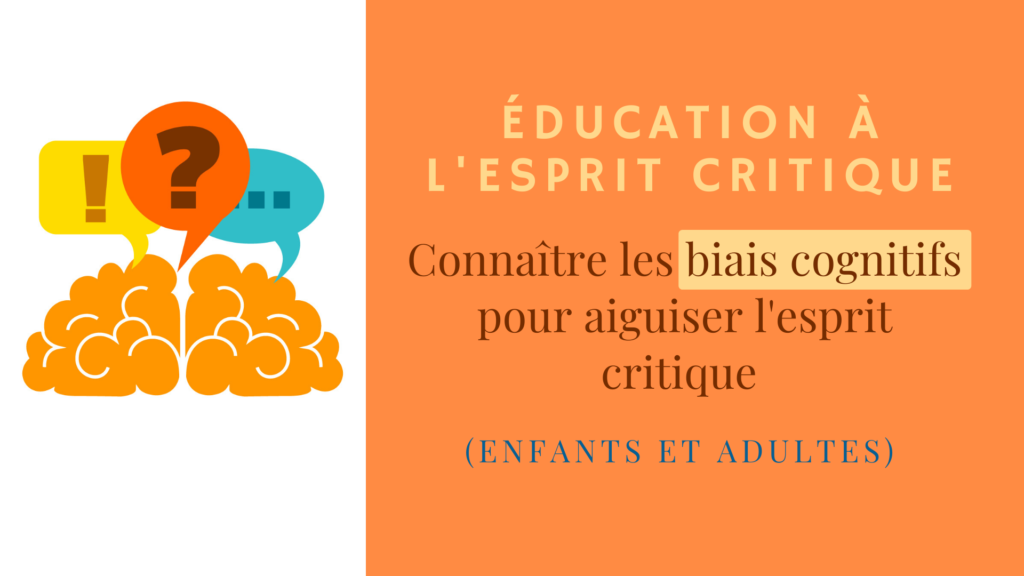
Education in critical thinking begins with knowing the mental shortcuts that quietly bend our reasoning. Cognitive biases affect our judgments and decisions, and they can supply "good reasons" for unfounded fears — fears that make the bed for beliefs and resistance to scientific information. Because these biases are shortcuts of thought that are hard to escape, simply knowing them is a useful first step toward (trying to) outwit them.
Children and teenagers can be introduced to the main cognitive biases that weaken critical thinking — their own as well as those of adults. The goal is not to turn anyone into a flawless thinker, but to give young people a shared vocabulary for noticing when a conclusion is being pushed by the mind rather than by the evidence.

Quick takeaways
- Cognitive biases are mental shortcuts that distort judgment and feed unfounded fears.
- Anchoring lets the first information we hear set a reference point for everything after.
- Confirmation bias makes us seek supporting evidence and dismiss what contradicts us.
- Fear, group conformity and authority figures all weaken independent reasoning.
- Framing and the halo effect change decisions without changing the underlying facts.
- Scientific evidence comes in levels, from case series up to established proof.
Anchoring, Sunk Beliefs and Confirmation
Start with the anchoring effect: the first piece of information we receive influences how we perceive everything that follows. This is especially visible in financial negotiations, where the first price offered becomes a reference point even when it is disconnected from reality. Children meet the same trap when a first headline or a first rumor sets the tone for everything they read afterward.
Next comes the cost of abandoning beliefs. The more time, energy and money we have invested in a belief presented as mistaken, the harder it is to let go. The same applies to suffering: humans need to give meaning to their pain, so they struggle to accept they could have done without it — as with people who defend spanking as an indispensable and harmless method because, without it, they would have turned out badly.
The confirmation bias closes this trio: we tend to seek information that reinforces our beliefs and to ignore, relativize or reject whatever contradicts them. Encouraging a child to actively look for the strongest opposing argument is a concrete way to practice the kind of open-ended exploration found in sensory play games.
Overconfidence and the Pull of Emotion
The Dunning-Kruger effect, or overconfidence effect, means the least qualified people in a field overestimate their competence — they are unaware of everything they do not know. The most qualified, by contrast, are more cautious, because they see how much remains to be discovered and how multi-factorial the causes usually are.
Our emotions, especially fear, and our motivations also steer us: we are more sensitive to risks than to benefits, we prefer the status quo, and conformity weighs heavily. Our brains also struggle with statistics and numbers, producing a distorted sense of randomness, overestimation of very low probabilities and proportionality errors. One gentle antidote is time spent reading together — even books with pop ups can be a calm moment to ask "how do we know that?" Facing small fears through stories, like these books about fear, builds the same habit of questioning.
| Bias | What happens | Question to ask |
|---|---|---|
| Anchoring | First information sets a reference | What came before this number? |
| Confirmation | We seek supporting evidence | What would prove me wrong? |
| Authority | Expert opinion is overvalued | Is this person truly an expert? |
| Framing | Presentation sways the decision | How else could this be stated? |
| Halo effect | One trait colors the whole view | Am I judging one thing or many? |
| Barnum effect | Vague claims feel personal | Could this describe anyone? |
Simple Explanations, Authority and the Barnum Effect
We are drawn to simple, causal explanations: we resist multi-factorial accounts and confuse correlation with causation. We also fall for the authority bias, overvaluing the opinion of someone we consider an expert — whether they truly are one or are simply presented as such.
The Barnum effect (also called subjective or personal validation) makes us accept a vague description of personality as if it applied specifically to us. We fill in the gaps and manufacture meaning, as happens with astrology. A playful way to expose this is to compare horoscopes side by side and let children spot how many statements could fit anyone — a detective game in the spirit of LEGO Ninjago characters, where everyone recognizes a bit of themselves.
Backfire, Group Effect, Framing and Halo
The backfire effect describes what happens when we meet evidence that contradicts our beliefs: we tend to reject it and close ranks around our original position, which is paradoxically reinforced by the contradictory proof. The group effect appears when we prioritize conformity with the group's opinion over scientific evidence and information.
The framing bias is the tendency to be influenced by how a problem is presented. A decision to take a risk shifts depending on whether the success rate or the failure rate is shown: both numbers give the same information, yet presenting the success rate tips the decision toward acting, while presenting the failure rate tips it against. The halo effect means our perception of a person or group is colored by one personal characteristic — someone judged physically beautiful is perceived as intelligent and trustworthy. Try a family experiment with airplane toys, outdoor toys or any shared item: describe it two ways and watch opinions move.
Telling Science Apart from Opinion
It also helps to know what distinguishes a scientific finding from an opinion, and what gives one piece of scientific data more value than another. The scientific method is first of all experimentation under controlled conditions and the reproduction of experiments. In medicine, a kind of pyramid of evidence levels is now accepted, and the French national health authority distinguishes three levels when building its recommendations.
The Three Levels of Evidence
A low level of evidence corresponds to case series (a succession of testimonials and descriptions), retrospective studies or case-control studies. A scientific presumption relies on low-power randomized comparative trials, well-conducted non-randomized comparative studies or cohort studies. An established scientific proof rests on high-power randomized comparative trials, a meta-analysis of randomized comparative trials or a decision analysis based on well-conducted studies.
When opinions are presented alongside data, ask children which level a claim comes from — a skill as useful for judging a toy review as for reading the label on GWP meaning in LEGO sets. The same critical eye helps when comparing child water safety elements or choosing books about art.

My hands-on take
I started using these ideas at the dinner table rather than in a formal lesson. When one of my children repeated something heard at school, I began asking, "What's the first thing you heard about this?" — a small anchor check that often revealed how much the first version had shaped everything after.
What surprised me most was how quickly the children turned the questions back on me. My own confirmation bias showed up when I defended a decision I had already invested effort in, and admitting that out loud did more for their critical thinking than any explanation. We now keep a running joke about "the halo of the shiny new toy," and it has become a gentle way to question first impressions without turning every conversation into a debate.
Frequently asked questions
At what age can children understand cognitive biases?
There is no fixed age, but concrete examples work best with younger children. Teenagers can handle the names and definitions once they have seen the pattern in a real situation.
Are cognitive biases always bad?
No. They are shortcuts that help the brain decide quickly, which is why they are hard to escape. The aim is to notice them when a decision matters, not to eliminate them.
How do I explain the difference between correlation and causation?
Use everyday examples where two things happen together but one does not cause the other. Ask whether a third factor could explain both.
What is the simplest way to teach the levels of evidence?
Present it as a ladder: single stories at the bottom, well-conducted comparative studies higher up. Ask which rung a claim is standing on.
Product Reviews
 Best Toys for Dogs With High Prey Drive |
Best Outdoor Toys for 3-4 Year Olds |
Best Outdoor Toys for 6 Year Olds |
Best Harness for Poodle |
Best LEGO Sets for Adults |
Best Travel Toys for 4 Year Olds on Airplane |
Best Toy Stores in Washington DC |
Best Potty Training Toys |
Best Toys for Tripod Dogs |
Maillot equipe de france







