


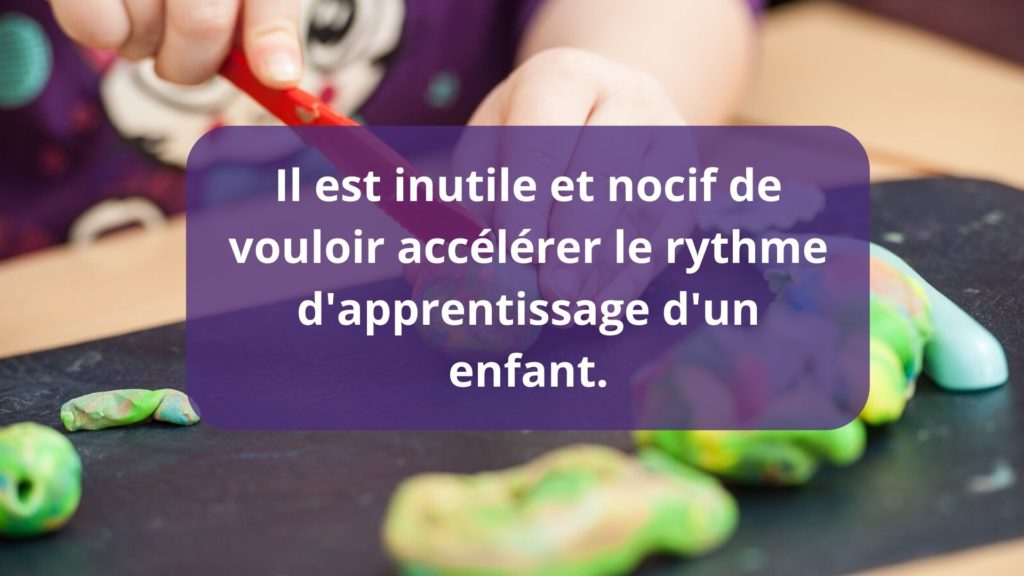
Respecting your child's learning pace is not laziness or a lack of ambition: it is one of the most protective choices you can make in early childhood. Trying to accelerate that pace is both useless and harmful, because the early years are meant to stay a season of unstructured time and free play.
Drawing on the work of Catherine L'Ecuyer, doctor in educational science, this article looks at what happens when adults push children into tasks they are not ready for, why self-directed play builds the foundations of future learning, and what parents can realistically do instead.

Quick takeaways
- Accelerating a child's learning pace is useless and harmful.
- Early childhood should stay a time of unstructured time and free play.
- Self-directed play develops executive functions, the base of all later learning.
- Not writing a name at three or reading at five is no cause for worry.
- Commercial and social pressure, not child development, drives early stimulation.
- Empty schedules and unhurried time serve children better than filled ones.
Why pushing a child to learn faster backfires
When adults try to speed up a child's learning rhythm, the child ends up doing things for which they are simply not ready. That gap places them in a frustrating position, with knock-on effects on self-esteem and a real sense of stress.
The pressure rarely stays academic. A child may start fearing mistakes, and may also do everything possible not to disappoint their parents or risk losing their love. Over time this can mean inhibiting personal preferences to please adults, pushing past physical limits by ignoring their own sensations and emotions, and losing touch with the internal compass that tells them who they really are.
None of this means parents should be indifferent. It means the goal is a child who feels safe enough to explore, which is why small everyday gestures of care, such as learning teeth brushing routine, matter more than early academic drills.
Free play builds the foundations of learning
Self-directed free play, with no instructions from an adult, is how children develop their executive functions. That development is the pillar of all later learning, whether relational and emotional skills such as resisting frustration and regulating aggression, or academic and school-based learning.
This is why there is no reason for parents to worry if a child cannot write their name at three or read at five. The brain is busy building something more fundamental than visible output, and simple materials often serve that work better than complex ones, as with the fine motor toys that let a child practise at their own level. The same patience matters later, when you ask are they ready for the next big step.
What free play actually looks like
It is a child deciding what to do next, changing their mind, getting bored, and inventing something else. Open-ended toys support this because they leave room for the child's own ideas, and the same principle applies to stimulating creativity without directing it. Even the way we instinctively hold the baby shows how naturally responsive care supports development.
| Dimension | Pushed pace | Respected pace |
|---|---|---|
| Adult role | Directs and corrects | Observes and supports |
| Child's experience | Fear of error, stress | Safety to explore |
| Main activity | Formal tasks and apps | Self-directed free play |
| Schedule | Filled with activities | Empty space protected |
| Self-esteem | At risk | Nurtured |
The commercial and social pressure to stimulate early
Everything pushes parents toward a model in which "good" parents stimulate their children as early as possible. Behind the idea of early stimulation sit financial interests: the baby-care and educational-toy market, educational apps, branded methods, private schools.
There are societal stakes too, such as the cult of performance and a "no pain, no gain" ideology, and economic ones, including fear of precariousness and unemployment that puts pressure on school success, and fear of social decline among upper-class parents.
It helps to remember that a toy is a tool, not a curriculum. Even when choosing something as ordinary as toys for two year olds, the question worth asking is whether it invites the child to play or asks them to perform.
Older children do not need a summer of worksheets
Even when children are older, they do not need to spend the summer sitting at the kitchen table with a holiday workbook so they "don't lose the rhythm". Nor do they need weekends of homework that is in principle not allowed in elementary school but is still assigned to "prepare for middle school".
Rest, boredom and unhurried time are not gaps in learning. Outdoor play is one of the most efficient ways to restore attention, and options like outdoor toys give children a reason to move, build and negotiate with others rather than sit still. Families raising suitable small mammals also find that caring for a pet over the holidays teaches responsibility far better than any worksheet.
What children actually need at that precious stage is to be surrounded by people close to them, to play, imagine and discover things for themselves without rushing. Drawing characters floating in the air, running through a field to catch butterflies, picking wild flowers with siblings, inventing fantastic adventures and secret passages: these are natural needs of the child too. As the chirigota reminds us, good fathers (and mothers) are present, not just providers of homework.

Why compartmentalising reality works against children
L'Ecuyer regrets that the obsession with distinction and performance leads adults to slice reality into school subjects, when the child sees life as a whole. Edgar Morin makes a similar point: when disciplines are specialised and closed, the mind loses its natural ability to put knowledge and facts back into context.
Morin writes that because our education has taught us to separate, compartmentalise, isolate and not to connect knowledge, the whole of it forms an unintelligible puzzle. The great human problems disappear in favour of particular technical problems.
He adds that a weakened perception of the global leads to weakened responsibility, since each person tends to be responsible only for their specialised task, and to weakened solidarity, since each no longer feels their link with fellow citizens. Unable to consider context and planetary complexity, blind intelligence makes people unconscious and irresponsible. Both authors agree that education should nurture the mind's natural ability to pose and solve essential problems, and so allow intelligence to be fully used.
How to respect your child's learning pace in practice
Protect empty space in the week. A child whose brain and schedule are full of after-school activities, mountains of homework and objectives of every kind has no time left to work out what genuinely suits them at this stage.
Watch your own reactions, too. If you notice yourself measuring your child against a neighbour's, pause: comparison is usually about adult anxiety, not about the child's needs. Everyday care routines, from helping baby sleep in hot weather to a calm bedtime, do more for readiness than an extra class.
Finally, let the child lead the activity and follow their interest rather than your plan. A parent who observes before intervening gives the child room to choose, fail safely and try again, which is exactly what a healthy learning pace looks like.

My hands-on take
I learned this the slow way. For a while I treated every quiet afternoon as a problem to solve, filling it with a workbook page or a "educational" game, and I could see the mood in the room change the moment I did. My child was not learning more; they were just waiting for me to leave so they could get back to their own project.
What worked was much less impressive to describe. I started leaving whole afternoons empty, putting out a few simple things and then sitting down with a cup of tea instead of hovering. The first days felt wasteful. Then the stories, the drawings and the long explanations started arriving, and I realised the child had been ready all along; I was the one who needed to slow down.
Frequently asked questions
Is it a problem if my five year old cannot read yet?
No. There is no reason to worry at that age; the foundations being built through play matter more than visible reading output.
Does respecting the pace mean no activities at all?
Not at all. It means keeping unstructured time and free play as the core, and choosing activities because the child enjoys them rather than to get ahead.
Why is free play so important?
Self-directed play is how children develop executive functions, which underpin emotional, relational and academic learning later on.
What happens when we push too hard?
The child is asked to do things they are not ready for, which brings frustration, fear of error and pressure to please adults at the cost of their own preferences.
Product Reviews
 Best Toys for Dogs With High Prey Drive |
Best Outdoor Toys for 3-4 Year Olds |
Best Outdoor Toys for 6 Year Olds |
Best Harness for Poodle |
Best LEGO Sets for Adults |
Best Travel Toys for 4 Year Olds on Airplane |
Best Toy Stores in Washington DC |
Best Potty Training Toys |
Best Toys for Tripod Dogs |
Maillot equipe de france







