


Anxiety stories for kids are the little narratives a child's inner voice spins after a remark, a reproach or a criticism, and learning to question them changes everything. An emotional reaction is normal: the emotion shows up first in the body through physical sensations, then through urges to act, all fed by thoughts.
It is precisely those thoughts, the stories our inner voice tells us, that generate anxiety and cause suffering, for adults and children alike. Once the body's defensive reactions have done their job, the inner voice takes over to justify old stories tied to similar past feelings.

These invented stories stretch a reaction that would normally pass in minutes. This article walks through a two-step game that helps children step out of their assumptions.
Quick takeaways
- Emotions start in the body; the inner voice then stretches them into anxiety.
- Help children see thoughts as stories, not facts.
- Play with four versions: normal, funny, impossible and comforting.
- The brain treats imagined danger like real danger, so stories matter.
- Rehearse a question, then ask the person what actually happened.
- Pause first, play the game second, once the body is calm.
How the Inner Voice Keeps Anxiety Alive
When a defensive reaction has fulfilled its role, satisfying the need for safety through action such as crying, shouting or fleeing, the body is relieved and the emotion passes. That is when the inner voice steps in to restore emotional balance, because the incident has awakened existential needs for security, identity and self-fulfilment.
The voice then justifies stories already told in the past: "nobody wants me", "I'm useless", "they'll laugh at me", "I'm shy". With these stories invented by the mind, children and adults create their own stress. A pause helps here, whether a deep breath, a few jumps, a glass of water or some stretching, so the child can notice: this is only an emotional reaction plus the story I'm telling myself, not the reality of the situation.
If you want to understand how much room to give a child's natural development before stepping in, these educate children reflections pair well with this pause. A calm body is also easier to settle into daily routines, as these teach routines books show.
Step One: Find Several Other Stories
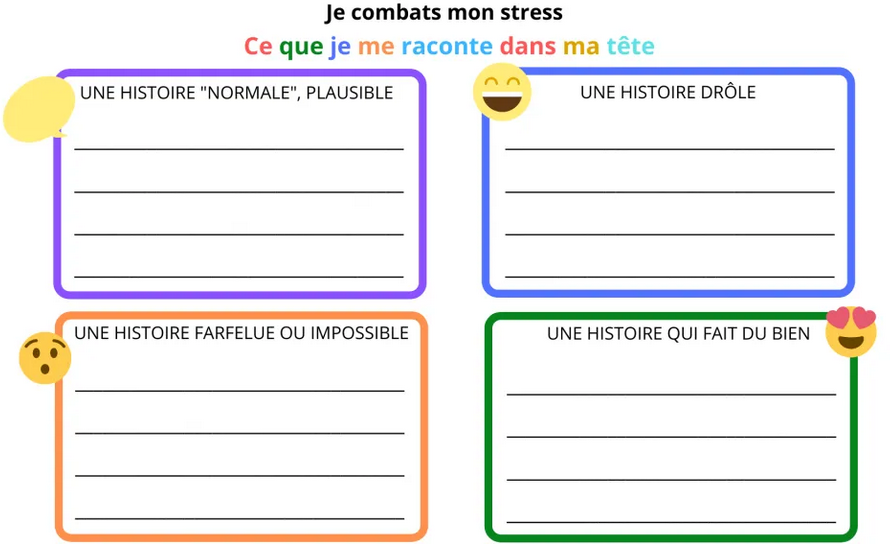
The first step is helping children understand that what happens in their head is only a story, and that several versions are possible. Suffering comes from believing a single thought is the only reality. To soothe the reaction, invite the child to tell at least four different stories, using humour and imagination for extra effect: a normal, plausible one, a funny one, a far-fetched or impossible one, and one that feels good.
Children usually cling to the worst story, the one that awakens the great human fear of not being loved, and that interpretation is exactly what hurts them. Simply thinking about something negative triggers contractions in the body and defence mechanisms of attack, withdrawal or flight, because the brain does not distinguish a real danger perceived by the five senses from an imagined one.
Playing with two, three or four interpretations of reality tricks our emotions, moving from worry to laughter or the ridiculous. Once the emotion has been identified and named, the child can amplify it, ridicule it or shrink it. That freedom matters as much as choosing safe, engaging play, which is why a good color dog toys set or other absorbing toys can support calm moments.
| Story type | Purpose | Example |
|---|---|---|
| Normal, plausible | Names the worry honestly | "Maybe they were busy." |
| Funny | Releases tension through laughter | "Maybe a dragon stole their phone." |
| Impossible | Shows the mind invents | "Maybe they turned into a cat." |
| Comforting | Restores a sense of safety | "My friend still likes me." |
| Question to the person | Checks reality | "Are you upset with me?" |
Step Two: Ask the Person Concerned
Asking the other person about the behaviour behind the reaction builds connection and reveals the truth, pleasant or not, stopping the inner voice from running wild. It is easier said than done, both in form and content. On form, invite children to imagine and rehearse a scenario several times before acting, so they avoid stammering, feeling intimidated or dodging the conversation.
The small-steps technique works well: break a big, daunting action into several small, feasible ones and do them one after another, anticipating obstacles along the way. On content, guide children to formulate their request, pick a good moment, tell the other person they have a question, describe what the five senses perceived, name what they felt, then make a request: "When you did this or said that, I felt..., would you agree to...?"
Rehearsing social confidence has parallels with other skills children build gradually, much like the patience behind get pregnant planning or the persistence needed to follow a LEGO Fortnite build step by step.
Why the Game Works for Anxious Children
The game works because it targets representations, the inner voice's commentary, rather than the emotion itself. When the voice in the head changes, the emotional reaction fades and the body settles. Children discover they can choose another path than painful thoughts and feelings, instead of being stuck on one looping assumption that feeds on rumination.
This is especially valuable for children prone to violence or withdrawal, since both often grow from the same frightened story. Naming the emotion, playing with versions of it and then checking reality gives the child two exits: imagination and conversation. Neither requires the adult to argue the child out of a feeling, which rarely works anyway.
For younger children, picture books about feelings and everyday courage can prepare the ground, just as fun mathematics stories make abstract ideas concrete. Parents who want to support a child's confidence may also enjoy reading about strong brave role models together.
Making It Part of Everyday Family Life
Keep the game light and short. A few minutes after school, at bedtime or in the car is enough. Ask which story the inner voice told, then play with the funny and impossible versions before gently moving to the "what could I ask?" question. The adult can model it too, telling a small worry and offering several versions of it.
Timing matters: a child in the middle of a strong reaction needs comfort first, not a game. Offer the pause, then return to the stories once the body is calm. Over time, children start noticing their own voice and saying things like "that's just my story again", which is the real goal.
Some families pair the game with quiet rituals, such as choosing a calming toy or reading together, much like picking toys for 18 month old babies when a younger sibling needs soothing too. Consistency, not intensity, makes it stick.

My hands-on take
I tried this with my own child after a rough day at school. Instead of arguing about whether a classmate really ignored her, I asked what story her inner voice was telling. She said, "she hates me." So we played: maybe she was distracted, maybe a giant bird carried her away, maybe she was just shy that morning. By the impossible version, my daughter was laughing, and the tight shoulders I had seen all evening softened.
The next day she decided to ask her friend a simple question, and it turned out the girl had simply been worried about a test. I will not pretend it works every time, and some evenings we just do the breathing pause and leave it there. But it gave us a shared language, and now she sometimes catches herself and says, "that's just a story." That small phrase has done more for our evenings than any lecture I could give.
Frequently asked questions
At what age can this game work?
Children old enough to name simple feelings and imagine alternatives, often around early school age, can join in with adult guidance. Younger children benefit most from the pause and from hearing an adult model several versions of a story.
What if my child refuses to play?
Keep it low-pressure and model it yourself first, telling a small worry of your own and offering funny versions. Children often join once they see it is playful rather than a correction. If the anxiety is intense or persistent, speak with a health professional.
Should I always push my child to ask the other person?
No. Step two is optional and should be rehearsed first, and some situations are not safe or worthwhile to confront. The goal is to offer a tool, not to force a confrontation the child is not ready for.
How is this different from telling a child to "think positive"?
The game does not replace a bad thought with a good one; it multiplies interpretations, including silly ones, so the child sees that the mind invents. That flexibility, plus checking reality, is what calms the reaction.
Product Reviews
 Best Toys for Dogs With High Prey Drive |
Best Outdoor Toys for 3-4 Year Olds |
Best Outdoor Toys for 6 Year Olds |
Best Harness for Poodle |
Best LEGO Sets for Adults |
Best Travel Toys for 4 Year Olds on Airplane |
Best Toy Stores in Washington DC |
Best Potty Training Toys |
Best Toys for Tripod Dogs |
Maillot equipe de france







