


Anger management for kids starts with helping a child understand what is actually happening inside them when the storm hits. This printable poster invites children to draw their angry face, notice the signals in their body, and put words on the thoughts and urges that come with the feeling.
Rather than shutting the emotion down, the poster treats anger as information: it points to a need that deserves attention. Children learn to estimate how intense the feeling is, from calm to fury, and then to choose a strategy that helps them cool down before they act.

It is a tool for quiet moments, not for the middle of a meltdown, and it grows with your child as they add new ideas over time.
Quick takeaways
- Anger is information about a need, not a behaviour to punish.
- Start with a drawing of the angry face to make the feeling concrete.
- Name body signals, thoughts and action urges before they peak.
- Rate intensity from calm to fury so children see anger has degrees.
- Build a short, familiar list of calming strategies together.
- Revisit and update the poster as new strategies are discovered.
Why anger deserves a closer look
Anger is not a behaviour to be punished; it is energy that can be redirected. When children learn to observe the emotion instead of being swept away by it, they can use that energy to serve their needs rather than to attack others. This is the core idea behind the poster: understand first, act second.
The same patient, observational approach pays off in other areas of family life, whether you are decoding the first words your toddler tries out or working through the everyday phrases you repeat without thinking. Naming what is happening is always the first step.
A calm moment, not a crisis
The poster is designed to be filled in when everyone is relaxed. Later, it can be displayed somewhere visible so a child can reach for it when tension rises.
Drawing the angry face
The first task is simple and concrete: draw your face when you are angry. Children often find it easier to start with a picture than with words, and the drawing gives them a safe distance from the feeling itself. You can invite them to add colour, clenched eyebrows or a tight mouth.
This kind of creative, hands-on activity fits naturally alongside other playful learning, much like the focus and fine-motor practice children get from pretend play toys or the concentration required by learning toys for young children. The point is not artistic skill but recognition.
Once the face is on paper, ask gently: what does your body do when you feel like this?
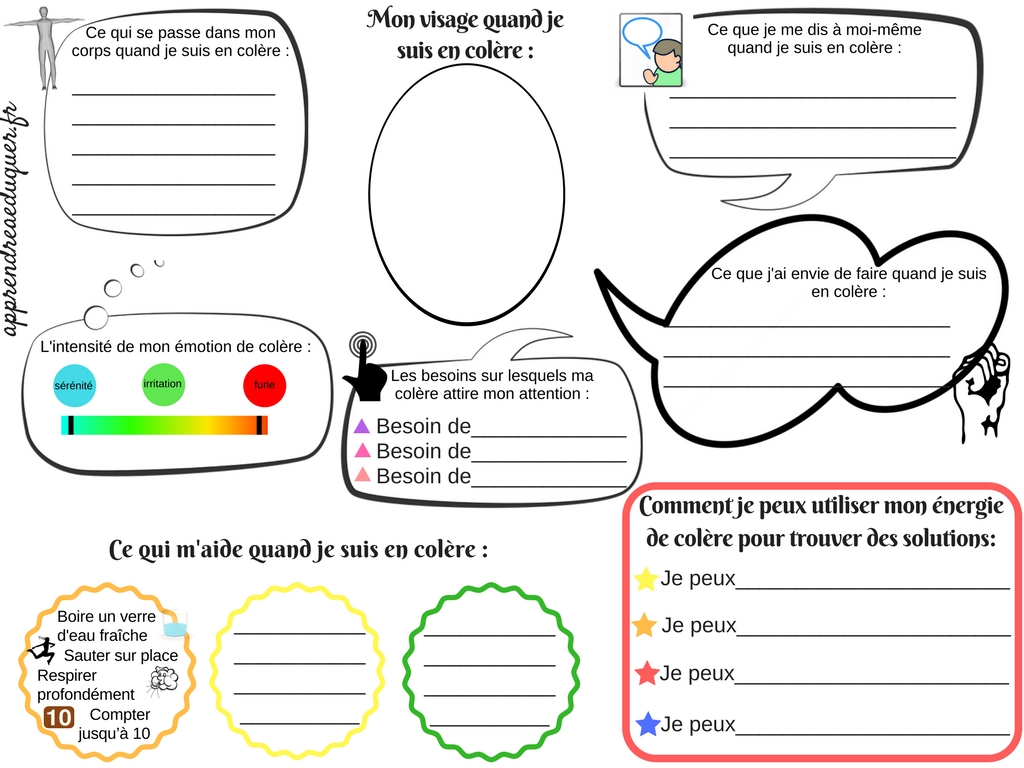
| Section | What the child does | Why it helps |
|---|---|---|
| Angry face | Draws their own expression | Makes the emotion concrete and safe to look at |
| Signals | Notes body sensations, thoughts, urges | Builds early awareness of rising anger |
| Intensity | Rates the feeling from calm to fury | Shows anger has degrees and can be managed |
| Needs | Identifies what the anger points to | Moves focus from blame to what is missing |
| Strategies | Lists water, jumping, breathing, counting | Gives a familiar toolkit to reach for |
| Solutions | Chooses non-violent responses | Replaces attack with action |
Noticing body signals, thoughts and urges
The poster asks children to capture the different ways anger shows up: sensations in the body, the thoughts that run through their head, and the actions they feel pulled toward. A hot face, a tight chest, a loud inner voice, the urge to shout or slam a door — all of it belongs on the sheet.
Helping a child notice these signals early is a bit like noticing the small signs that a child takes hours: the clues come before the problem peaks. Body awareness is a skill, and it improves with practice.
From calm to fury
Children are then invited to estimate the intensity of the emotion on a scale running from serenity to rage. This teaches them that anger has degrees, and that a level three can be handled differently from a level nine.
Looking for the need behind the anger
Anger draws attention to a need. The poster encourages children to reason in terms of needs rather than blame: maybe they need rest, space, fairness, or to be heard. This shift is powerful because it moves the conversation away from "who is guilty" and toward "what is missing".
Meeting basic needs matters in every domain, from the energy provided by potatoes in children's diets to the comfort of a predictable bedtime songs routine. When a need is invisible, it often comes out as frustration.
Ask your child: what would make this feeling smaller?

Building a toolkit of calming strategies
The poster lists practical regulation strategies children can try: drinking a glass of cool water, jumping on the spot, breathing deeply, or counting to ten. These are simple on purpose — a child in a heightened state cannot process complicated instructions, but they can reach for something familiar.
Let your child add their own ideas as they discover what works, and revisit the poster regularly so the toolkit stays current. A calm, well-rehearsed plan is worth more than a lecture delivered mid-storm.
Choosing non-violent solutions
The final section asks what children can actually do: walk away, ask for help, use words, squeeze a cushion. The goal is to replace attack with action, and to make sure the child knows their anger is allowed even when certain behaviours are not.
Making the poster part of family life
Print the poster, fill it in together over several sittings, and hang it where it can be seen. Treat it as a living document rather than a finished worksheet, and let your child update it whenever they find a new strategy that helps.
You can pair it with other calming rituals, such as a quiet corner with a few fidget toys to hold, or a shared routine that signals the day is winding down. Consistency matters more than perfection.
Over time, the poster becomes a reference point the whole family can use — including the adults.

My hands-on take
I have used a version of this poster at home, and the part that surprised me most was how much my child enjoyed drawing the angry face. It turned a topic we usually avoided into something we could look at together without anyone feeling accused. The intensity scale was the second hit: my child started announcing "I'm at a six" instead of simply exploding, which gave us both a moment to breathe.
What I would do differently next time is start even smaller. Instead of filling in every section at once, we worked on one box per week, and the strategies list only became useful once we had actually tested each idea during a real moment of frustration. The poster is not magic, but it gives a shared language, and that alone has changed how our household handles a difficult afternoon.
Frequently asked questions
When should we use the anger poster?
Use it during a calm moment, never in the middle of a crisis. Fill it in together when everyone is relaxed, then display it so your child can refer to it when tension rises.
What age is this poster suitable for?
It works best with children who can draw a face and talk about feelings in simple terms. Younger children can complete it with an adult's help, using pictures more than words.
Can children add their own strategies?
Yes, and they should. The poster is meant to be updated over time as your child discovers new calming techniques that work for them.
Does this replace discipline?
No. It teaches emotional skills alongside your existing boundaries. Anger is allowed; hurting others is not, and the poster helps children find alternatives.
Product Reviews
 Best Toys for Dogs With High Prey Drive |
Best Outdoor Toys for 3-4 Year Olds |
Best Outdoor Toys for 6 Year Olds |
Best Harness for Poodle |
Best LEGO Sets for Adults |
Best Travel Toys for 4 Year Olds on Airplane |
Best Toy Stores in Washington DC |
Best Potty Training Toys |
Best Toys for Tripod Dogs |
Maillot equipe de france







